


When Laws Evolve, Part 1: The Emerging Crisis of Modern Science
In order to maintain the commitments
of methodological naturalism, the defini-
tion of Nature must be reconfigured
When Laws Evolve: The Emerging Crisis of Modern Science
Part 1: Biology and the Return of an Ancient Question
by John D. Wise, PhD
 The universe evolves like a life form (Timothy Jackson,[1] iai News, 11 May, 2026). The subtitle is as provocative as the title: “The laws of physics are not fixed, they are evolving.” This is not an isolated speculation. CEH readers will recall a recent article engaging the work of João Magueijo advancing a strikingly similar claim from within cosmology.
This convergence is telling.
A physicist and a biologist, working independently, arrive at the same conclusion: the laws of nature are not fundamental, but emergent. This is not just cross-disciplinary borrowing. It is a shared response to growing explanatory pressure across the sciences. Biologist Timothy Jackson makes the move explicit in this article, extending Darwinian logic beyond biology and into the structure of reality itself.
“Darwin’s central insight… was to show how such order might emerge, via natural selection—a principle which can explain, but never predict, the patterns that make up the world.”
This claim serves to mark a cataclysmic shift in the structure of scientific explanation that has been progressively unfolding for many years. Prediction is yielding to retrospective storytelling. Fixed laws are giving way to emergent patterns. Stability is no longer assumed as the foundation of the universe; it is being treated as a ‘contingent achievement of an historical, evolutionary process.’[2]
The Great Inversion: Becoming Over Being
Jackson belongs to a growing chorus of scientific voices suggesting a startling thesis: the “laws” of physics are not eternal. Instead, they are historically emergent regularities, products of evolution rather than foundational bedrock.
we see increasing appeal to models that posit primary variation, such as “Entropic Gravity,” and evolving laws or constants, in attempts to solve outstanding questions in fundamental physics.
To understand how radical this shift is, we have to consider the ancient hierarchy that has governed Western thought for millennia:
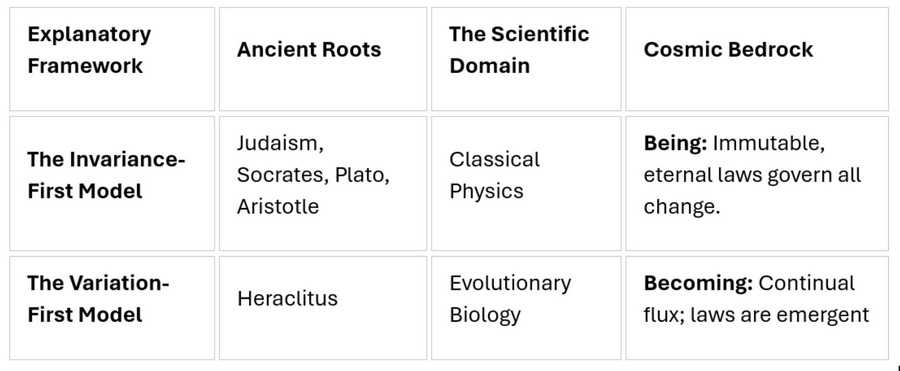
For the past two centuries, science has been slowly but steadily sliding from the first row to the second. We are witnessing a transition where becoming takes precedence over being.
This scientific shift closely parallels the absolute idealism of GWF Hegel (1770-1831). In Hegel’s philosophy, reality is not a static arrangement of fixed substances governed by external laws; it is a self-developing process whose intelligibility emerges only through its own unfolding.
Today’s scientists do not invoke Hegel, but they are trapped in his logic. If intelligibility is no longer grounded in fixed, transcendent law, the burden of explanation shifts entirely. The issue is no longer how stable laws govern change, but how stability, law, and meaning can emerge out of a chaotic, mindless flux.[3]
- Variation as First Principle
The decisive step in this new paradigm consists in elevating variation from a feature of biological systems to the ultimate principle of explanation itself. Jackson says this:
“Darwin’s major insight was to see that in biology, everything varies.”
This claim is fundamentally metaphysical. Variation is no longer an anomaly to be explained away within a system of stable laws; it is the starting point from which all order, all regularity, all being must be understood. Historically, this was the classical battle between the pre-Socratic philosophers Parmenides and Heraclitus, as Jackson himself points out.
Displacement of the Bedrock
Under this view, what are traditionally considered “invariants” – the constants of nature, the structural rules – are reinterpreted as derivative. Our article is explicit:
We tend to think of reality as made up of things, governed by fixed laws that determine how they change over time. But biochemist Timothy Jackson argues that this is back to front: fundamental reality is a lawless flux, a chaos of unpredictable change, and what needs explaining is not chaos but the stability and order that emerge from it. The “laws” of physics are not eternal truths but descriptions of patterns that have persisted long enough to look permanent. Darwin’s central insight … was to show how such order might emerge, via natural selection. (my emphasis)
Invariance, the traditional bedrock of science, is not eliminated on Jackson’s view.
It is displaced.
The role once played by transcendent, immutable law is now explained as immanent, unfolding process.
The Expansion to Physics
This logic of immanence is not and cannot be contained within biology. Once you grant that biological stability is just a temporary byproduct of process, the logic presses outward toward the cosmos. If the apparent invariants of biology are products of history, why should the invariants of physics be exempt?[4]
This logic is not a neutral tool; it is inherently transgressive. It is not the Aristotelian logic of Being in which contradiction indexes error; it is a logic of becoming in which contradiction is generative, the engine of progress.
Jackson openly invites this boundary-dissolving leap:
“…it may yet be the case that biology has much to offer physics in return… as we see increasing appeal to models that posit primary variation… and evolving laws or constants…”
The traditional Western picture of a law-governed universe is dissolving before our eyes. Order is no longer the unchanging framework within which change occurs; order is the temporary outcome of change.
- From Biology to Metaphysics: The End of Physics-Envy
For generations, biology suffered from a pathology of “physics-envy.” Physics, with its mathematical precision, its predictive successes, was the gold standard of science since the Enlightenment. Physics was King because it dealt with the eternal, the invariable. Biology was messy, historical, and contingent.
The elevation of variation-first reasoning flips this power dynamic entirely. But it does so in order to solve a philosophical crisis.
And it does so at great cost.
The Return of the Suppressed
For much of the post-Enlightenment modern era, science told itself that it had outgrown metaphysics. It claimed to operate on pure, bracketed empiricism. But as Jackson acknowledges, that disavowal did not expunge metaphysics from science. It simply concealed it, even from scientists themselves. That repression is now unraveling:
From panpsychism to “Platonic Space,” assertions that we need to move “beyond physics” are increasingly common among scientists and philosophers…. current conversations seem to be more explicitly metaphysical than has traditionally been the case among scientists. It seems that the disavowal of metaphysics as a meaningful pursuit hasn’t really expunged it from modern science, so much as hidden it.
Jackson calls that hidden metaphysics “physicalism,” what we’ve elsewhere called naturalism or materialism – the often-tacit assumption that reality is composed of mindless, material[5] entities governed by stable, external regularities. It is this framework that scientists are now realizing cannot hold the weight of reality.
The Materialist Rescue Mission
As our tools have advanced, biology has revealed highly ordered, functionally integrated patterns of immense complexity. These are not random assortments; they are deeply structured, rational systems. For the proponent of an Invariance-First model, this stunning order is perfectly intelligible: it reflects a primary, non-derived structural architecture: a design spoken into being by a transcendent Intelligence.
But for the secular scientist, this clarity engenders an existential crisis. Under the dogma of methodological naturalism, admitting a fixed, inherently intelligent blueprint is strictly forbidden.
The expansion of Darwinian logic to the laws of physics is not a bold step of triumphant innovation and progressive discovery; it is a rescue operation required to preserve monistic materialism under mounting explanatory strain. Because the materialist refuses to ground this undeniable biological order in a transcendent Lawgiver, it must be relocated within blind process. What cannot be admitted is an inherent, designed structure.
In this context, “emergence” functions as the immanent analogue of “creation”: a term required to name the appearance of order while denying any source beyond the system itself.
The result is a striking inversion: in order to maintain the commitments of methodological naturalism, the definition of Nature must be reconfigured until it includes features that look exactly like the design, purpose, and intelligence that materialist immanentism was formulated to exclude. This shift does not eliminate the need for grounding; it mutates the form that grounding must take.
The Unavoidable Binary Ahead
Science appears to be approaching a fork in the road:
- Path A: Admit that the intelligibility encountered in nature reflects a source of intelligence beyond nature.
- Path B: Insist that intelligibility is not grounded beyond the system, but is identical with the unfolding process itself, so that law, order, and meaning are understood as the self-articulation of a fundamentally immanent reality.
Jackson and the vanguard of modern science, though not yet fully apprehending this binary, are being logically pressed in the direction of Path B, locating intelligibility not beyond the system, but within the unfolding process itself. On this view, law, order, and meaning are no longer grounded realities but emergent expressions of an immanent development.
The question, however, does not disappear; it is displaced. For if the process itself must now bear the full weight of intelligibility, we are left to ask how such a process can ground the very order it is said to produce.
What began as an attempt to explain the laws of nature thus returns us to an ancient problem: whether reality is grounded in being or in becoming. By forcing the laws of physics to evolve, modern science has not escaped this question; it has only rediscovered it in a more acute form.
The consequences of that rediscovery will be the subject of Part Two.
Footnotes
[1] Timothy Jackson is Research Fellow and Co-Head at the Australian Venom Research Unit, University of Melbourne.
[2] The actual quote from the article is this: “In the specifically biological strata of relations, there are very few true invariants, and even those which exist—for example the genetic code—are understood to be contingent ‘achievements’ of an historical, evolutionary process. They just happen to be ‘synapomorphies’ (shared derived characteristics) of all life as we know it.”
[3] The flux is not for Hegel mindless. Rather it is Mind itself, or to use his word, Spirit (Geist).
[4] This outward pressure is not driven by empirical data, but by the relentless internal necessity of the immanentist logic itself. Once near-infinite changeability is granted to biological forms, the narrative is forced to retreat backward toward origins. In origin-of-life (OOL) research, this necessitates projecting the selection mechanism into “pre-life” scenarios: witness Eugene Koonin’s models of prebiotic selection or Robert Hazen’s concepts of mineral-driven chemical evolution. To maintain a closed naturalist system, this selection-logic must inevitably be pushed further back to explain the evolution of the solar system, galaxies, and the cosmos itself. It is a striking demonstration that the overarching evolutionary narrative is dictated not by empirical discovery, but by the metaphysical posture of immanence adopted from the outset.
[5] This does not exclude the matter/energy equivalence of E=mc2.
 John Wise received his PhD in philosophy from the University of CA, Irvine in 2004. His dissertation was titled Sartre’s Phenomenological Ontology and the German Idealist Tradition. His area of specialization is 19th to early 20th century continental philosophy.
He tells the story of his 25-year odyssey from atheism to Christianity in the book, Through the Looking Glass: The Imploding of an Atheist Professor’s Worldview (available on Amazon). Since his return to Christ, his research interests include developing a Christian (YEC) philosophy of science and the integration of all human knowledge with God’s word.
He has taught philosophy for the University of CA, Irvine, East Stroudsburg University of PA, Grand Canyon University, American Intercontinental University, and Ashford University. He currently teaches online for the University of Arizona, Global Campus, and is a member of the Heterodox Academy. He and his wife Jenny are known online as The Christian Atheist with a podcast of that name, in addition to a YouTube channel: John and Jenny Wise.