

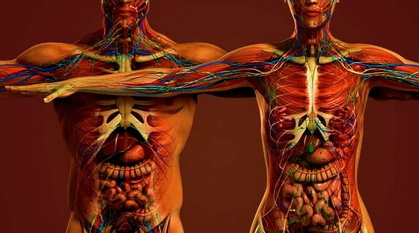

Brain Cleaned by Abdominal Hydraulic System
Scientists discover that the human brain
is more mechanically interconnected with
the abdomen than previously thought
Hydraulic Harmony
The Hidden Engineering in the Brain
by Dr. Sarah Buckland-Reynolds
When we hear of hydraulic systems, the imagery of a power-transmitting, motorized machinery would likely come to mind, such as car brakes or airplane landing gear. These machines are efficient as they use pressurized fluid to enable heavy lifting, precise control, and reliable motion, generating huge forces in compact spaces. However, one of the most intriguing examples of hydraulic systems resides within biological systems: in the brain. This remarkable finding was recently published in the following research paper:
 Brain motion is driven by mechanical coupling with the abdomen (Garborg et al., Nature Neuroscience, 27 April 2026). Garborg et al., (2026) revealed that the brain is far from being an isolated organ floating passively within the skull, but is mechanically coupled to the abdomen through a hydraulic-like system.
Through examining the mechanism in mice, they found that abdominal contractions push blood into the vertebral venous plexus, transmitting pressure into the cranial cavity and causing the brain to move gently within the skull. This motion circulates cerebrospinal fluid (CSF), helping to clear waste and maintain brain health.
From a Biblical creationist perspective, this discovery highlights another extraordinary example of engineering embedded in biological systems, forming part of a well-coordinated, integrated hydraulic system linking abdominal muscles, venous networks, and brain fluid dynamics. Such complexity raises profound questions about evolutionary explanations and points instead to intelligent design.
The Findings: A Hydraulic Brain
In an accompanying press release by Penn State University, one of the co-authors, Prof. Patrick Drew (Engineering science and mechanical, neurosurgery, biology and of biomedical engineering professor), described the findings as follows:
“When the abdominal muscles contract, they push blood from the abdomen into the spinal cord, just like in a hydraulic system, applying pressure to the brain and making it move. Simulations show that this gentle brain movement will drive fluid flow in and around the brain”
They confirmed the mechanism by applying external abdominal pressure, which resulted in the brain moving back to its baseline position after the abdominal pressure was relieved. From this observation, they concluded that “abdominal pressure can rapidly and significantly alter the position of the brain within the skull” and can be triggered by exercise. This discovery astonished researchers because the brain was long thought to be mechanically insulated from the rest of the body.
A Remarkable Example of Engineering Principles in Biology
While we encounter examples of hydraulic systems in human technology daily, it is well recognized and accepted that the origins of these technologies require forethought. Yet, when the same mechanisms are found in biological systems, evolutionary theory is still the mainstream framework that is appealed to.
When we examine the findings from Garborg and colleagues, the parallels to human technology are numerous. Just as hydraulic systems in engineering use pumps, valves, and pressure chambers to move fluids, here, abdominal muscles act as pumps, veins as conduits, and the brain as a responsive chamber. However, not only does the brain simulate known technological mechanisms, but the hydraulic processes in the brain also undergo added complexities for it to function.
In a commentary with the Penn State press release, co-author and Professor of engineering science, mechanics, biomedical engineering and mathematics, Francesco Costanzo explained some of the added complexities that would have to be taken into account in modeling such a system within the brain. Quoting from the article, Prof. Costanzo stated:
“Modeling fluid flow in and around the brain offers unique challenges because there are simultaneous, independent movements, as well as time-dependent, coupled movements. Accounting for all of them requires accounting for the special physics that happens every time a fluid particle crosses one of the many membranes in the brain,” Costanzo said. “So, we simplified it. The brain has a structure similar to a sponge, in the sense that you have a soft skeleton and fluid can move through it.”
By simplifying the geometry of the brain to that of a sponge, Costanzo explained that the team could model how fluid flows through a structure with varied spaces, like wrinkles in the brain, or pores in the sponge.
“Keeping with the idea of the brain as a sponge, we also thought of it as a dirty sponge — how do you clean a dirty sponge?” Costanzo asked. “You run it under a tap and squeeze it out. In our simulations, we were able to get a sense of how the brain moving from an abdominal contraction can help induce fluid flow over the brain to help clear waste products.”
While hydraulic systems in man-made technology often achieve a singular purpose, the brain transcends several categories, incorporating the functions of industrial cleaning systems, hydraulic presses, and fluid pumps with far greater sophistication than insular hydraulic systems. This interconnectivity allows for waste clearance, pressure regulation, and fluid redistribution in one seamless design by coupling locomotion with fluid flow.

Abdominal motions act like a hydraulic system to cleanse the brain, removing waste products from the cerebrospinal fluid.
Yet, this example of the brain’s hydraulic system merely adds to a long list of other biological system that show similar engineering parallels, such as:
- Bacterial flagellum that operates like an outboard motor, with rotor, stator, and drive shaft.
- The blood clotting cascade that functions like a finely tuned chemical alarm system, activating only when needed.
- Photosynthetic reaction centers that act like solar panels, capturing light, and converting it into chemical power.
With such vast ranges of highly interconnected machinery present in biological systems, is it really reasonable to theorize that blind processes could produce these?
Critiquing Evolutionary Explanations
In a system that depends on efficient waste removal, evolutionary gradualism would threaten organismal survival if all components were to have evolved step by step? Without the full system in place, partial structures would confer no survival advantage.
Even apart from gradualism, the authors found other surprising elements to brain motion, which suggest pre-programming mechanisms that pose additional questions to evolutionary origins. In their words:
“Brain motion frequently preceded the onset of locomotion, suggesting that locomotion in and of itself does not cause brain motion within the skull” (Garborg et al., 2026).
The observation that brain motion precedes locomotion demonstrates anticipatory coordination rather than passive response. Abdominal muscle activation raises intra‑abdominal pressure, which is hydraulically transmitted through the vertebral venous plexus to the brain, producing intracranial pressure changes before movement begins. This timing shows a feed‑forward mechanism, consisting of a pre‑programmed integration of abdominal mechanics with brain fluid dynamics. This has many benefits, including ensuring stability and fluid circulation in advance of locomotor stress, rather than relying on random or delayed mutation‑driven processes.
Implications for Intelligent Design
In view of these highly complex, anticipatory mechanisms, Garborg et al.’s discovery therefore opens more questions for evolution than it answers:
- Why would natural selection produce a hydraulic link between the abdomen and the brain?
- How could random mutations foresee the need to clear neural waste through CSF circulation?
The engineering parallels are too precise to be accidental.
For intelligent design proponents, however, the findings are expected. The Creator designed multilevel systems that operate seamlessly: muscles, veins, brain, and fluid flows working together. The hydraulic brain is not a product of chance but of purposeful design.
Conclusion
Garborg et al.’s study offers yet another amazing testimony of design in biological systems that challenge evolutionary interpretations. The intricacies required for such functionalities point to the Wisdom of the Creator. Just as we can easily recognize the mechanical design in car brakes and other man-made systems, let us remember that our bodies’ autonomous systems even surpass these man-made technologies.
So, next time we see a smooth plane landing or use our car brakes, let us remember with awe the divine engineering that resides in each of us. Our Creator’s design far surpasses human technology.
For additional information: Learn about interoception in this article and podcast.
 Dr. Sarah Buckland-Reynolds is a Christian, Jamaican, Environmental Science researcher, and journal associate editor. She holds the degree of Doctor of Philosophy in Geography from the University of the West Indies (UWI), Mona with high commendation, and a postgraduate specialization in Geomatics at the Universidad del Valle, Cali, Colombia. The quality of her research activity in Environmental Science has been recognized by various awards including the 2024 Editor’s Award from the American Meteorological Society for her reviewing service in the Weather, Climate and Society Journal, the 2023 L’Oreal/UNESCO Women in Science Caribbean Award, the 2023 ICETEX International Experts Exchange Award for study in Colombia. and with her PhD research in drought management also being shortlisted in the top 10 globally for the 2023 Allianz Climate Risk Award by Munich Re Insurance, Germany. Motivated by her faith in God and zeal to positively influence society, Dr. Buckland-Reynolds is also the founder and Principal Director of Chosen to G.L.O.W. Ministries, a Jamaican charitable organization which seeks to amplify the Christian voice in the public sphere and equip more youths to know how to defend their faith.