


Happy World Oceans Day
In commemoration of World Oceans Day,
we explore the multifunctionalities of the
earth’s oceans in biodiversity, livelihoods and
climate balance, as reflections of God’s wisdom.
Commemorating World Oceans Day
The Visible and Invisible Wonders
by Dr. Sarah Buckland-Reynolds
Our temporary home on earth is known as the ‘blue planet’ because of the predominance of oceans covering more than 70% of the surface. While humans are relegated to occupy land, have we wondered why would God create over two-thirds of the earth under ocean coverage? Increasingly, science continues to uncover the multiplicity of earth’s processes that depend on ocean health.
In commemoration of the immense importance of oceans, the United Nations proposed a special day for acknowledging the functions of the oceans in 1992, which was officially adopted in 2008. The 2026 celebration takes place on June 8, 2026, under the theme: “Strong Marine Protected Areas for Our Blue Planet”. As Christians, it is fitting for us to pause and reflect on this created resource as a gift to be stewarded and one that testifies of the overwhelming wisdom of our Creator.
The Waters of the Deep: Present at the Dawn of Creation
While much of the attention on the first day of creation is on the creation of light, it may be noteworthy to point out that prior to the creation of light, God’s spirit was said to be “hovering on the face of the waters.” While the separation of the waters above from the waters below did not happen until day two and the gathering of the waters below into one place did not happen until day three, the Biblical account of creation shows that the presence of waters on the void earth was already fundamental.
The oceans remain fundamental today, as they form one of the main regulatory mechanisms for earth’s balanced climate for life, sustaining unique biodiversity, and providing livelihoods for billions. In terms of chemical cycles, the oceans are the largest reservoir of carbon dioxide exchange, central to both the biological carbon pump (sequestering CO₂ through photosynthesis and sinking organic matter) and the carbonate pump (returning CO₂ via calcification).
Even without explaining these processes, the Bible has numerous documentations of the functional properties of the oceans that have revolutionized scientific enquiry. One example is its early description of the hydrological cycle in Ecclesiastes 1:7: “All the rivers run into the sea; yet the sea is not full; unto the place from whence the rivers come, thither they return again.”, Even more profoundly, the Father of Modern Oceanography, Sir Matthew Fontaine Maury, had used the Bible’s hint of there being “paths in the seas” (Psalm 8), to discover ocean currents. These discoveries continue to revolutionize daily travel and our understanding of climate drivers and processes today.
The Ocean’s Visible Biodiversity: Recent Discoveries on the Octopus
In addition to its significant role in climatic balance, the ocean hosts some of earth’s rarest forms of biodiversity. Yet, despite centuries of exploration, over 80% of the oceans remain unexplored, with new discoveries continuing to be documented by modern science. One such recent discovery published just in time for World Oceans Day was on the marvels of the octopus.
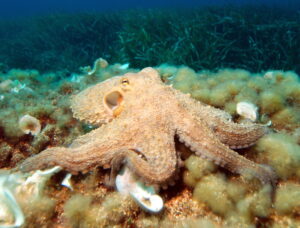
An octopus. They have complex vision. Note the eyes on top of its head. From Wikimedia Commons.
In a breathtaking discovery published in an article titled: Octopus bimaculoides can learn to utilize a mirror to localize a reward outside the line of sight ([Mary Kieseler et al.]), Current Biology, 3 June 2026), it shows one tangible example of the rare biodiversity hosted by the earth’s oceans. Kieseler et al’s team describe a new discovery: that there is evidence that octopuses have a capacity for self-recognition and problem‑solving. These creatures, despite being invertebrates, are able to use mirrors that have traditionally been considered as a hallmark of higher cognition. As the study noted, this capability of “mirror-mediated localization of hidden objects is well documented in vertebrates… but has never been demonstrated in invertebrates…”; that is, until now.
Despite admitting to the complexities involved in these capabilities, literature on these amazing ocean dwellers consistently appeals to evolution as their ‘go-to’ explanation. In the case of Kieseler et al’s article, reference to the word stem “evol” (evolution/evolved/evolutionary), occurred at least eight (8) times in the article and a dozen times on the page with the references. Still, the authors attempt to reconcile their observations admitting to the need to explore more deeply the complexities inherent in these ocean-dwelling creatures. In their words:
“…it raises the question as to whether octopuses might possess an internal map of the 3D terrain that can be used to navigate, and whether octopuses possess more complex mirror competencies, such as those associated with self-recognition. “
Adding to complexity, octopuses’ self-recognition ability complements other amazing capabilities of ocean dwellers, including their camouflage systems, which involve intricate coordination by a sophisticated nervous system. Other ocean dwellers are known to possess properties of bioluminescence and biofluorescence, with capabilities that continue to be harnessed by several branches of science.
For Christians, the octopus and other ocean dwellers are a living testimony of design. The octopus and other visible creatures in the oceans point to profound intelligence, adaptability, and intentional design.
Invisible Mysteries: Microbes in Fish Guts
In commemoration of World Oceans Day, it is also valuable to note the roles of creatures and properties not directly visible to the human eye, and the interdependencies that exist between the biotic and abiotic components of the oceans. Exemplifying this in another recent discovery published in an article titled:
 Symbiotic bacteria may support calcium carbonate precipitation in the Gulf toadfish (Anthony M. Bonacolta et al., PLOS Biology, 18 May 2026). Researchers from the University of Miami revealed that microbes inside fish guts help regulate ocean chemistry.
It was specifically found that Gulf toadfish (Opsanus beta) host Vibrio bacteria that express urease genes, producing bicarbonate that precipitates calcium carbonate. The researchers concluded: “CaCO₃ precipitation in marine fish may not solely be a host-driven process, but potentially the result of a functional symbiosis with gut-associated Vibrio bacteria.”
This shows one example of many hidden alliances that exist within the oceans that link biology with its geochemistry, upon which other earth processes depend. Even beyond this, this discovery overturns decades of assumptions. For years, scientists believed fish alone produced calcium carbonate pellets (ichthyocarbonates) as part of osmoregulation. Now, evidence shows that gut microbes are essential partners in this process. The profoundness of these interconnections was acknowledged by one of the study’s co-authors, Prof. Martin Grosell, in a University of Miami press release, as he described:
“Most life on Earth is microbial, driving nutrient cycles and ecosystem function while revealing new dimensions of biological diversity through symbiosis….The ocean is especially rich in these partnerships, and the toadfish-vibrio symbiosis potentially linked to calcium carbonate production is a striking new example.””
For Christians, this invisible partnership operating even within the vast ocean reminds us that God’s design operates at scales beyond our perception. The complexity of the earth’s oceans in maintaining earth’s balance through visible and invisible processes illustrates the need for proper stewardship of these resources.
Oceans in Earth’s Livelihoods and Trade: Incomparable Value to Other Worlds
Even beyond its visible and invisible environmental value, earth’s oceans and seas provide tremendous economic value. Even in the Biblical era, maritime trade was a dominant practice, for example, in Solomon’s era: “The king had a fleet of trading ships… once every three years it returned, bringing gold, silver and ivory, and apes and baboons” (1 Kings 10:22). Ancient commerce depended on currents and winds: systems embedded in earth’s oceans. Today, oceans remain the arteries of global trade. Over 90% of goods move by sea, and fisheries provide protein for billions.
While humans depend on the oceans for climate balance, ecosystem sustenance and economic gain, it is interesting that the lack of oceans on other planets is one key differentiating mark that makes earth unique. Unlike Earth, with its vast oceans teeming with life, most other planets either lack oceans altogether or have ones that are inhospitable. Mars, for example, is believed to once having had seas, but today its surface water is gone, locked away as ice or vapour, leaving behind a barren landscape. Venus, though similar in size to Earth, has no oceans at all, as its extreme heat and thick carbon dioxide atmosphere would not have allowed any liquid water to survive on the surface.
Even with more recent discoveries of other worlds that appear to have oceans, like Europa or Enceladus, the environmental conditions keep them hidden beneath thick ice crusts. These subsurface oceans are cut off from sunlight and surface ecosystems, making them profoundly different from Earth’s open, life-rich seas. Earth’s oceans are unique as they are accessible, stable, and finely tuned to support a diversity of life. This balance is unmatched elsewhere in the solar system.
Theological Reflection: Stewardship of a Temporary Gift
World Oceans Day 2026 reminds us that the oceans are both visible wonders and invisible regulators that God built into our world. Earth’s oceans deserve our attention as stewards of God’s creation. The intentionality of both the living and non-living components and their interdependencies should be enough to cause us to marvel, as profound mysteries continue to be uncovered. Although Revelation promises a future without seas, our present calling is stewardship.
As we reflect on the value of the oceans, let us endeavour to protect this resource. In this summer vacation period, spending time by the oceans is even a wonderful opportunity to share a ‘fun fact’ about the oceans and point persons to stand in awe of God. In stewarding our oceans and using them as a symbol for evangelism, we do well in honouring our Creator.
 Dr. Sarah Buckland-Reynolds is a Christian, Jamaican, Environmental Science researcher, and journal associate editor. She holds the degree of Doctor of Philosophy in Geography from the University of the West Indies (UWI), Mona with high commendation, and a postgraduate specialization in Geomatics at the Universidad del Valle, Cali, Colombia. The quality of her research activity in Environmental Science has been recognized by various awards including the 2024 Editor’s Award from the American Meteorological Society for her reviewing service in the Weather, Climate and Society Journal, the 2023 L’Oreal/UNESCO Women in Science Caribbean Award, the 2023 ICETEX International Experts Exchange Award for study in Colombia. and with her PhD research in drought management also being shortlisted in the top 10 globally for the 2023 Allianz Climate Risk Award by Munich Re Insurance, Germany. Motivated by her faith in God and zeal to positively influence society, Dr. Buckland-Reynolds is also the founder and Principal Director of Chosen to G.L.O.W. Ministries, a Jamaican charitable organization which seeks to amplify the Christian voice in the public sphere and equip more youths to know how to defend their faith.