



Robot Fail Highlights Human Coordination
Despite the rapid progress in artificial
intelligence, AI systems continue to fall far short
of human dexterity and fine-motor capability
AI-Powered Humanoid Robots Can’t Stand Up to Divine Design
AIdol public mishap highlights the superior design of the human body
by Dr. Sarah Buckland-Reynolds
The AI revolution has taken the world by storm, with some industries rushing to harness the perceived superior efficiency brought by these technologies. This technological race has seen a flurry of publications on methodologies suggesting how to minimize the need for human input into AI data processing systems and exploring mechanisms to improve the mechanical design of AI-powered robots.
But despite the rapid progress in artificial intelligence, time and again, AI systems continue to fall far short of human dexterity and fine-motor capability.
Embarrassing Robot Fail
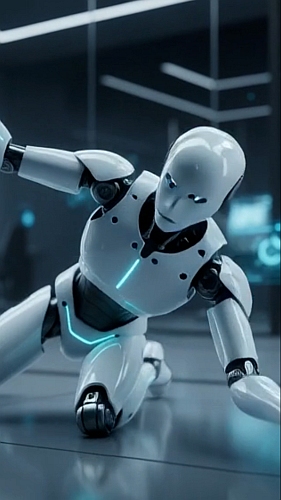
Highlighting one such recent example in Moscow, on November 11, 2025, Euronews ran this headline: “Russia’s first AI-powered humanoid robot AIDOL collapses during its onstage debut”. A viral video showed the humanoid losing balance and falling after walking onto the stage and taking a few steps. The humanoid (comically) continued moving its hands and feet while face-downwards on the ground, while stage crew dragged it offstage.

Young children can learn walking and fine motor control of their limbs, such as playing piano. The ease with which they learn these skills puts robots to shame.
With decades of research underpinning these technologies, why is it that such mishaps continue to occur involving what may be deemed by some as ‘basic’ functionalities? For instance, just a few months earlier, an abstract on the very topic of enhancing robotic joints was published by Magomedov and colleagues at the 2025 International Russian Automation Conference hosted by the Institute of Electrical and Electronics Engineers (IEEE, September 2025). In the abstract, the authors completed 15 simulations, testing 3 configurations to test the efficiency of specific physical mechanisms of AI-powered joint extensions for robots, with the stated purpose of “automat[ing] any possible process and to replace the human workforce with more reliable and functional technology.”
If a technology that promises to ‘replace’ the human workforce cannot yet stay upright on stage after decades of robotics research, algorithmic refinement, and computational modeling—and if, after all this research, we still struggle to reproduce the effortless balance of a toddler, a deeper question inevitably arises: What does that reveal about the origin and the engineering of the human body itself?
Reviewing Robotics vs. Human Joints: What the Newest Simulations Teach Us
Magomedov’s study of a model of a robotic arm with three joints (mimicking humans’ wrist, elbow and shoulder joint – not including finger joints) explored how extendable parts may achieve enhancements in flexibility. The structure included three joints each rotating on three axes, in addition to three extendable parts, mimicking humans’ extendable mechanisms through muscle contraction and tendon leverage. The publicly available summary of the study focused on how extendable segments in robotic joints affect power consumption across various rotation angles. The authors found that efficiency depends on which joint activates the extension. They concluded that algorithmic optimization is required to minimize energy use and determine best-performing paths. In the words of the authors:
“…It can be concluded that it is important to understand when to activate the links to minimize the power consumption and other important values. Hence, the use of algorithmic advantages to calculate the best performing positions or paths will play a major role in the functioning of the robotic arm and in efficiency.”
While the authors’ conclusion highlighted the need for algorithms to programme joint efficiency, the human arm – with its 30 joints (24 hand joints, 6 arm joints), as with other parts of the human body, operates as an integrated biomechanical system with self-repair capacity. Efficiency of motion is autonomous and instinctive in humans through neuromuscular coordination. Yet ironically, the idea of AI-powered robots potentially becoming “more reliable and functional” than humans is still stated as a goal for this technology. But, why?
The Logic: If Blind Evolution Could Form Humans, Purposeful AI Can Surpass Humans

Running downhill comes naturally to young children. Photo credits: DFC
The logic is ironic. Proponents of evolution often view AI as an advancement of the evolutionary process, but how reasonable is it to believe that the human arm, with its seamless coordination, adaptive strength, and sensory feedback, emerged from a blind, incremental process of mutation and selection, when even our most advanced machines require deliberate programming to mimic just a fraction of its capabilities? Why does the human nervous system perform “algorithmic” calculations instinctively, in real time, and across countless variables, while robotic systems need external algorithms to calculate optimal joint activation? Also, as the simulations revealed that the efficiency of robotic joint extensions depends on precise timing and configuration, how could biological systems, which far exceed this complexity, have assembled themselves without guidance?
When comparing both robotic and human systems, the engineering of the human body is superior in several ways, including:
- Integrated Sensory Feedback: Humans instantly sense load, texture, temperature, and adjust grip or force accordingly. Robots require external sensors and programming.
- Energy Efficiency: Muscles convert chemical energy into mechanical work with adaptive efficiency, while robotic arms must calculate optimal paths to avoid waste.
- Self-Repair and Resilience: Human arms heal after injury; robotic arms need external repair or replacement.
- Versatility: Human arms can perform delicate tasks (threading a needle) and powerful ones (lifting heavy loads) seamlessly. Robots are usually specialized.
- Adaptive Intelligence: The brain continuously recalculates optimal movements in real time, far surpassing algorithmic pathfinding.
- Design Elegance: The human arm integrates strength, dexterity, and sensory awareness in a single system—something robotic arms attempt to mimic but cannot fully replicate.
The persistent superiority of the human body across multiple dimensions as highlighted above invites a profound reassessment of the prevailing evolutionary narrative. If the pinnacle of purposeful human engineering, AI robotics, cannot yet even copy the design, efficiency, and function of the human body, how reasonable is it to believe that it was designed and assembled from scratch by random blind evolutionary forces?
Divine Design Prevails
Watch and share the Short Reel about this article! Click to view it now.
While the authors’ simulations offer valuable insights into optimizing robotic arm efficiency, their findings inadvertently highlight something far more profound: the unmatched ingenuity of biological design in the human body. The human-engineered coordination of joint activation, energy conservation, and structural adaptability in robotic systems (achieved only through deliberate programming and algorithmic fine-tuning) attempts to imitate, albeit imperfectly, the seamless integration already present in the human arm. Yet, unlike robotic arms, which require external intelligence to function, the human arm operates with innate precision, adaptability, and self-regulation. Such sophistication, embedded from the outset, defies the notion of gradual, unguided evolution. Instead, it points unmistakably to a system that was not merely assembled by chance but intentionally crafted with purpose and foresight.
As the Moscow show also highlighted, AIdols have to fall prostrate to the Maker, who will always stand superior to the wills of man to copy divine design.
Ed. note: To emphasize the incredible coordination potential in humans, watch this man play the French horn like a pro on YouTube using only his left foot. The French horn is a difficult enough instrument to master with two hands, let alone with one foot! Yet his sound is equal to the best horn players in the world.
 Dr. Sarah Buckland-Reynolds is a Christian, Jamaican, Environmental Science researcher, and journal associate editor. She holds the degree of Doctor of Philosophy in Geography from the University of the West Indies (UWI), Mona with high commendation, and a postgraduate specialization in Geomatics at the Universidad del Valle, Cali, Colombia. The quality of her research activity in Environmental Science has been recognized by various awards including the 2024 Editor’s Award from the American Meteorological Society for her reviewing service in the Weather, Climate and Society Journal, the 2023 L’Oreal/UNESCO Women in Science Caribbean Award, the 2023 ICETEX International Experts Exchange Award for study in Colombia. and with her PhD research in drought management also being shortlisted in the top 10 globally for the 2023 Allianz Climate Risk Award by Munich Re Insurance, Germany. Motivated by her faith in God and zeal to positively influence society, Dr. Buckland-Reynolds is also the founder and Principal Director of Chosen to G.L.O.W. Ministries, a Jamaican charitable organization which seeks to amplify the Christian voice in the public sphere and equip more youths to know how to defend their faith.
Comments
A.I. is taken for granted. I’ve seen YouTube videos or shorts and I can (to my best abilities) discern a real video from A.I. The A.I. video or short is too crisp and the object has inconsistencies (wrong shape, misplaced features, etc.).