


Asymmetry With a Purpose: Climatic Oscillations Spread Earth Resources
New analyses of total water storage
reveal remarkable synchronicity driven
by intricate atmosphere-oceanic interactions
What Synchronized Extremes in Weather
Show Us About Earth’s Interconnectivity
by Dr. Sarah Buckland-Reynolds
Imagine if someone were to invent a planetary power grid that automatically reroutes energy across continents in real time, so that when demand surges in one region, the system instantly draws surplus from a distant region on the other part of the globe, keeping the entire planet in balance! Scientists have shown that a version of this revolutionary global-scale balancing technology already exists in the form of modes of climate variability, such as the El Niño Southern Oscillation (ENSO).
 Dynamics and Couplings of Terrestrial Water Storage Extremes From GRACE and GRACE-FO Missions During 2002–2024 (Rateb et al, AGU Advances Journal, 20 Nov 2025).
While the impacts of ENSO have already been extensively studied, this new research provides further insights into even more remarkable balances that are driven by ENSO cycles — aligning water storage totals across continents, sometimes making distant regions simultaneously wet or dry.
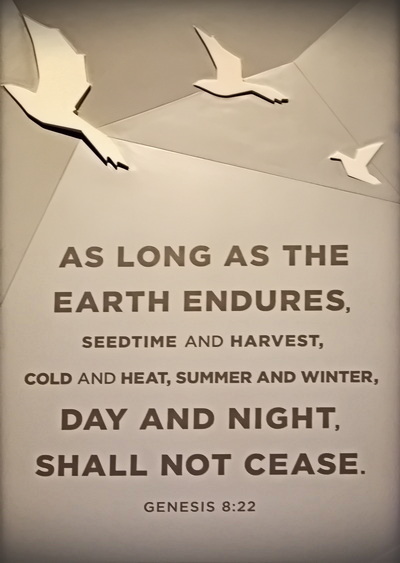
Poster at the Museum of the Bible, Washington DC (photo by David Coppedge)
The researchers Rateb et al., from the University of Texas at Austin, used satellite data to show that these extremes are not isolated events, but part of a synchronized and predictable global rhythm driven by El Niño and La Niña. These rhythms shape civilizations, alter ecosystems, and test the resilience of societies. From a creation science perspective, these findings highlight the remarkable interconnectedness of Earth’s climate systems and reflect purposeful design.
ENSO: A Global Climate Synchronizer
The El Niño Southern Oscillation (ENSO) is a climate pattern that arises from interactions between the tropical Pacific Ocean and the atmosphere. It has two main phases: El Niño, referred to as the ‘warm phase’, which occurs when warm water accumulates in the central and eastern Pacific, weakening trade winds and shifting rainfall patterns; and La Niña, the cool phase of ENSO, which occurs when cooler-than-normal Pacific waters strengthen trade winds, producing largely opposite effects.
While ENSO’s impacts on climate extremes have been documented worldwide, relatively little research has examined how these interactions affect total water storage.
The findings, which complement similar studies using the GRACE and GRACE-FO satellite missions from 2002 to 2024, show a clear oscillation in total water storage (TWS) around/across the globe, that is tightly synchronized with ocean-atmosphere interactions:
“Global TWS extremes are governed by a 2–3-year oscillatory cycle linked to El Niño–Southern Oscillation, which synchronizes drought and pluvial conditions across continents.”
The measured regularity of these cycles resembles the functionality of a refrigerator’s thermostat, which switches on and off periodically to keep temperature balanced. In much the same way, ENSO-related cycles redistribute heat and water storage globally, maintaining large-scale climatic equilibrium.
Even More Complexity
Rateb et al.’s research uncovered even more complexities involved in ENSO processes. Beyond redistributing heat resulting in contrasting conditions across the globe, the likelihood of a region becoming “wetter” or “drier” because of these ENSO events were not equal. This hydrologic asymmetry is characterized by disproportionately stronger wet events than dry events. In the authors’ words, they found that:
“Wet extremes attain roughly twice the magnitude of droughts, underscoring an intrinsic hydrologic asymmetry amplified by land–atmosphere feedback.”
This finding is significant because it reveals a deeper layer of design complexity within Earth’s climate system. ENSO is not simply a “switch” that toggles between wet and dry conditions but rather operates with built-in asymmetry that magnifies certain outcomes more than others. This implies that the system is not balanced in a simplistic, equal-and-opposite way; instead, it exhibits nonlinear responses, in which surpluses of moisture trigger stronger and more expansive feedback than deficits.

Earthrise from Selene spacecraft, envisioned through an Apollo-style porthole window.
From a design perspective, this asymmetry reflects a form of intelligent calibration. Just as a complex machine may be tuned to favour safety margins or resilience, ENSO’s hydrologic asymmetry allows water surpluses to propagate more forcefully, redistributing resources across ecosystems and sustaining agriculture and biodiversity. Meanwhile, droughts, though damaging, tend to spread more uniformly but with less intensity, reducing the risk of catastrophic collapse within the global water cycle.
This pattern resembles a multi-tiered control system, suggesting purposeful orchestration in which interconnected processes are coordinated to maintain long-term stability despite short-term extremes. From an intelligent design standpoint, ENSO’s synchronizing power reflects purposeful order through its intricate interconnections, predictable rhythms, and alignment with the provision of water for sustaining ecosystems across the globe.
Critiquing Evolutionary and Uniformitarian Assumptions
These new insights into ENSO’s complexity raise important questions about traditional evolutionary assumptions, including uniformitarianism. For example, ENSO’s global “thermostat” directly challenges the evolutionary framing of climate evolution as being primarily driven by chance. Coordinated, global rhythms point toward foresight rather than randomness.
Another challenge to evolutionary assumptions arises from evidence against strict gradual continuity. ENSO’s complexity, including its hydrologic asymmetries and the occurrence of abrupt shifts from wet to dry dominated phases within its cycles, does not align with uniformitarian gradualism. From a creation science perspective, such discontinuities may instead be interpreted as purposeful resets within a designed climate system.
A Call to Action and Awe
Rateb et al.’s work uncovers remarkable complexities behind weather shifts that many observe but often take for granted. In particular, ENSO’s global synchronization and hydrologic asymmetry provide important insights that should be incorporated into future climate models to improve representations of ocean-atmosphere dynamics.
Scripturally, the wisdom shown/evident in these processes offers a glimpse into God’s sovereignty over climate. As Genesis 8:22 states: “While the earth remains, seedtime and harvest, cold and heat, winter and summer, and day and night shall not cease.” ENSO cycles reflect this promise of ongoing/enduring rhythms. Moreover, the tendency toward stronger and more expansive wet phases highlights God’s providence, sustaining ecosystems and human societies through the redistribution of water across the globe.
While evolutionary and uniformitarian assumptions continue to struggle to explain these observations, the evidence aligns more naturally with signs of intelligent and purposeful design. As we face future climate challenges, we must acknowledge both the limits of human models and the wisdom inherent in divine design. Whether in times of drought or abundance, ENSO reminds us that creation is not random but rhythmic, not chaotic but coordinated.
 Dr. Sarah Buckland-Reynolds is a Christian, Jamaican, Environmental Science researcher, and journal associate editor. She holds the degree of Doctor of Philosophy in Geography from the University of the West Indies (UWI), Mona with high commendation, and a postgraduate specialization in Geomatics at the Universidad del Valle, Cali, Colombia. The quality of her research activity in Environmental Science has been recognized by various awards including the 2024 Editor’s Award from the American Meteorological Society for her reviewing service in the Weather, Climate and Society Journal, the 2023 L’Oreal/UNESCO Women in Science Caribbean Award, the 2023 ICETEX International Experts Exchange Award for study in Colombia. and with her PhD research in drought management also being shortlisted in the top 10 globally for the 2023 Allianz Climate Risk Award by Munich Re Insurance, Germany. Motivated by her faith in God and zeal to positively influence society, Dr. Buckland-Reynolds is also the founder and Principal Director of Chosen to G.L.O.W. Ministries, a Jamaican charitable organization which seeks to amplify the Christian voice in the public sphere and equip more youths to know how to defend their faith.