


Drunken Monkey Hypothesis Looks Tipsy
Evolutionary interpretation,
unlike the slightly fermented fruit
of this study, is highly intoxicating.
Drunken Monkeys and Evolutionary Stories
by John D. Wise, PhD
A new story making the rounds in science news claims that chimpanzees may help explain humanity’s fondness for alcohol.
 “Chimps’ taste for fermented fruit hints at the origins of humans’ love of alcohol (NPR, 9 March 2026). reports that wild chimpanzees regularly eat naturally fermented fruit containing small amounts of ethanol. From this observation, some researchers suggest that our attraction to alcohol may trace back to primate ancestors who consumed fermenting fruit millions of years ago.
Fermentation in the Canopy
The observation itself is not especially controversial. Many fruits ferment naturally as yeasts convert sugars into ethanol. Studies measuring fruit samples eaten by chimpanzees in African forests found alcohol levels around three-tenths of one percent, and the apes’ heavy fruit consumption could amount to roughly a single human-equivalent drink per day.
But as always with the evolutionary compulsion to closure, the observation quickly transforms into a narrative, invoking the so-called “drunken monkey hypothesis,” which proposes that human attraction to alcohol evolved because ancestral primates relied on ripe and fermenting fruit for calories.
The NPR article is based on the work of Aleksey Maro and other graduate students, and was published in Biology Letters, “Urinary concentrations of a direct ethanol metabolite indicate substantial ingestion of fermenting fruit by chimpanzees,” 25 February 2026. The journal article appeals to evolution twice:
As ethanol accumulates within fruit tissues, it can … help frugivores to assess individual fruit ripeness … as compared to non-fermented fruits. For primates, such associations of ethanol with frugivory have been suggested to be the origin of modern-day human attraction to alcohol, with excessive consumption deriving from an evolutionary mismatch between those levels of ethanol available within a primarily frugivorous ancestral diet relative to those available today (i.e. the ‘drunken monkey’ hypothesis).
… since chimpanzees are ripe fruit specialists, their capacity to metabolize ethanol, as chronically ingested via fermented fruit, may thus have evolved to be correspondingly faster.

By contrast “evolution” and its cognates appear six times in the much shorter pop-sci NPR article. The results?
Out of 19 chimps in the study, urine samples of 17 tested positive for ethanol. And at least 10 of those contained a concentration equivalent in humans to having had one or two drinks.
It’s too small a number to say anything definitive, “but it is tantalizing,” says Maro. “Chimpanzees are consuming alcohol. It’s plausible that our ancestral diet may have had similar alcohol just baked into our everyday existence.”
From measurements of ethanol in fruit and chimpanzee urine, the story leaps millions of years into the past to reconstruct the motivations and behaviors of hypothetical ancestors. This is a classic example of “retrospective storytelling.” The researcher is presented with a present-day result and must work backward to a process they did not witness.
The difficulty, of course, is that a single result can be produced by a near-infinity of potential histories. How does one narrow down the possibilities? Without the advantage of an eyewitness account, the narrator often constrains the story using the only tools available: the prevailing assumptions of their field.
The Critique: The View from the Outside
As C.S. Lewis pointed out in his brilliant essay, “Modern Theology and Biblical Criticism,” this method invites a particular kind of error. Lewis observed that critics often look at a finished literary work and confidently construct a story explaining how it must have come into existence. Both the higher critic and the evolutionary biologist attempt the same feat: they are “outsiders” trying to reconstruct the “inside” history of a present reality.
Lewis writes from personal experience:
My impression is that in the whole of my experience not one of these guesses has on any one point been right; that the method shows a record of 100 percent failure.
And yet, he adds, such explanations can sound extremely convincing, especially when the truth is lost to history. Its persuasive power is simple:
… the results cannot be checked by fact.
The ‘assured results of modern scholarship,’ as to the way in which an old book was written, are ‘assured,’ we may conclude, only because the men who knew the facts are dead.
The same pattern appears repeatedly in evolutionary storytelling: confident reconstructions of how something must have arisen, built on speculations whose actual history no one can check. This should come as no surprise, as dialectical story-telling is the pattern on which Lewis’ critique, and our own, rests.
This is exactly the kind of storytelling that CEH editor David Coppedge addressed this week in “There Is No Such Thing as Evolutionary Creativity.” Darwinian explanations frequently rely on language that quietly attributes agency, foresight, and innovation to a blind process. Yet natural selection is not creative. It does not invent solutions; it filters existing variations.
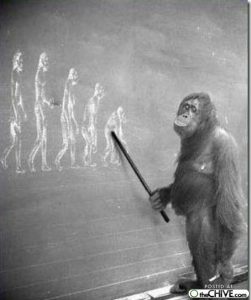 From Observation to Narrative
When the explanatory vocabulary shifts from observation to narrative, the boundary between science and speculation begins to blur.
The chimpanzee study illustrates the pattern. What we know is straightforward:
- Chimpanzees eat fruit.
- Fruit sometimes ferments.
- Fermented fruit contains small amounts of ethanol.
Everything beyond that becomes conjecture. Did primates evolve an attraction to alcohol? Did ethanol provide an adaptive advantage? Did this shape human behavior millions of years later? These may be interesting speculations, but they are not discoveries.
The Conclusion: Science vs. Speculation
What they are is evolutionary stories.
Readers of CEH may recall the same theme in my last year’s article, “Darwine and Chips: A Toast to Evolutionary Storytelling,” which examined how speculative narratives often grow around ordinary biological observations (also see here). That phenomenon appears again here. A modest measurement in the forest canopy becomes a sweeping tale about the deep origins of human behavior.
The chimpanzees, meanwhile, continue doing what chimpanzees have always done: eat fruit … and pee.
Observations belong to science. The stories we wrap around them belong to interpretation. And evolutionary interpretation, unlike the slightly fermented fruit of this study, is highly intoxicating.
Darwine, indeed.
 John Wise received his PhD in philosophy from the University of CA, Irvine in 2004. His dissertation was titled Sartre’s Phenomenological Ontology and the German Idealist Tradition. His area of specialization is 19th to early 20th century continental philosophy.
He tells the story of his 25-year odyssey from atheism to Christianity in the book, Through the Looking Glass: The Imploding of an Atheist Professor’s Worldview (available on Amazon). Since his return to Christ, his research interests include developing a Christian (YEC) philosophy of science and the integration of all human knowledge with God’s word.
He has taught philosophy for the University of CA, Irvine, East Stroudsburg University of PA, Grand Canyon University, American Intercontinental University, and Ashford University. He currently teaches online for the University of Arizona, Global Campus, and is a member of the Heterodox Academy. He and his wife Jenny are known online as The Christian Atheist with a podcast of that name, in addition to a YouTube channel: John and Jenny Wise.