


Lungfish Evolution Story Is Breathless
Evolutionary scientists “explain away” major
difficulties in documenting evolutionary transitions
instead of resolving them through empirical evidence
New fossils and CT analysis fail to support lungfish evolution
by Jerry Bergman, PhD
Many examples exist in which Darwinian evolution and its claims are not supported by empirical evidence. A paper about lungfish evolution covers in some detail one such example.
Narrative Construction, Darwin Style
A common pattern of evolutionary researchers is to describe observations in a way that implies evolutionary processes without directly demonstrating them.
1. In one instance, one textbook states that “all dogs evolved from wolves,” suggesting that mutations and natural selection produced the diversity of modern dog breeds.[1]
Actually, the example being described is artificial selection performed by breeders. Through selective breeding, humans have produced more than 300 dog breeds from the enormous genetic diversity already present within the canine population. Similar variation exists within many animal kinds, including cats and horses.
2. Another example occurs when descriptions are framed in ways that imply Darwinian evolution without explicitly claiming that the evidence demonstrates evolution. For example, consider the following quotation in which Qiao et al. reported:
a new Early Devonian lungfish from China, Paleolophus, which bridges the morphological gap between Diabolepis [believed to be the most primitive lungfish ancestor] and eudipnoans [all true lungfishes]. Its three-dimensional preservation reveals cranial anatomy, indicating that key adaptations for durophagy evolved rapidly during the initial diversification of the group.[2]
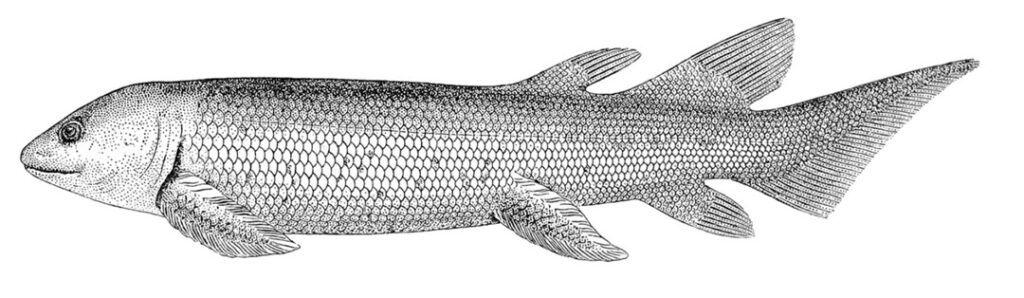
Diabolepis (Wikimedia Commons).
This interpretive approach appears in the title of an article in the peer-reviewed journal Current Biology:
 A new fossil fish sheds light on the rapid evolution of early lungfishes (Qiao et al., Current Biology, 5 January 2026). A team of five scientists from the Chinese Academy of Sciences, and one from Flinders University, claims that their fossil illustrates “rapid evolution.”
Narrative Repair, Gould Style
One proposed solution to the problem of gaps in the fossil record is the concept of punctuated equilibrium (often abbreviated in academic settings as “punk eq”), first proposed by Niles Eldredge and Stephen Jay Gould in 1972. This model suggests that species remain relatively unchanged for long periods of time (stasis) and that evolutionary change occurs in relatively short bursts of rapid speciation.
Note the term “rapid evolution” in the Current Biology title, implying punctuated equilibrium, even though no evidence for evolution was presented.
Eldredge and Gould concocted “punk eq” primarily to explain away the lack of fossil transitional forms. In that tradition, the research team led by Tuo Qiao says that “lungfishes evolved rapidly during their early history.”[3] The implication is that, since this change happened so rapidly, we should not expect it to appear in the fossil record.
Critics argue that such explanations rely heavily on inference because the proposed rapid transitions are not directly documented in the fossil record but assumed by evolutionists. From this perspective, the hypothesis functions as a post-hoc interpretation rather than a testable explanation of the observed gaps.
Evolutionary Fish Stories
The “punk eq” strategy appears in the following statement from ScienceDaily dated 20 March, 2026 about the Qiao et al. paper:
Scientists have uncovered new clues about some of Earth’s earliest fish, shedding light on the ancient origins of vertebrates that eventually moved onto land. By reanalyzing mysterious fossils from Australia’s famed Gogo Formation and studying a newly reconstructed 410-million-year-old lungfish skull from China, researchers are revealing how these primitive creatures evolved.[4]
The article does not present empirical evidence for progressive evolutionary change, such as transitional fossils documenting the transformation of one form into another more evolved form. Instead, it primarily describes the anatomical characteristics of a particular lungfish specimen.
The Evidence, Please: The Qiao et al. Data
As background, the genus Diabolepis is often considered the most basal (earliest) known lungfish. Within evolutionary interpretations, it is proposed to represent an ancestral form from which later lungfishes, including those grouped within Eudipnoi [a lobe-finned fish subclass], eventually arose. However, while the fossils do reveal the existence and anatomy of these organisms, there is no direct fossil evidence documenting the proposed evolutionary transitions.
In an effort to document evolutionary history, the 2026 paper by Qiao et al. states that “lungfishes, the closest living relatives of land vertebrates, have a long and conservative evolutionary history that began over 415 million years ago in the Early Devonian.” However, “a long and conservative history” is evidence of morphological stability, or stasis—a key element of punctuated equilibrium theory—rather than the progressive upward developmental change required for evolution.
The authors themselves acknowledge that lungfishes are often described as living fossils—organisms whose basic body plan has remained largely unchanged since their first appearance in the fossil record. Thus, rather than documenting a sequence of transitional forms, the evidence instead highlights the remarkable persistence and stability of the lungfish body plan over vast lengths of time.
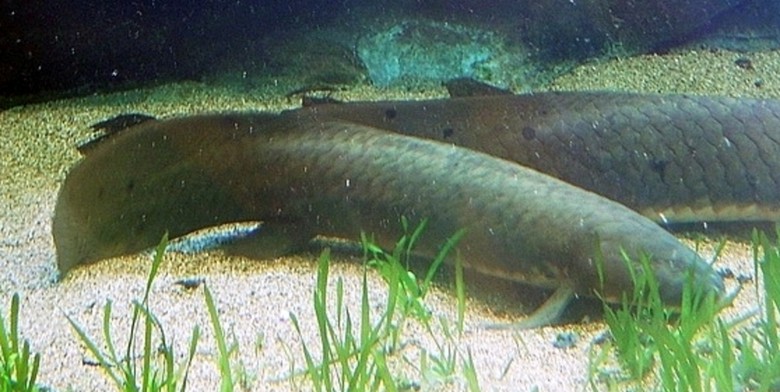
Modern living Diabolepus, a “living fossil” resembling its alleged 415-million-year-old ancestor (Wikimedia Commons).
Gaps Rather than Lineages
The paper by Qiao et al. also acknowledges an important difficulty in reconstructing lungfish evolution: “Morphological gaps between the earliest known and most primitive lungfish, Diabolepis, and the more derived members of the group (Eudipnoi) hinder a comprehensive understanding of key evolutionary transformations.”
In other words, the fossil record currently lacks clear transitional forms connecting these early lungfish with their proposed descendants. The authors note that Uranolophus fossils from Wyoming have been suggested as a possible intermediate between Diabolepis and the Eudipnoi. However, they also acknowledge that these fossils are too flattened to reveal important internal structures such as the braincase, limiting their usefulness for evaluating evolutionary relationships.[5]
To address this problem, the authors described the recent discovery of another early lungfish fossil from the Pragian Stage [Lower Devonian strata] of China that revealed an exceptionally well-preserved skull.[6] Because the specimen can be analyzed with computed tomography (CT), the internal structures of the head can be studied in unprecedented detail, providing what they hoped would be clear evidence of this evolutionary transition.
However, the conclusions from the detailed CT analysis, rather than providing support for evolution, show that a large gap exists between this lungfish and its proposed ancestor. The earliest diversification of the lungfish clade (Dipnoi) remains uncertain. As the authors themselves conclude, “the earliest diversification of the lungfish (Dipnoi) clade is the subject of ongoing debate, with Diabolepis.”[7]
The use of computed tomography (CT) to analyze this poorly preserved fossil was intended to clarify its evolutionary significance, but the results did not provide the evidence for evolutionary transitions that had been anticipated:
We now recognize Cainocara enigma as a lungfish (order Dipnoi) based on anatomy revealed via CT, but concede that this enigmatic specimen most likely remains a nomen nudum [“naked/invalid name”] and nomen dubium [“doubtful name”].[8]
The example reviewed above illustrates how scientists “explain away” major difficulties in documenting evolutionary transitions instead of resolving them through empirical evidence. In many cases, the interpretation of the data appears to begin with an evolutionary assumption, which is then applied to the physical findings. However, when the evidence is examined more closely—such as through the use of computed tomography (CT)—it frequently fails to document the proposed evolutionary transitions.
A more objective evaluation of the fossil record requires the removal of “evolutionary glasses,” allowing the data to be examined and interpreted without presupposing a particular evolutionary framework. When the statements made by researchers, such as those mentioned above, are analyzed carefully, we see that the fossils themselves simply document the existence and stability of distinct organisms rather than a clear sequence of evolutionary change. This pattern of long-term biological stability aligns more closely with a creation-based interpretation of origins than with an evolutionary interpretation.
Comments
Right. And what about the fish that supposedly evolved into amphibians? Evolutionists seem to have “lungs” in one line of fish and more developed bony fins and skull/neck morphology in another line, and assume that’s enough to show that it all came together somewhere, somehow, and continued further to produce true lungs, legs, digits, etc.