


Fossil Mistaken Identity Fools Experts for 26 Years
Evolutionary narratives have sometimes
been reconstructed from little more than a
jaw, a few teeth, or some scattered bones
The world’s “oldest octopus” turned out not to be an octopus at all!
by Jerry Bergman, PhD
While researching the fossil evidence for evolution, one observation that has always amazed me is how some evolutionists make claims about fossils based on nothing but a few broken fossil fragments and a lot of imagination.
 ‘Oldest octopus’ fossil is no octopus at all, scans reveal (University of Reading, 8 April 2026). “Sometimes, reexamining controversial fossils with new techniques reveals tiny clues that lead to really exciting discoveries.” That’s a polite way of saying that the experts were wrong.
Cases like this raise an uncomfortable question: how often are confident scientific claims built on incomplete evidence? In paleontology, entire creatures—and even evolutionary narratives—have sometimes been reconstructed from little more than a jaw, a few teeth, or scattered bones.
While such reconstructions are often presented with great confidence, later discoveries not uncommonly revealed mistakes, underscoring just how tentative those conclusions really were.
Guesswork Instead of Scientific Rigor
The most egregious example of this is the famous iconic “Progression of Man” illustration by Rudolph Zallinger and published in the 1965 Time-Life Book as part of the Early Man volume in the Life Nature Library. F. Clark Howell, Professor of Anthropology at the University of Chicago, is listed as the book’s author. In that book, Professor Howell admitted that many of the figures in the “progression” were created from only a few “fragments … and thus are products of educated guessing.”[1]

The now refuted evolutionary progression showing evolution from ape to human. From Wikimedia Commons.
Howell further stated: “Some of the stages [in the progression] have been drawn on the basis of very little evidence—a few teeth, a jaw, or some leg bones. However, experts can often figure out a great deal about what a whole animal looked like from studying these few remains.”[2]
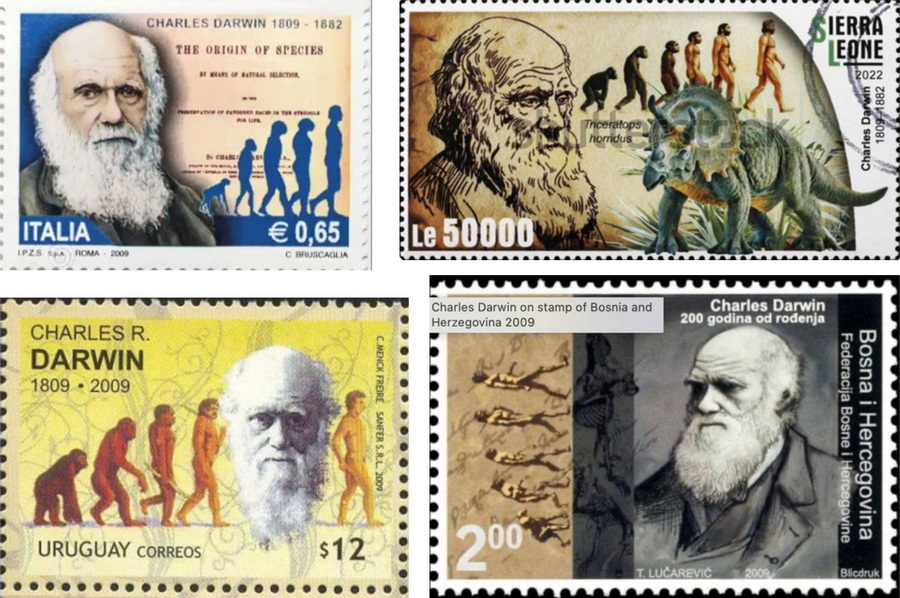
A few examples of worldwide postage stamps depicting the now-debunked “Progression.” I have over 100 in my collection and many more exist. This illustrates the widespread international popularity of “The Progression,” as an icon of evolutionism.
Even so, these tentative reconstructions have been turned into highly polished images that were reproduced widely, including on postage stamps, to popularize evolutionary claims. However, the fact that each of the examples used in this iconic progression have since been debunked, calls into question the reliability of such reconstructions. The lesson is clear: such images should never be treated as definitive evidence. [3]
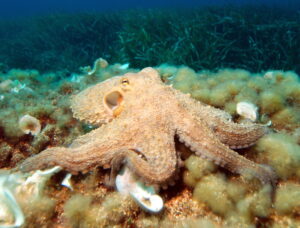
An octopus. They have complex vision. Note the eyes on top of its head. From Wikimedia Commons.
The Case of the Not-Octopus
One of the more notable recent examples of this kind of debunking or correction of mistaken evolutionary interpretations comes from the subject of this article.
A fossil once identified as the world’s oldest octopus has been exposed as a case of mistaken identity after it was reexamined using advanced imaging techniques—specifically synchrotron imaging, a high-resolution X-ray method capable of revealing structures hidden within rock.
Such technologies have significantly improved researchers’ ability to study fossils in detail, and have revealed many mistakes in previous evolutionary interpretations of fossils. This particular fossil was discovered in Illinois, USA, and first described in 2000.
It quickly became important in studies of cephalopod evolution, with scientists interpreting its features as evidence of eight arms, fins, and other traits associated with octopuses. This pushed the known origin of octopuses back by about 150 million years.[4] Recently, however,
advanced imaging revealed hidden teeth, showing it was actually related to a nautilus, not an octopus. The confusion came from decay that altered its shape before fossilization. This discovery rewrites part of evolutionary history, pushing the true origin of octopuses much later in time.[5]
While the details of this discovery do reveal the growing sophistication of paleontological methods, they also reveal the challenges inherent in accurately reconstructing fossilized organisms. The magnitude of the mistaken interpretation of this particular fossil should not be overlooked:
A well-known 300-million-year-old fossil once believed to be the oldest octopus ever discovered has been reclassified after new analysis revealed it is something entirely different. The specimen had even earned a place in the Guinness Book of Records, but scientists now say that distinction was based on a misinterpretation.[6]
One is left to wonder how many other “famous fossils” may be subject to reinterpretation as new and more powerful research tools become available.
Readjusting the Evolutionary Clock
Nautiloids are often described as “living fossils,” meaning that modern forms retain characteristics very similar to those of their ancestors, which evolutionary paleontologists estimate lived millions of years ago. Octopuses, by contrast, differ substantially from cephalopods in the fossil record, leading evolutionary paleontologists to view them as “more highly evolved” than nautiloids. This particular fossil also played an important role in evolutionary timing models.
As a result, the new synchrotron data have created challenges for evolutionary dating. As one study noted: “This single specimen provides a key calibration point for molecular clock studies, which estimated a Paleozoic origin for octobrachians, pushing the fossil record of crown octopuses back 150 million years…. Despite being a textbook ‘phylogenetic fuse’ example, the systematic position of Pohlsepia is controversial and, consequently, our understanding of cephalopod evolution remains in flux.”[7]
The reinterpretation of this specimen has called its value as a calibration point into question. This event illustrates how sensitive such models can be to the assignment of a single fossil. When errors occur in the interpretation of key specimens such as this, they can have significant implications for the evolutionary timelines built upon them.
Nautiloids Are Not Octopuses
Nautiloids (specifically the modern Nautilus) and octopuses, although both classified as cephalopods, differ in several significant ways:[8]
- Shell structure: Nautiloids possess a coiled, 8 chambered external shell used for protection and buoyancy. As the animal grows, it adds new chambers. Mature shells can contain 30 or more chambers. Octopuses, by contrast, lack an external shell altogether. Among living cephalopods, the nautilus is unique in retaining a fully developed external shell.
- Locomotion: Nautiloids primarily rely on jet propulsion to travel through the water, while octopuses are more versatile, capable of jet propulsion but also swimming, crawling and maneuvering along the seafloor using their arms.
- Defense mechanisms: Unlike octopuses, nautiloids lack an ink sac. Octopuses eject ink to obscure the water to blind predators, allowing them to evade predators.
- Lifespan and reproduction: Nautiloids are relatively long-lived (often over 20 years) and can reproduce multiple times. Most octopus species have much shorter lifespans—typically 1–2 years (though some can live longer)—and generally reproduce once before dying.
- Eye structure: Nautilus eyes are often described as “pinhole camera”-like and lack a true lens. Octopuses, in contrast, possess highly developed lens-based eyes capable of forming detailed images.
- Circulatory System: Nautiloids have a simpler circulatory arrangement compared to other cephalopods. Octopuses have a well-developed system with three hearts—two branchial hearts (serving the gills) and one systemic heart.
- Appendages: Nautiloids possess numerous slender tentacles (often 60–90 or more) that lack suckers. Octopuses have eight arms equipped with suckers, which are used for manipulation, locomotion, and prey capture.
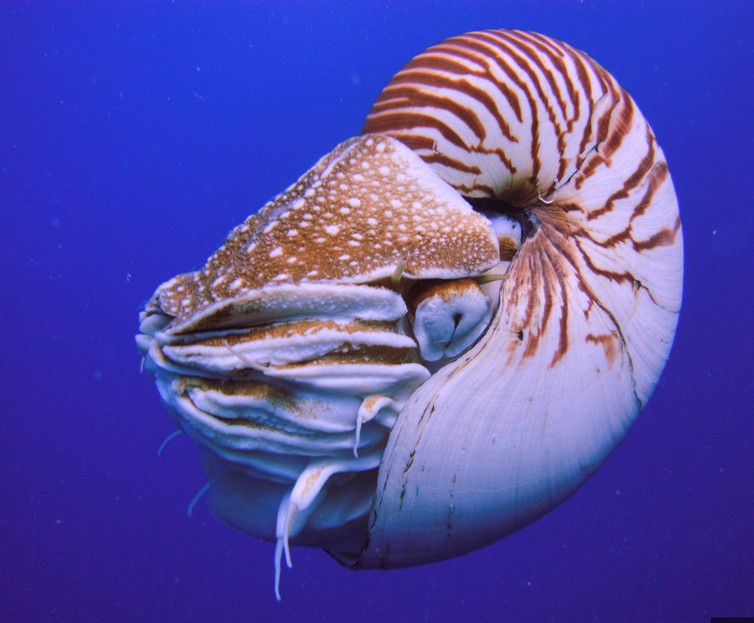
A nautiloid, as is evident from the illustration, is morphologically very different from an octopus. One difference is that nautiluses have primitive “pinhole” eyes that lack lenses and are useful only for detecting light and dark. From Wikimedia Commons.
The differences between nautiloids and octopuses illustrate how challenging it is to accurately reconstruct entire organisms using what are often fragmentary fossils. When only partial remains are available, scientists must infer the overall anatomy, which can sometimes lead to misinterpretation. This is somewhat analogous to uncovering a few large bones and concluding they belong to an elephant, when in fact they might come from a very different animal, such as a whale.[9]
This example also highlights the challenges involved in using fragmentary fossils to inform evolutionary timelines. When conclusions rest on incomplete or ambiguous evidence, they should be regarded as tentative, and the interpretations built upon them—including aspects of dating—must likewise be approached with appropriate caution.
Summary
Even informal discussions reflect an awareness of the issues discussed above. As one commentator noted, recalling a public lecture: “I remember a TED talk about a guy who proved many “similar” dino species were actually the same species at different points in development.” … “It [Paleontology] will always be a work in progress, and there will always be disagreements among paleontologists. I think it’s best to be inspired by the most up-to-date reconstructions but be aware of the current debates among the experts.”10 While such comments are not formal scientific sources, they echo a well-recognized reality: paleontology is an evolving field in which interpretations should be seen as tentative, continually tested, and revised or even overturned as new evidence becomes available.
References
[1] Howell, F. Clark, Early Man, Time-Life Books, New York, NY, p. 41, 1970.
[2] Howell, F. Clark, Early Man, Young Readers Edition. Time-Life Books, New York, NY, p. 30, 1968.
[3] Dawson, Gowan, Monkey to Man, University Press, New Haven, CT, 2024.
[4] University of Reading, “The world’s “oldest octopus” was never an octopus,” reposted by ScienceDaily, www.sciencedaily.com/releases/2026/04/260407193853.htm, 7 April 2026.

Learn about other blunders made by evolutionists in this book by Dr Bergman. Click to order.
[5] University of Reading, 2026.
[6] University of Reading, 2026.
[7] Clements, Thomas, et al., “Synchrotron data reveal nautiloid characters in Pohlsepia mazonensis, refuting a Paleozoic origin for octobrachians,” Proceedings of the Royal Society B: Biological Sciences 293(2068):20252369, 8 April 2026.
[8] Hall, Danielle, “Octopuses, squids, and relatives,” Smithsonian National Museum of Natural History, https://ocean.si.edu/ocean-life/invertebrates/octopuses-squids-and-relatives, February 2018.
[9] Kröger, B., J. Vinther, and D. Fuchs, “Cephalopod origin and evolution: A congruent picture emerging from fossils, development, and molecules: Extant cephalopods are younger than previously realized and were under major selection to become agile, shell-less predators,” BioEssays 33(8):602–613, August 2011.
10 “How legit is paleontology, really?,” https://www.reddit.com/r/Paleontology/comments/ogi2fe/how_legit_is_paleontology_really/?solution=adef3f3db2c944a1adef3f3db2c944a1&js_challenge=1&token=bbbe4bf1c9a2b5160829c4be34da5861729dfca1d0b4e3eb8f6978170b2ef674, 2021.
 Dr. Jerry Bergman has taught biology, genetics, chemistry, biochemistry, anthropology, geology, and microbiology for over 40 years at several colleges and universities including Bowling Green State University, Medical College of Ohio where he was a research associate in experimental pathology, and The University of Toledo. He is a graduate of the Medical College of Ohio, Wayne State University in Detroit, the University of Toledo, and Bowling Green State University. He has over 1,900 publications in 14 languages and 40 books and monographs. His books and textbooks that include chapters that he authored are in over 1,800 college libraries in 27 countries. So far over 80,000 copies of the 60 books and monographs that he has authored or co-authored are in print. For more articles by Dr Bergman, see his Author Profile.