


Lizard Evolution Challenges Deep Time
Rapid evolution in “Hulk” lizards
confounds gradualist expectations
and evolutionary timelines
Evolution Faces the Hulk
How Wall Lizards are Threatening Deep Time Narratives
by Dr. Sarah Buckland-Reynolds
The sight of wall lizards often triggers contrasting reactions: fascination for the avid collector, or frantic fear for those startled by their sudden scurrying. Yet beyond these everyday encounters, something far more profound is unfolding: Whether you love them or loathe them, wall lizards are exposing cracks in evolution’s slow‑change narrative. Consider this statement:
 A myriad of colours that survived millions of years of evolution have disappeared in a short period of time. The culprit? A bright green, aggressive, and sexually dominant wall lizard that has wiped out several colour variants within its species.
That’s the large print from an evolutionary story about rapid evolution in the common wall lizard (Podarcis muralis), “a species widespread in the Mediterranean region.”
 Adaptive spread of a sexually selected syndrome eliminates an ancient color polymorphism in wall lizards (Uller et al., Science, 1 January 2026), In this intriguing paper, researchers Tobias Uller and colleagues reveal that recent observations of these creatures has shown extraordinarily rapid changes, disrupting “a million-year balance across the morphs”.
The press release from Lund University explains what happened:
The researchers analysed colour data from about 240 populations of wall lizards, totaling more than 10,000 individuals. The results speak for themselves. The so‑called Hulk lizards – large, aggressive lizards with a characteristic appearance – have shifted the balance within the species.
As the “Hulk” lizards spread across the landscape, the yellow and orange throat colours also disappear. Only the white colour remains.
“The aggressive behaviour disrupts the finely tuned social systems that previously enabled several colour strategies to coexist,” says Tobias Uller.
The speed of this “selection” process is what has startled evolutionists, occurring in just a few decades, in contrast to what was assumed to be a “million-year balance”.
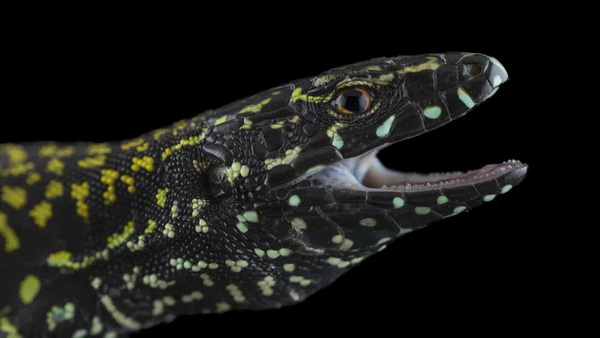
The so-called “Hulk” lizard, larger with green spots. (Lund University)
The findings have led the lead researchers to express incredible surprise about the changes in the “very short evolutionary timescale”, causing them to rethink the “surprising vulnerability” of species in an evolutionary framework. This article delves more deeply into the main evolutionary assumptions and contradictions inherent in this case and the continued tensions between gradualist philosophy and actual observations in nature.
The Vanishing Colours of Gradualism: Evolutionary Interpretation and Its Contradictions
Uller and colleagues examined 10,000 separate lizards across 240 populations to reach their conclusions. In attempting to explain these cases, evolutionists refer to “negative frequency‑dependent selection”, where each morph thrives when rare, to maintain balance. Nevertheless, some decades ago, a new “aggressive green morph” lizard led to disruptions in this system.
Even though evolutionists chalk up these observations as an example of natural selection, the speed of such observed “selection” which caused a collapse in such a short span raises several questions for evolutionary theory. If traits can vanish so quickly, how reliable are claims of ancient stability that were not actually observed? The evolutionary framework both claims resilience and admits fragility, undermining its own coherence.
Moreover, the language of surprise betrays the tension. In the press release by Lund University, co-author Tobias Uller stated:
“By showing how color variants that have coexisted for millions of years are wiped out, we now better understand how the emergence of new traits changes competition in nature.”
Yet is this “better understanding” simply an admission that evolutionary expectations failed? What seems to be happening is a retrofitting of evolutionary theory to accommodate rapid change, contradicting its own gradualist foundations.
Other Evidence of Rapid Change Creeps Up in the Literature
In discussing the observations from the lizard case, it is important to note that this newest finding is not isolated. The case of the hulk lizard joins several other well‑documented examples that reveal how gradualist expectations collapse when evidence is observed directly. Among these include:
- The Peppered Moth: The classic peppered moth story was long presented as a slow evolutionary showcase. Yet industrial pollution revealed rapid shifts in coloration within decades. The supposed gradual adaptation was actually a swift, reversible response to environmental pressures. Evolutionary textbooks overstated the case, ignoring the speed and reversibility that fit designed adaptability.
- Darwin’s Finches: The famed Darwin’s finches of the Galápagos were hailed as icons of slow speciation. Yet field studies revealed beak size changes within just a few years during droughts. These rapid, oscillating shifts contradict the narrative of gradual divergence over millennia. The finches demonstrate plasticity, not deep‑time evolution.
- Cichlid Fish: In Lake Victoria, cichlid fish speciation occurred explosively within centuries, not millions of years. Hundreds of species diversified rapidly, driven by ecological pressures and hybridization. Evolutionary gradualism cannot account for such a speed. Creationist perspectives see this as variation within a created kind, not evidence of macroevolution.
Just as with the lizard, each case shows that real‑time evidence reveals rapid, reversible, and environmentally triggered changes, not slow mutation‑driven evolution. Gradualist assumptions blind researchers to the reality of rapid processes, leading to inflated timelines and contradictory narratives.
Polymorphism Pulverized: Evolution’s Confusion Cannot be Camouflaged
Reexamining the case of the hulk lizard shows even more reasons to infer that the observations align naturally with special creation:
- Designed Adaptability: Creationist models account for changes driven by environmental pressures; however, argue that these pressures cannot explain origins. These changes are also often reversible and function as a built-in design for creatures to adapt to different environments and diversify within their kind. As the lizard morph observations demonstrate, there is built‑in capacity to adjust rapidly to changing environments. From a creationist point of view, this is not blind mutation but purposeful adaptability.
- No Need for Millions of Years: Another reason that the evolutionary narrative is inadequate is that the collapse of polymorphisms in decades (alongside dozens of other examples) shows that complex systems can shift without invoking deep time. The insistence on “millions of years” is imposed by evolutionary theory, not derived from observation. Creationist models recognize that rapid change is sufficient.
- Irreducible Complexity: The coordinated throat colour strategies are linked to behaviour, competition, and mating strategies. How does evolution account for the origins of these links? Coherence is often a hallmark of intelligent creation, not chance.
In these and several other ways, the observations fit seamlessly within a creationist framework, showcasing rapid, functional changes within created kinds, designed for resilience and adaptability.
Evolutionary Territorialism Despite the Evidence
Amidst such glaring contradictions to the gradualist evolutionary theory, the article repeatedly invokes “millions of years” of stability. This raises the question of how much literature is based on gatekeeping rather than advancing science.
The evolutionary implication of the hulk observations is that, if observations show a swift collapse, why should we trust unobserved evolutionary timelines of the “stability” of polymorphs? From a creationist point of view, the assumption of gradualism inflates timescales unnecessarily. If processes previously assumed to require vast ages can occur rapidly, does this not undermine the foundation of evolutionary chronology?
What this means for us
The findings of Uller et al. open more questions for evolution than they answer, as the case of the hulk lizard joins a growing list of examples where gradualist expectations collapsed. The rapid elimination of polymorphisms shows yet another case where observations again contradict gradualist assumptions, undermine inflated timelines, and reveal that processes assumed to require vast ages can occur swiftly. Why trust a theory that must constantly retrofit itself to accommodate rapid change, contradicting its own foundations?
From a Biblical creationist perspective, the observations are coherent with special creation, where organisms were designed with adaptive capacity, not dependent on blind, slow mutations. From the beginning, God pre‑programmed “creeping things” to function within their environments. Genesis 1:24–25 declares:
“And God said, Let the earth bring forth the living creature after his kind, cattle, and creeping thing, and beast of the earth after his kind: and it was so. And God made the beast of the earth after his kind, and cattle after their kind, and everything that creepeth upon the earth after his kind: and God saw that it was good.”
While preying and extinction pressures were not part of the original “very good” creation, these processes still declare God’s sovereignty. Even in a fallen world, the adaptive capacity of lizards testifies foresight in design. This calls us to action: to recognize that creation, though groaning under the weight of the fall, still reflects the wisdom of its Maker. Our responsibility is to steward these creatures and the ecosystems they inhabit, safeguarding the marvels of design that continue to point back to the Creator. Let us therefore honour that charge, protecting biodiversity, sustaining balance, and celebrating the adaptive resilience that declares God’s sovereignty.
 Dr. Sarah Buckland-Reynolds is a Christian, Jamaican, Environmental Science researcher, and journal associate editor. She holds the degree of Doctor of Philosophy in Geography from the University of the West Indies (UWI), Mona with high commendation, and a postgraduate specialization in Geomatics at the Universidad del Valle, Cali, Colombia. The quality of her research activity in Environmental Science has been recognized by various awards including the 2024 Editor’s Award from the American Meteorological Society for her reviewing service in the Weather, Climate and Society Journal, the 2023 L’Oreal/UNESCO Women in Science Caribbean Award, the 2023 ICETEX International Experts Exchange Award for study in Colombia. and with her PhD research in drought management also being shortlisted in the top 10 globally for the 2023 Allianz Climate Risk Award by Munich Re Insurance, Germany. Motivated by her faith in God and zeal to positively influence society, Dr. Buckland-Reynolds is also the founder and Principal Director of Chosen to G.L.O.W. Ministries, a Jamaican charitable organization which seeks to amplify the Christian voice in the public sphere and equip more youths to know how to defend their faith.