


How Evolution Is Taught in Public Schools
Long-held beliefs are not easily
abandoned—even when new
evidence suggests they should be
Bloodletting Science
Evolution in K-12 Curricula, and Why it Matters
by Ronald Fritz, PhD
It’s 1830, and you live in Paris.
You have a severe sore throat, so you visit a respected doctor—trusted, well-trained, and fully current with the best medical science of his day. After examining you, he says:
“Mon ami, this is a clear case of excess blood in the throat causing dangerous inflammation. We must remove it immediately. I will apply leeches to your neck to draw out the corrupted blood and restore balance. If needed, we will repeat the treatment tomorrow.”
This was not fringe medicine. It was standard practice. In fact, doctors across France used tens of millions of leeches each year. Bloodletting was considered one of the most reliable treatments available.1 Today, we know the truth: It didn’t work. Worse—it often weakened patients, increased the risk of infection, and sometimes contributed to death.
Yet here’s the part most people don’t realize: Even after evidence began to show that bloodletting was ineffective and harmful, it continued to be taught in leading medical schools, for decades.1 Why? Because long-held beliefs are not easily abandoned—even when new evidence suggests they should be.
Now consider this: what if something similar is happening today—on a far more important issue?
Our children are being taught evolution as the scientific explanation for their origins—a message that shapes how they see themselves, their purpose, and ultimately how they live their lives. This matters—given its importance, we need to get this right.
So, how strong is the evidence behind what they’re being taught? Is it as settled and unquestionable as it’s presented in the classroom? Or is there more to the story?
Evolution Teaching in 2026 — What Students Are Taught in Major Curricula
Let’s start by characterizing the state of evolution teaching in U.S. public schools.
- All 50 states now include evolution in their science standards.2
- Most states have adopted or aligned with the Next Generation Science Standards (NGSS), which emphasize evolution as a core concept.3
- As a result, evolution is taught as well-established science throughout almost all of K–12 education.4
- Instruction varies by district, but a significant portion (65-80%) of students are taught using major NGSS-aligned curricula such as Amplify Science, OpenSciEd, and STEMScopes—or materials modeled after them.4-6
So which situation are your children in? Chances are, they are being taught evolution in a way consistent with these major curricula. Because of its powerful influence on worldview, this raises a big question:
Are your kids being shown the full weight of the evidence in these curricula—or only one interpretation of it?
To explore this, the big three—Amplify Science, OpenSciEd, and STEMScopes—were reviewed across multiple grade levels, including student materials, teacher guides, and assessments.
Because of the sheer size of these curricula—spanning hundreds of lessons across multiple years—the review was conducted with the assistance of SuperGrok AI. This made it possible to systematically analyze large volumes of publicly available content, full units (for OpenSciEd), and detailed program resources across all three curricula, helping identify consistent themes, patterns, and omissions.
The question asked of SuperGrok was:
“What are the main categories of evidence for evolution in Amplify Science, OpenSciEd, and STEMScopes, and which are most emphasized?”
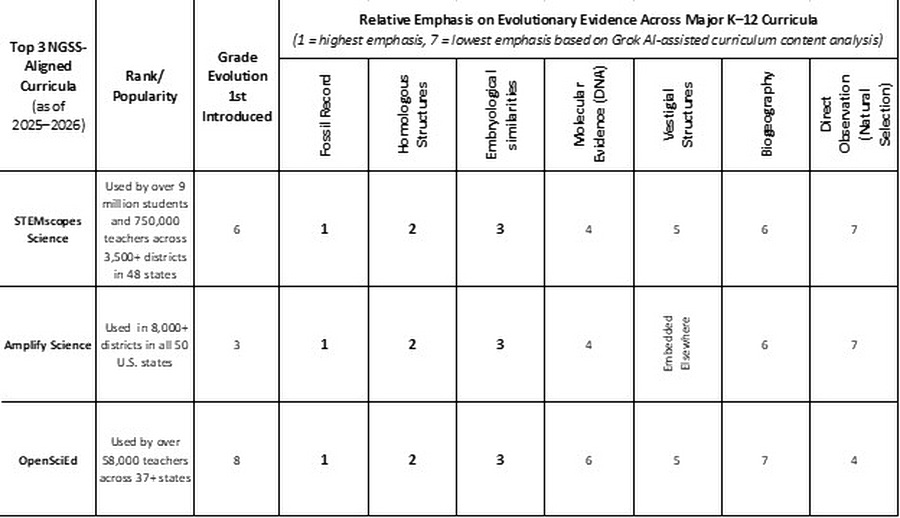
All three curricula rely on the same core categories of evidence, though they organize and emphasize them somewhat differently (see Table 1). They all share seven major areas that together form the primary case taught to students across them—and they all present them as strong, unified support for evolution.
Table 1. Shared Core Evidence Categories and Their Relative Emphasis Across Major K–12 Evolution Curricula (AI-Assisted Analysis)
Let’s take a closer look at what students are actually taught in these curricula.
- The Fossil Record
Students are taught that the fossil record shows a clear progression of life, supported by “transitional fossils” such as Tiktaalik and Archaeopteryx.
What’s not emphasized though is how much is missing. For example, complex multicellular animals appear abruptly in the Cambrian Explosion—already equipped with advanced systems like nervous, digestive, and sensory structures, functioning at high levels.7 That’s not a small gap—it’s a massive one.
Other major groups—birds, whales, bats, and flowering plants—also appear in the fossil record with limited or contested transitional forms.8 “Living fossils,” showing little change over long periods, are rarely discussed. Even Charles Darwin acknowledged this challenge, calling it one of the most serious objections to his theory.9
Rather than focusing on these gaps, students are often left with the impression that they have been—or will soon be—filled.
- Homologous Structures (Comparative Anatomy)
Students learn that similar structures—like the human arm, bat wing, and whale flipper—demonstrate common ancestry. But these similarities were recognized long before Darwin, and were originally understood as evidence of a shared design or structural plan.10
In other words, the observation itself is not in dispute—the interpretation is. Similarity can point to common descent, but it can also point to common design. By itself, it does not prove one over the other.
- Comparative Embryology
Older textbooks relied heavily on drawings suggesting that embryos of different animals look nearly identical in early stages. Those drawings have since been discredited and removed.11 However, the basic claim remains in the curricula: that similarities in early development point to common ancestry.
What is not emphasized though is that important differences appear very early in development—and that similar structures can arise through very different genetic pathways.12 Modern embryology has revealed a far more complex picture than the simplified version these curricula present.
- Molecular Evidence (DNA)
Students are taught that similarities in DNA across living organisms demonstrate common ancestry.
While DNA similarity can be consistent with this idea, the data is not always straightforward. For example, evolutionary relationships inferred from different genes sometimes conflict with each other—and with the fossil record.13
There are also “orphan genes”—genes that appear unique to particular organisms, without clear evolutionary predecessors.14
Even some evolutionary scientists have acknowledged the difficulty of fitting all genetic data into a single, consistent “tree of life.”15 These complexities are real, but they are often minimized in classroom presentations.
- Vestigial Structures
Students are taught that certain organs—such as the appendix or whale pelvic bones—are vestigial—often presented as leftover structures from evolutionary history with little or no function.
But the long-standing claim that vestigial organs are simply useless evolutionary remnants has steadily eroded, as structure after structure has been found to serve real biological functions.
In response, the definition of “vestigial” has been shifted. Rather than meaning functionless, it is now often defined as reduced or modified from an assumed ancestral form—a change that preserves the concept, but alters its original meaning.
Even some evolutionary biologists have acknowledged that vestigial structures no longer provide the clear, straightforward evidence they were once thought to offer.16 Yet this revised understanding is not always clearly communicated, leaving students with an oversimplified impression of the evidence.
- Biogeography
Students learn that the geographic distribution of species—such as animals unique to islands—supports evolution over long periods of isolation.
This is often based on observable adaptation within species, sometimes called microevolution. However, these examples are frequently extended to support large-scale evolutionary changes, even though those larger transitions have not been directly observed in ‘real time’ (that is, over timescales we can directly observe).16 Alternative explanations exist, but they are generally not explored in the curriculum.
- Direct Observation (Natural Selection)
Examples like Darwin’s finches and antibiotic-resistant bacteria are presented as evolution happening in real time.

Darwin teaching traditional Darwinism in Groupthink 101.
These are clear examples of change within populations. However, they involve relatively small-scale variations—not the origin of entirely new biological systems or body plans.16
In the case of antibiotic resistance, the changes often come with trade-offs, such as reduced fitness in normal environments.17
While these examples demonstrate adaptation, their ability to account for large-scale evolutionary change is subject to ongoing interpretive debate.
Taken together, these seven areas form the core case for evolution presented to students across major curricula.
The Bottom Line
Like the medical establishment that once clung to bloodletting, today’s educational system presents evolution as settled fact—even though most of its key lines of evidence are more complex and debated than students are led to believe.
This matters. Because evolution is not just a scientific explanation—it carries a message:
- That life is the result of unguided natural processes.
- That we are here by chance.
- That there is no ultimate purpose.
Over time, that message shapes belief.
This may help explain why 64% of 18–29-year-olds who grew up in church have dropped out of church involvement as adults18.
Just as bloodletting continued in medicine long after its value was discredited, today’s teaching on origins suffers from a similar — yet far more consequential — flaw, for it profoundly shapes how the next generation understands life, meaning, and truth.
A Parent’s Responsibility
As Christian parents, our calling is not to shield our children from opposing ideas, but to boldly prepare them for what they will face.
- They must understand what is being taught in the classroom.
- They must recognize the underlying assumptions and worldview behind it.
- They need to be grounded in the truth of who they are: they are not cosmic accidents or products of chance.
- They are intentionally created, personally known, and fiercely loved by their Creator. “… for I am fearfully and wonderfully made” (Psalm 139:14).
When children are equipped with both understanding and truth, they are far more likely to stand firm in their faith—even in the face of confident and persuasive alternatives.
For those who want to explore these topics in greater depth, several well-researched resources examine and challenge what is commonly taught in public school science classrooms:
- The top ten scientific problems with biological and chemical evolution – Casey Luskin
- Evolution: The Grand Experiment – Carl Werner
- Icons of evolution: Science or myth? – Jonathan Wells
- Origins Science in U.S. K-12 Public Schools: Is it Education or Indoctrination? – Biedebach & Calvert
References:
1. Morabia, A. (2006). Pierre-Charles-Alexandre Louis and the evaluation of bloodletting. Journal of the Royal Society of Medicine, 99(3), 158–160. https://doi.org/10.1177/014107680609900322
2. National Center for Science Education. (2024). Evolution in state science standards. https://ncse.ngo
3. National Association of State Boards of Education. (2025). The state of K-12 science curriculum. https://www.nasbe.org/the-state-of-k-12-science-curriculum/
4. Plutzer, E., Branch, G., & Reid, A. (2020). Teaching evolution in U.S. public schools: A continuing challenge. Evolution: Education and Outreach, 13(1), Article 14. https://doi.org/10.1186/s12052-020-00126-8
5. RAND Corporation. (2026). Standards-aligned instructional materials use and science practices in K–12 schools: Findings from the Spring 2025 American Instructional Resources Survey. https://www.rand.org/pubs/research_reports/RRA4594-3.html
6. Informed estimate based on publisher-reported data (Accelerate Learning, Amplify, OpenSciEd) and RAND Corporation (2026).
7. Erwin, D. H., & Valentine, J. W. (2013). The Cambrian explosion: The construction of animal biodiversity. Princeton University Press.
8. Benton, M. J. (2015). Vertebrate paleontology (4th ed.). Wiley-Blackwell.
9. Darwin, C. (1859). On the origin of species (1st ed., p. 280). John Murray.
10. Owen, R. (1848). On the archetype and homologies of the vertebrate skeleton. John Van Voorst.
11. Gould (2000) The Lying Stones of Marrakech
12. Richardson, M. K., Hanken, J., Gooneratne, M. L., Pieau, C., Raynaud, A., Selwood, L., & Wright, G. M. (1997). There is no highly conserved embryonic stage in the vertebrates: Implications for current theories of evolution and development. Anatomy and Embryology, 196(2), 91–106.
13. Maddison, W. P. (1997). Gene trees in species trees. Systematic Biology, 46(3), 523–536. https://doi.org/10.1093/sysbio/46.3.523
14. Tautz, D., & Domazet-Lošo, T. (2011). The evolutionary origin of orphan genes. Nature Reviews Genetics, 12(10), 692–702. https://doi.org/10.1038/nrg3053
15. Doolittle, W. F. (1999). Phylogenetic classification and the universal tree. Science, 284(5423), 2124–2129. https://doi.org/10.1126/science.284.5423.2124
16. Futuyma, D. J., & Kirkpatrick, M. (2017). Evolution (4th ed.). Sinauer Associates.
17. Andersson, D. I., & Hughes, D. (2010). Antibiotic resistance and its cost: Is it possible to reverse resistance? Nature Reviews Microbiology, 8(4), 260–271. https://doi.org/10.1038/nrmicro2319
18. Barna Group. (2019, September 4). Church dropouts have risen to 64%—But what about those who stay? https://www.barna.com/research/resilient-disciples/

Ronald D. Fritz, PhD, is a retired research statistician whose career spanned 27 years. Before entering the field of statistics, he worked as an engineer and engineering manager in the defense industry. He earned his doctorate in Industrial Engineering, with a minor in Mathematical Statistics, from Clemson University, where he was honored as a Dean’s Scholar. Dr. Fritz served as a consulting statistician across a broad range of industries, culminating in a 12-year role as a global statistical resource at PepsiCo. During his time at PepsiCo, he led significant research on gluten contamination in oats and its relationship to celiac disease, publishing several articles on the subject.
In retirement, Dr. Fritz developed a deep interest in creation science, sparked by a visit to the Creation Museum in Petersburg, Kentucky. As he delved into the topic, he shared his findings with his pastor, which led to an invitation to speak at their church. This initial presentation opened the door to further speaking engagements at churches throughout the region. Dr. Fritz has been married for 35 years to his wife, Mitzie. They live in the mountain community of Bee Log, North Carolina, within sight of the church where they were married and now worship. In his free time, Dr. Fritz tends a small chestnut orchard on their property, working to revive what was once a cherished local delicacy. The couple has two adult children.