


Climate Change Alarmism Pushed in Schools
A proposed act raises ongoing questions
about how controversial scientific topics
should be presented in public education
The Climate Change Education Act
A Federal Push to Turn Schools into Climate Alarmism Factories?
by Ronald Fritz, PhD
The National Center for Science Education (NCSE) issued a celebratory press release on April 29, 2026, titled:
 The Climate Change Education Act returns to Congress yet again. (National Center for Science Education, 29 April 2026). This article announces the reintroduction of the Climate Change Education Act.
In it, NCSE hailed the reintroduction of the Climate Change Education Act. Identical companion bills were introduced in both chambers:
- S. 4377 by Sen. Edward J. Markey (D-MA) in the Senate
- H.R. 8406 by Rep. Debbie Dingell (D-MI) in the House
These are similar to versions introduced in previous Congresses, as the push for aggressive climate education continues.
The bill’s justification rests on a 2014–2015 NCSE/Penn State survey claiming that:
“Only 30 percent of middle school science teachers and 45 percent of high school science teachers understand the extent of the scientific consensus on climate change.”2
In other words, the problem isn’t that students aren’t hearing enough about climate change — it’s that too many teachers aren’t pushing the climate crisis narrative hard enough.
Rep. Debbie Dingell made the stakes clear in her April 22, 2026 press release:
“We cannot fully confront the existential threat of climate change without a thorough understanding of the impact it will have on our lives and the steps we must take to combat it. Students learning these lessons today will be on the frontlines of the fight to save our planet.”
Sen. Markey echoed the urgency, framing the bill as essential preparation for a “hotter and more dangerous planet.” (Markey, April 22, 2026)3
What the Act Would Do
The legislation would direct NOAA to hand out tens of millions in grants for curriculum development, teacher training, and programs aimed at K-12 schools, universities, and youth organizations. Its stated goals include broadening understanding of climate change and its “disproportionate impacts” on poor and minority communities, preparing 3.5 million graduates each year to make “informed” decisions that “positively affect the climate,” and directing resources toward “environmental justice communities” (low-income and minority neighborhoods designated as most vulnerable).
In plain English
This is a federally funded effort to sensitize teachers so they can impress upon middle and high school students that their existence is threatened by fossil fuels, that humanity faces an existential climate crisis, and that the solution requires urgent collective action to rapidly transform our energy system.
That is an extraordinarily heavy message to lay on children. It risks turning impressionable students into anxious activists who view modern civilization — built on affordable, reliable fossil fuel energy — as the enemy.
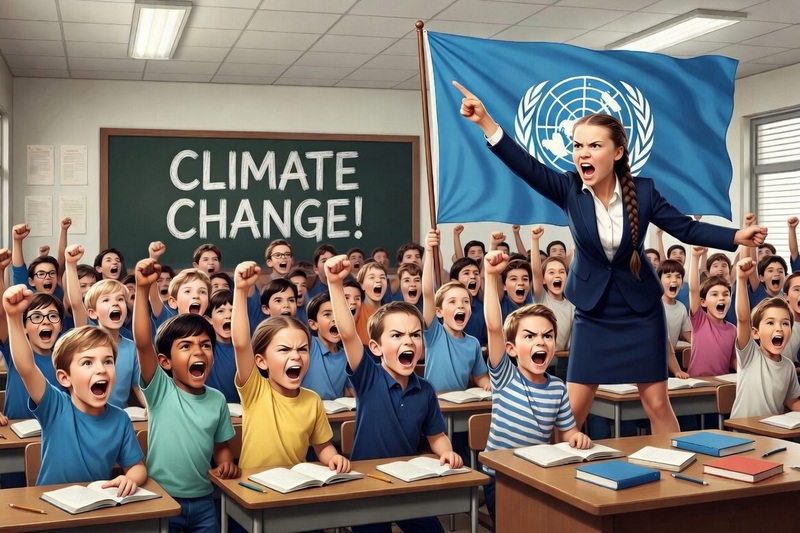
Schools should not be indoctrination centers for “environmental justice” revolution.
Before we traumatize a generation and push policies that would dramatically raise energy costs, cripple industries, and weaken national security, we had better be right about the science.
The Political Landscape Today
Democrats are deliberately downplaying alarmist “existential threat” and “climate emergency” rhetoric in public discourse for electoral reasons ahead of the 2026 midterms, even as they aggressively pursue far-reaching climate policies through legislation — often justified with the very same alarmist language candidates are being advised against using on the campaign trail. Examples:
- Why Democrats aren’t talking about climate change. (Kate Yoder, Grist.org, https://grist.org/politics/democrats-arent-talking-about-climate-change-cheap-energy/, Oct 21, 2025.) Democrats and allied groups are shifting messaging toward “cheap energy” and affordability based on polling, while downplaying explicit “climate change” talk. ‘Don’t say climate change.’
- What Trump’s Victory Taught Democrats About Climate Change. (Debra Kahn, Politico.com, https://www.politico.com/news/magazine/2025/10/16/democrats-climate-change-affordability-trump-column-00609841, Oct 16, 2025.) This examines how Democrats, after Trump’s 2024 victory, are de-emphasizing climate rhetoric in favor of pocketbook issues like electricity costs.
- “Three Tough Truths About Climate” / “A new approach for the world’s climate strategy”, (Bill Gates, Gates Notes, October 28, 2025.) Gates softens his tone arguing against “doomsday” climate narratives, acknowledging serious impacts (especially on the poor) still remain but states they “will not lead to humanity’s demise”.
The Scientific Case for Skepticism
A small but credentialed group of climate scientists argues that the dominant man-made crisis narrative is overstated. These include Dr. Roy Spencer (former NASA scientist and keeper of the University of Alabama-Huntsville satellite temperature record), Dr. Judith Curry (former chair of Earth and Atmospheric Sciences at Georgia Tech), and Dr. Richard Lindzen (emeritus professor at MIT).
Key points they and others raise:
- Climate models run too hot. Intergovernmental Panel on Climate Change (IPCC) models have, on average, predicted 43% more warming than satellite and balloon observations since 1979. This suggests the models dramatically exaggerate how sensitive the atmosphere is to CO₂.4
- Low climate sensitivity. Observational data point to far milder warming from doubled CO₂ (roughly 0.5–1.8°C) than the high-end model projections (2.5–4°C+). Basic physics plus likely negative cloud feedbacks (clouds that counteract warming by reflecting more sunlight) support only modest effects.5
- Natural variability is underestimated. Long-term ocean cycles (such as the PDO — Pacific Decadal Oscillation — and AMO — Atlantic Multidecadal Oscillation), solar influences, and chaotic internal variability can explain a large portion of 20th-century warming. Past warm periods like the Medieval Warm Period occurred without industrial CO₂.6
- Weak “fingerprints.” Climate models predict a strong tropical upper-troposphere “hot spot” (faster warming high in the atmosphere) that has not appeared as clearly as expected in real-world data.7,8
These scientists do not deny some human influence or modest warming. They argue the effect is minor compared to natural factors, and the catastrophic predictions lack solid empirical support.
What’s Really Driving This?
If the “existential threat” case is scientifically shaky, why the relentless push — including this education bill?
Skeptics point to a powerful climate-industrial complex of financial, political, and ideological interests:
- The Gravy Train: Billions in research grants, green subsidies, carbon trading schemes, and consulting contracts flow to those who amplify alarm. Dissenters find doors closed.
- Political Control: The crisis narrative justifies expanding government power over energy, transportation, housing, and industry. Net-zero policies and “climate justice” become vehicles for wealth redistribution and centralized planning.
- Ideological Agenda: It functions as a secular religion — human prosperity and fossil fuels as original sin, requiring sacrifice, guilt, and a transformed society. Targeting children ensures the next generation internalizes the worldview before they can critically evaluate the evidence.
- Suppression of Debate: By embedding one-sided climate literacy in schools via federal dollars, the bill marginalizes skeptical voices and trains students to accept “consensus” as dogma rather than examine data, model failures, and uncertainties.
Judith Curry has strongly criticized similar climate education bills, arguing that they move toward indoctrination rather than genuine education by promoting a one-sided government view of climate change. (Wojick, 2016, on her blog Climate Etc.)
A Better Path
This development raises ongoing questions about how controversial scientific topics are presented in public education, the balance between urgency and uncertainty, and the long-term effects on students’ views of energy, technology, and human progress.
True science education should present the full range of evidence: the benefits of CO₂ (such as global greening and higher crop yields), successful human adaptation, the limitations of current models, and the enormous costs of rapid fossil fuel elimination. Scaring children into activism without presenting robust counter-evidence is not education — it is propaganda.
Parents, educators, and citizens who value critical thinking should watch this bill closely. Before we rewrite textbooks and reshape young minds around a contested crisis narrative, we must demand open debate, not federally funded certainty. Our children’s future — and America’s historic strengths in innovation, energy abundance, economic freedom, and technological leadership — deserves nothing less.
References
1. National Center for Science Education (NCSE). (2026, April 29). The Climate Change Education Act returns to Congress yet again. https://ncse.ngo/climate-change-education-act-returns-congress-yet-again
2. Plutzer, E., et al. (2016). Climate change in the American mind: Americans’ global warming beliefs and attitudes in March 2016 (and related NCSE/Penn State teacher survey). Reported in CBS News (Feb 16, 2016) and cited in NCSE materials. The exact wording appears in the 2014–2015 NCSE/Penn State survey of science teachers.
3. Senator Edward J. Markey’s official press release, April 22, 2026. Link: https://www.markey.senate.gov/news/press-releases/markey-dingell-brownley-introduce-legislation-to-strengthen-climate-education
4. Roy W. Spencer, PhD. (2024). Global Warming: Observations vs. Climate Models. The Heritage Foundation. → “The models have produced, on average, 43 percent faster warming than has been observed from 1979 to 2022.”
5. Lewis, Nicholas, and Judith A. Curry. (2018). “The Impact of Recent Forcing and Ocean Heat Uptake Data on Estimates of Climate Sensitivity.” Journal of Climate, 31(15), 6051–6071. https://doi.org/10.1175/JCLI-D-17-0667.1
6. Curry, Judith A. (2017). Climate Models for the Layman. Global Warming Policy Foundation.
7. Christy, John R., and Roy W. Spencer. (Ongoing analyses, latest 2026 update). “Tropical Tropospheric Temperature Trends, 1979–2025: The Epic Climate Model Failure Continues.” drroyspencer.com, January 13, 2026. Also: Christy, John R. (2018). “Examination of space-based bulk atmospheric temperatures and surface temperatures in CMIP5 models and observations.” International Journal of Remote Sensing (and earlier congressional testimony).
8. Wojick, David. (2016, September 4). “Senator Markey’s Climate Education Act Goes The Wrong Way.” Climate Etc. (Judith Curry’s blog). Available at: https://judithcurry.com/2016/09/04/senator-markeys-climate-education-act-goes-the-wrong-way/

Ronald D. Fritz, PhD, is a retired research statistician whose career spanned 27 years. Before entering the field of statistics, he worked as an engineer and engineering manager in the defense industry. He earned his doctorate in Industrial Engineering, with a minor in Mathematical Statistics, from Clemson University, where he was honored as a Dean’s Scholar. Dr. Fritz served as a consulting statistician across a broad range of industries, culminating in a 12-year role as a global statistical resource at PepsiCo. During his time at PepsiCo, he led significant research on gluten contamination in oats and its relationship to celiac disease, publishing several articles on the subject.
In retirement, Dr. Fritz developed a deep interest in creation science, sparked by a visit to the Creation Museum in Petersburg, Kentucky. As he delved into the topic, he shared his findings with his pastor, which led to an invitation to speak at their church. This initial presentation opened the door to further speaking engagements at churches throughout the region. Dr. Fritz has been married for 35 years to his wife, Mitzie. They live in the mountain community of Bee Log, North Carolina, within sight of the church where they were married and now worship. In his free time, Dr. Fritz tends a small chestnut orchard on their property, working to revive what was once a cherished local delicacy. The couple has two adult children.