


A Lost World Revealed by Physics
What we have been given is not just a
vision of lost civilizations, but a reminder of
how much of the past still lies beyond our sight
A Lost Amazonian World
and a Lesson in Scientific Humility
by John D. Wise, PhD
 Great mysteries of archaeology: an ancient Amazonian world revealed from the sky (José Iriarte, The Conversation, 8 June 2026).
José Iriarte, Professor of Archaeology at the University of Exeter, reveals the fascinating and ongoing discoveries of previously unknown complex and large-scale societies in Amazonia, a place scientists previously believed insignificant in human historical terms. At first, he says, what LIDAR[1] scans reveal
… feels random, almost unreadable. Only gradually does the pattern resolve itself: raised causeways or paths fanning out to link the forest islands, and a dense, scattered web of canals threading the terrain. Slowly you realise it’s a structured network of intersecting lines, enclosures and roads – the imprint of past human design.
A remarkable picture of what lies beneath the Amazonian canopy is being progressively pieced together, here and elsewhere. Using lidar technology, researchers are mapping vast networks of earthworks, roads, canals, and settlements, evidence of large, organized societies that once significantly reshaped the landscape. What scientists and historians long assumed to be largely untouched wilderness is now recognized to have been extensively inhabited and engineered.
This discovery is not marginal. It goes to the heart of what we thought we knew about human history. As is so often the case, this correction of our ignorance was made possible by new technology, revealing what had been concealed by time and accretion.
But the significance of this discovery is not only what it reveals. It is also what it overturns. For decades, the prevailing view among experts held that the Amazon could not support large, complex populations. This new evidence does not simply refine that picture.
It reverses it.
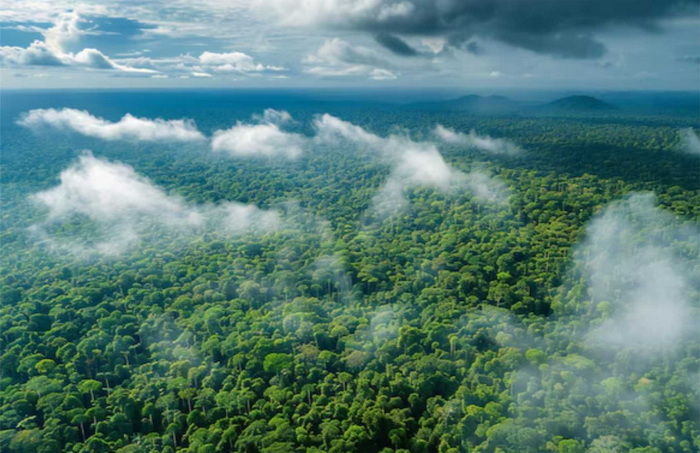
Most details on the ground in the Amazon rainforest are undecipherable from the air. (Freepik.com)
An entire class of human activity – regional planning, coordinated construction, sustained landscape and agricultural and trade management – was effectively invisible until very recently. The question is not merely why earlier researchers failed to see it. The forest hid it well at every scale easily accessible to the naked human eye.
The more pressing question is the confidence with which such a mistaken picture was maintained for so long.
This is not the first time such signals have appeared. In 2022, David Coppedge drew attention to growing evidence of large-scale, intentional design in the Amazon, pointing to geometric earthworks and engineered features that challenged the image of a pristine, unworked jungle only sparsely inhabited by primitive, scattered Stone Age cultures.
The evidence on the ground is testifying more clearly than ever before. The scientists, the historians and the textbooks were wrong. Their anthropological story didn’t just have gaps; it had massive errors in historical reconstruction.
What this episode invites is not simple revision, but reflection on the grand scale.
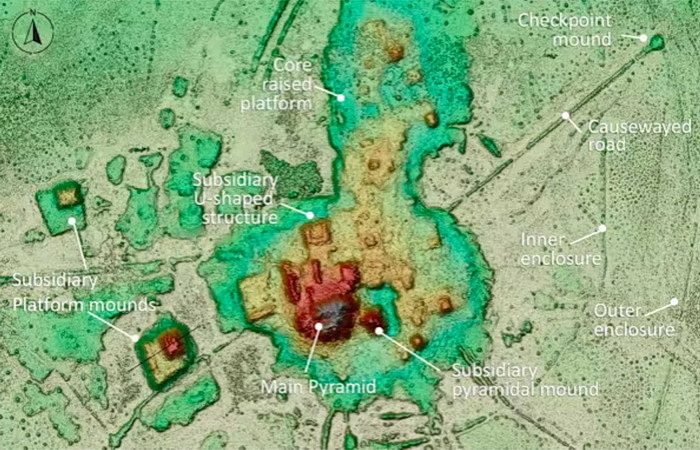
Map of a hidden Amazonian civilization discovered by the Iriarte team using Lidar (TheConversation.com).
The Illusion of Primitive Isolation
For much of the modern era, anthropological reconstructions of the ancient world have been guided by a simple assumption: that early human societies were largely constrained by their environments, progressing slowly from small, isolated and scattered groups toward more complex forms of organization, and more advanced technologies. It is the evolutionary story of humanity with which we are all familiar.
In the case of the Amazon, this assumption took a specific form. Because the soils were considered acidic and nutrient-poor, large, organized populations were widely thought to be ecologically unlikely, if not impossible. The new lidar evidence does not merely adjust that picture.
It inverts it.
The societies emerging from the new data did not simply endure a difficult environment; they systematically reshaped it. As the article notes,
we know partly from lake sediment data that people enriched the forests with species that provided food, building materials, medicines and other resources, from açaí and cacao to palms, cinchona and copaiba.
In other words, the forest itself bears the imprint of intentional cultivation. What appears today as “natural” in many areas may be the long-term result of human design.
This pattern extends beyond vegetation. Waterways were modified, landscapes were engineered, and in some regions soils were transformed into fertile ‘anthrosols.’[2] The enduring presence of these features suggests not momentary adaptation, but sustained, coordinated activity over generations, perhaps centuries, and a substantial knowledge base coupled with technological sophistication.
What has emerged is not a picture of stone-age primitives living at the edge of subsistence. It is a picture of rational planning, sustained modification, and long-term interaction with the environment on a scale that earlier models would have simply dismissed.
The Epistemological Blindspot
How did our collective academic expertise maintain such absolute confidence in a completely inverted narrative for so long?
The answer lies in a rigid adherence to uniformitarian, naturalistic, and evolutionary assumptions. Secular archaeology has long assumed that natural landscapes require long ages of gradual change to erase the footprint of human civilization. Because the dense canopy looked ancient, wild and untamed to the naked eye, it was assumed to have been that way for millennia.
But more recent data indicate nature’s staggering capacity for rapid reclamation (e.g., here, here, and here). When these societies dissolved, whether due to pathogens or regional conflict, the tropical environment didn’t take millennia to reclaim their achievements. It took centuries, and within a few generations twenty-meter-tall pyramids, complex canals, and road systems were entombed beneath a living green shroud.
We often see only what we’ve trained ourselves to see. Too often this blinds us to what is truly there.
Too often we don’t even look. When we looked at the Amazon, we saw:
… not simply a collection of settlements, but an entire urbanized landscape. A large part in the south-east of this region belonged to the Casarabe culture…. It extends across 20,000km², which is roughly the size of New Jersey in the US.
The Casarabe organised into a hierarchy of four different sizes of settlements…. The biggest ones – the primary settlements – were as large as 3km²….
These settlements connect along the raised causeways to smaller secondary and tertiary sites a number of kilometres away, all of which were permanently inhabited as opposed to empty ceremonial hubs. A fourth tier consists of groups of isolated mounds located out in the pampas, which likely correspond to dwelling areas occupied by farmers who would have worked the fields.
Chesterton Got Here First
This dramatic reversal of academic fortune brings to mind G.K. Chesterton’s The Everlasting Man. Criticizing the rigid evolutionary assumptions of his own day, Chesterton noted that when modern anthropologists encounter a seemingly “primitive” culture left in the wild, they assume they are looking at the ancestor of civilization, but:
… it has appeared to a good many intelligent and well-informed people quite as probable that the experience of the savages has been that of a decline from civilisation.[3]
He argued that what the secular mind labels a “primitive state” is very often the tragic aftermath of a cultural decline, the remnants of a highly sophisticated people who were scattered, isolated, or overtaken by disaster.
The Amazonian canopy has validated Chesterton’s skepticism. For centuries, Western observers looked at the scattered, sparse indigenous populations of the basin and assumed they were witnessing a static, “stone-age” culture that had never evolved past basic hunter-gatherer existence. They failed to realize they were looking at the survivors of a civilizational collapse. The advanced, urbanized Casarabe culture had been there, reshaping the continent with a massive network of engineering feats, before being rapidly swallowed by the jungle. The “primitive” state was not the beginning of the story; it was merely the green curtain that fell on the final act.
A Call for Epistemic Modesty
Lidar has indeed changed what we see, but it has not simply added new data; it has also exposed how much was previously hidden and by what. It exposed how much we didn’t know we didn’t know, and how wrong what we thought we knew could be.
All of which raises a broader question. If our understanding of one of the largest regions on Earth, one whose history is very recent on the “geological timescale,” can be so significantly falsified by what we were unable to see, how should we calibrate our confidence in other reconstructed histories, especially those in which assumptions dominate, evidence is fragmentary and ambiguous, theories are underdetermined and no comparable corrective technology exists?
Chesterton once more:
Science is weak about these prehistoric things in a way that has hardly been noticed…. In all practical inventions, in most natural discoveries, [science] can always increase evidence by experiment. But it cannot experiment in making men…. An inventor can advance step by step in the construction of an aeroplane…. But he cannot watch the Missing Link evolving…. If he has made a mistake in his calculations, the aeroplane will correct it by crashing to the ground. But if he has made a mistake about the arboreal habitat of his ancestor, he cannot see his arboreal ancestor falling off the tree….
In dealing with a past that has almost entirely perished, he can only go by evidence and not by experiment. And there is hardly enough evidence to be even evidential. Thus while most science moves in a sort of curve, being constantly corrected by new evidence, this science flies off into space in a straight line uncorrected by anything.[4]
Chesterton was not making an argument against archaeology, nor am I. We are arguing for proportion between what we find, what we infer, and how strongly we claim to know. The Amazon revealed by lidar is a cautionary tale directed precisely at the heart of “historical science.” What we have been given is not just a vision of lost civilizations, but a reminder of how much of the past still lies beyond our sight.
And how carefully, therefore, we should speak of them in the meantime.
Footnotes
[1] Lidar (Light Detection and Ranging) is an airborne laser scanning technology that measures distances to the ground surface. Because some pulses penetrate gaps in vegetation, researchers can digitally remove the forest layer and expose underlying terrain features that are otherwise invisible from above.
[2] Anthrosols are soils significantly altered by human activity. In the Amazon, this includes terra preta (“dark earth”), a highly fertile, man-made soil produced by incorporating charcoal, organic matter, and other residues into otherwise nutrient-poor ground. These soils can persist for centuries and are widely taken as evidence of sustained, intentional land management.
[3] The Everlasting Man, p. 48. When I first read this in Chesterton it hit me like a lightning bolt. I was not yet prepared to accept it, but the challenge to the arbitrary assumptions of evolutionary history stuck with me.
[4] The Everlasting Man, p. 24-25.
 John Wise received his PhD in philosophy from the University of CA, Irvine in 2004. His dissertation was titled Sartre’s Phenomenological Ontology and the German Idealist Tradition. His area of specialization is 19th to early 20th century continental philosophy.
He tells the story of his 25-year odyssey from atheism to Christianity in the book, Through the Looking Glass: The Imploding of an Atheist Professor’s Worldview (available on Amazon). Since his return to Christ, his research interests include developing a Christian (YEC) philosophy of science and the integration of all human knowledge with God’s word.
He has taught philosophy for the University of CA, Irvine, East Stroudsburg University of PA, Grand Canyon University, American Intercontinental University, and Ashford University. He currently teaches online for the University of Arizona, Global Campus, and is a member of the Heterodox Academy. He and his wife Jenny are known online as The Christian Atheist with a podcast of that name, in addition to a YouTube channel: John and Jenny Wise.
Comments
This has been known for a while. See, for example, 1491: New Revelations of the Americas Before Columbus, by Charles C. Mann. Published in 2005. Hard to get past the guardians at the gate.
Thanks, Craig, but while the critique that “this has been known for a while” is valid regarding the premise of Mann’s book, it misses how much the recent LiDAR data has transformed our understanding of the scale and structure of these societies.
When Mann wrote 1491 in 2005, the idea that the Amazon hosted massive populations was a brilliant, heavily contested hypothesis built on fragmentary clues. The recent LiDAR revelations, particularly the landmark studies published in Nature (2022), reported on here by David Coppedge, regarding the Casarabe culture and subsequent finds in the Upano Valley, provided three major breakthroughs that Mann did not, and could not, know at the time.
1) When Mann wrote about the Beni region of Bolivia (the Llanos de Mojos) and the Upper Xingu, the prevailing archaeological model was one of “garden cities,” or highly organized and interconnected clusters of large villages.
The LiDAR data completely redefined this, forcing researchers to use a word that was forbidden in Amazonian archaeology in 2005: “urbanism.” The lasers revealed a four-tiered regional hierarchy. These weren’t just scattered settlements of equal size; they were full-scale civic/ceremonial hubs (like the Cotoca site), controlling vast networks of secondary and tertiary suburbs. The sheer size of the central nodes, some covering over a square mile and featuring 70-foot-tall earthen pyramids and massive U-shaped stepped platforms, represents a level of centralized, monumental architecture that Mann could only guess at.
2) In 1491, Mann noted that early explorers reported seeing wide roads, but because the jungle swallows earthworks so quickly, traditional archaeology could only map small, disconnected segments. Excavating a square mile of dense tropical canopy by hand takes years.
LiDAR stripped away the vegetation digitally, revealing that the infrastructure was vast, continuous, and highly sophisticated, causeways weren’t just paths – they were perfectly straight, elevated highways stretching for miles, raised above the seasonal floodwaters.
The scans brought to light massive, region-wide water-management systems, including artificial reservoirs and canals designed for both long-distance transport and intensive aquaculture.
Mann knew they altered the landscape, but he did not know they had fully re-engineered the hydrology of entire regions to mimic the civil engineering seen in the Andes or ancient Europe.
3) Traditionalists accused Mann and the archaeologists he championed of wildly overestimating pre-Columbian populations based on scanty evidence. Critics argued that a few isolated mounds didn’t prove a massive civilization.
LiDAR effectively ended that debate by providing empirical, unarguable visual proof. Instead of guessing how many mounds lay hidden in the forest based on what a machete crew could clear, a single helicopter flight mapped 6,000 rectangular earthen platforms in a single valley. It moved the conversation out of the realm of statistical extrapolation and into direct observation.
Charles Mann wrote a masterpiece convincing the world that a fire had once burned in the Amazon. The 2020s LiDAR data didn’t just confirm the fire; it mapped the entire layout of the ancient city that burned, revealing the height of its monuments, the paths of its highways, and a complexity of social stratification that even the most optimistic archaeologists in 2005 hesitated to claim.
In my view, that’s pretty revolutionary.
John
John,
Seems you read my comment as a criticism. Not so. I’m not as eloquent as you. So I try to keep things brief.
My intent was to point out what it takes to get consensus to take note of the obvious. Human beings do not sit around in the dirt being at one with nature. We alter nature to suit our needs. Always have and always will. If the Traditionalists were not steeped in Darwinian theology, they would have extrapolated from Mann’s (and earlier) observations and gone looking for the evidence. It was there the entire time. Sure the jungle made it hard. But it is a lot harder if you start from the premise that it does not exist.
Makes you wonder what else we’re missing about the pre-Columbus peoples of the Americas. Lots of hints but nobody goes looking.
Best,
Craig
Hi Craig, sorry to go defensive on you. As a former YouTuber I’m far more used to trolls than anyone agreeing with me. LOL. I think you’re pretty eloquent, actually. Your comments above are terse and telling – right to the point. Consensus, almost by its very nature, is all the more likely to not be corrected when it is wrong, for as you point out – they almost never go looking for anything that might “do the trick.”