



Is the “Science God” in Trouble?
An important reason people
believe in evolution is due
to their social connections
Is the “Science God” in Trouble?
Regardless, the Creation View Holds Steady
by Jerry Bergman, PhD
A recent report in the latest issue of Nature, one of the world’s most prestigious scientific journals, has admitted that public confidence in science may not be as strong as it once was.
 The article, titled “Have people stopped trusting science? The data tell a surprising story,”[1] The surveys showing that, while overall trust in science remains relatively high, confidence has declined in some segments of the population.
For example, a survey by the Pew Research Center found that in the United States the percentage of people who expressed confidence that scientists act in the public’s best interests dropped from 87% in 2020 to 73% in 2023.[2]
A similar trend is seen in the United Kingdom. The researchers report “A UK survey published in January found that only 40% of people think that the science information they are aware of is ‘generally true.’”[3] The report also observed that people who identify with politically conservative parties tend to express less trust in science than those who identify with parties on the political left.
Another survey of people living in Britain, published in April 2026, revealed that 84% of respondents said their trust in science had declined, although they still had at least some trust in science. The proportion of respondents who trusted science “a lot” dropped from 63% in 2020 to just 34% in 2026.[4]
Demographic and Political Factors
Researchers also found that trust in science has declined among certain demographic and political groups. In the United States, for example, trust in science has fallen among Republican-leaning individuals. According to the Pew Research Center, about 90% of Democrats express at least a fair amount of confidence that scientists act in the public’s best interests, compared with only about 65% of Republicans. This partisan gap widened significantly during the COVID-19 pandemic, contributing to an even steeper decline in trust of scientists among Republicans.[5]
When a scientific issue aligns with a group’s core beliefs or perceived economic interests, members of different political parties often adopt distinct positions. Global warming is another example. A Pew Research Center study found that “Among Republicans and those who lean to the Republican Party, 56% think climate policies usually hurt the economy. By contrast, 52% of Democrats and those who lean Democratic say climate policies usually help the economy.”[6]
The Darwin Effect
This Republican-Democratic divide is also reflected in attitudes toward the evolutionary worldview. A 2008 survey found that a majority of Republicans (often around 50% to 60%) believed that God created humans in their present form roughly 10,000 years ago. By contrast, Democrats were much more likely than Republicans to accept the view that humans and other living things evolved over time.
More recent research has found similar results (see the chart). Surveys conducted by both the Pew Research Center and Gallup show that Republicans are far less likely than Democrats or Independents to accept the evolution worldview and are much more likely to endorse creationist views. Respondents with advanced degrees are also more likely to believe in evolution, as are those who place the greatest trust in NPR and PBS as news sources. In contrast, people without college degrees and those who primarily watch Fox News are more likely to hold creationist views.
This supports the conclusion noted above that one’s social group is important in how they view science. These findings support the conclusion noted above that a person’s social group plays a very important role in the acceptance of an evolutionary or a creationary worldview.
Conclusions
Attitudes toward science and politics often cluster together because scientific issues are frequently intertwined with moral values and one’s political ideology. They also support the view that people accept evolution not so much because of the scientific evidence but also because of their social/political connections.
An important takeaway from this research is that belief in evolution affects people’s broad beliefs about values, morals, religion, politics, and other social issues—not just views about science. People who accept evolution are generally more likely to rely on liberal-leaning news sources, whereas those who reject evolution are generally more likely to rely on conservative-leaning news sources.
Graphs
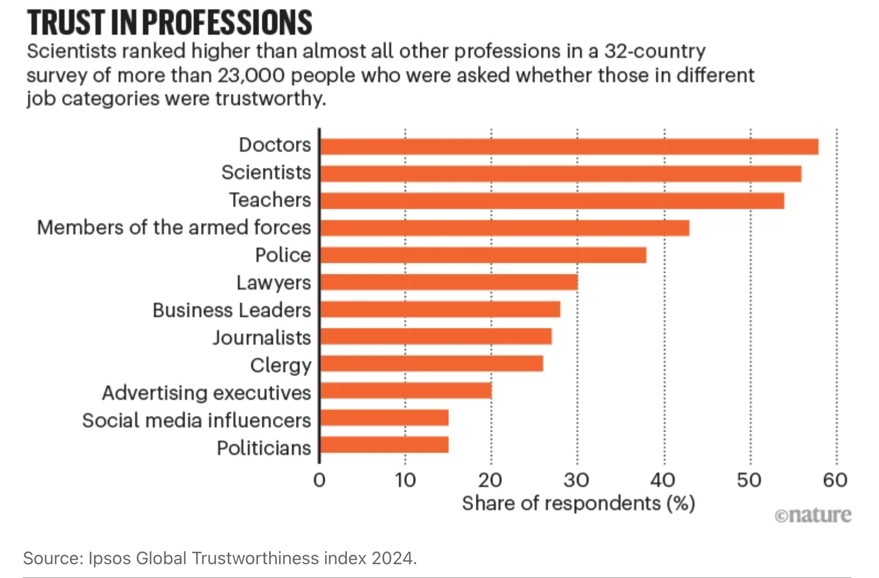
Note that scientists enjoy a large level of trust and clergy a low level.
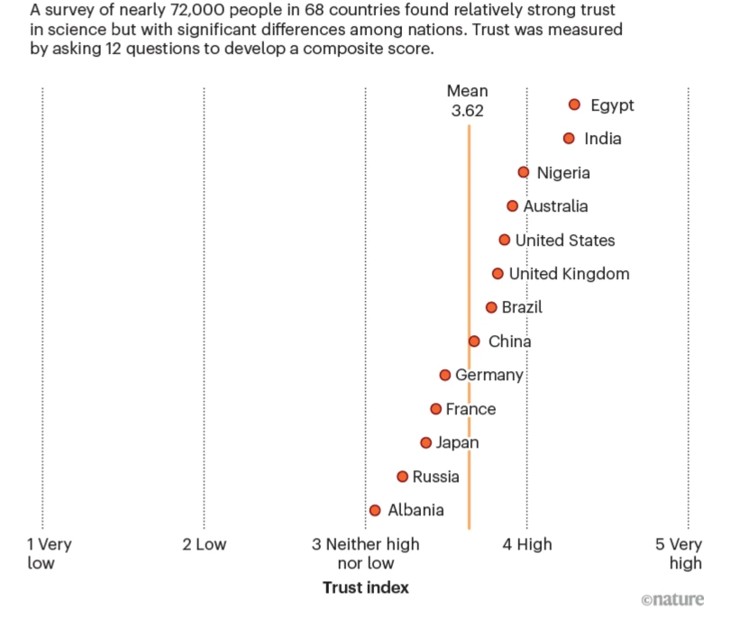
Note that trust in science varies greatly depending on the country. Reprinted from the Nature article.
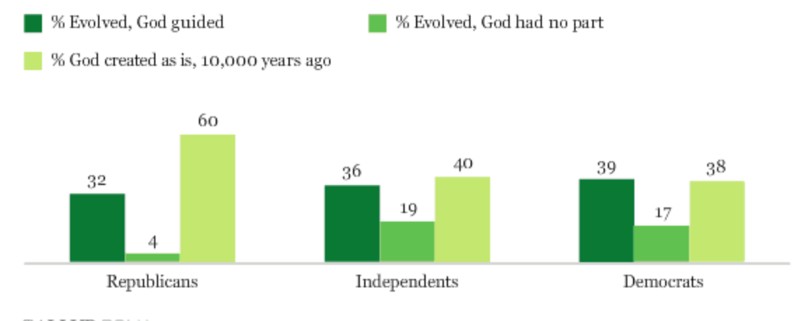
From the Pew survey. Note the strong relationship between political party and the acceptance of evolution.
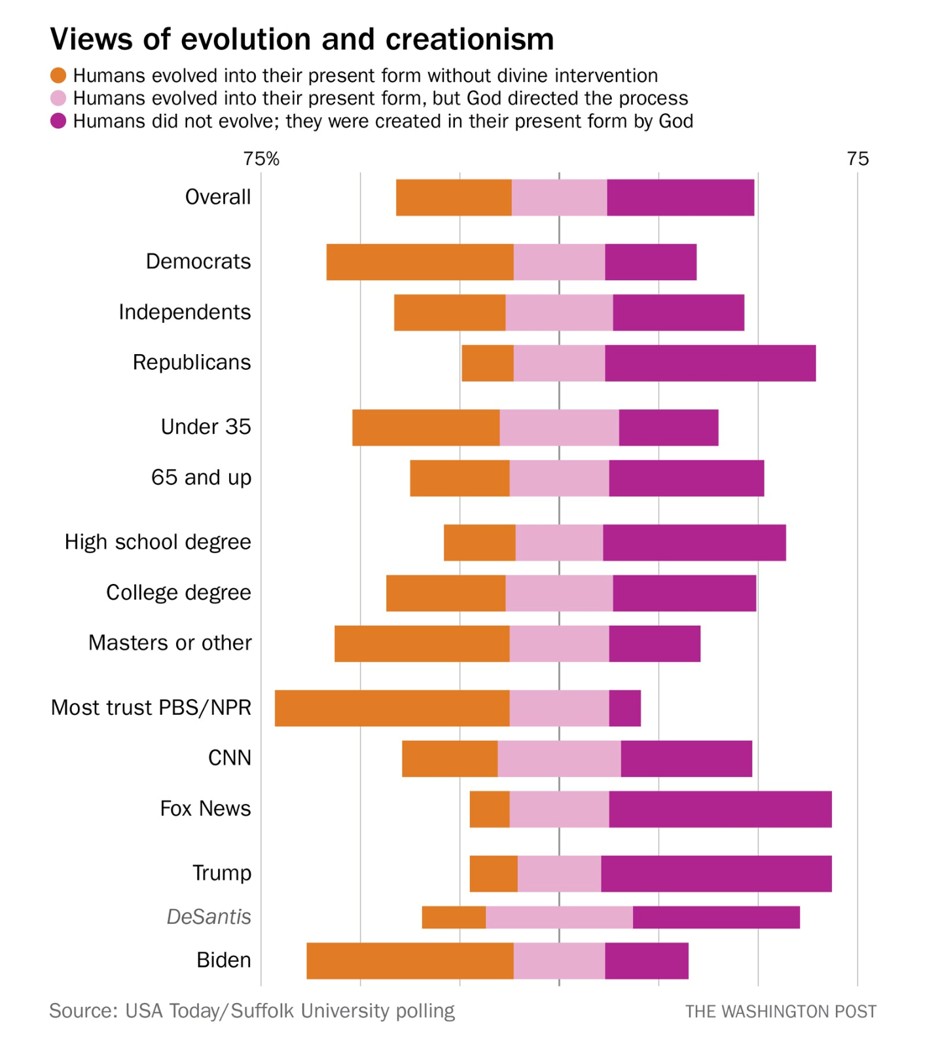
Note how one’s social group greatly influences what they believe about evolution.
References
[1] Pearson, Helen, “Have people stopped trusting science? The data tell a surprising story, Nature, 1 July 2026.
[2] Kennedy, B., and E. Kikuchi, “Do Americans think the country is losing or gaining ground in science?,” Pew Research Center, https://www.pewresearch.org/science/2026/01/15/do-americans-think-the-country-is-losing-or-gaining-ground-in-science/, 15 January 2026.
[3] Wong, Clarissa, “Largest post-pandemic survey finds trust in scientists is high. Study of more than 70,000 people suggests that trust levels vary among countries and are linked to political orientation,” https://www.nature.com/articles/d41586-026-01977-9?utm_source=Live+Audience&utm_campaign=840588bfc4-nature-briefing-daily-20260703&utm_medium=email&utm_term=0_-33f35e09ea-51315184, 24 February 2024.
[4] More in Common, “Britain talks trust in science,” Wellcome Trust. https://wellcome.org/insights/reports/britain-talks-trust-science, 17 April 2026.
[5] Kennedy, Brian, and Isabelle Pula, “Americans are increasingly pessimistic about avoiding the worst effects of climate change,” Pew Research Center, https://www.pewresearch.org/science/2026/05/28/americans-are-increasingly-pessimistic-about-avoiding-the-worst-effects-of-climate-change/, 28 May 2026.
[6] Kennedy, Brian, and Alec Tyson, “How Americans view climate change and policies to address the issue,” Pew Research Center, https://www.pewresearch.org/science/2024/12/09/how-americans-view-climate-change-and-policies-to-address-the-issue/, 9 December 2024.
 Dr. Jerry Bergman has taught biology, genetics, chemistry, biochemistry, anthropology, geology, and microbiology for over 40 years at several colleges and universities including Bowling Green State University, Medical College of Ohio where he was a research associate in experimental pathology, and The University of Toledo. He is a graduate of the Medical College of Ohio, Wayne State University in Detroit, the University of Toledo, and Bowling Green State University. He has over 1,900 publications in 14 languages and 40 books and monographs. His books and textbooks that include chapters that he authored are in over 1,800 college libraries in 27 countries. So far over 80,000 copies of the 60 books and monographs that he has authored or co-authored are in print. For more articles by Dr Bergman, see his Author Profile.