


SCT: What’s Driving Darwin’s Driverless Car?
Selective pressure is said to
be a driver of evolution.
See if that makes any sense.
This article was first published at Science & Culture Today.
What’s Driving Darwin’s Driverless Car?
by David Coppedge
Science & Culture Today, Sept 5, 2023
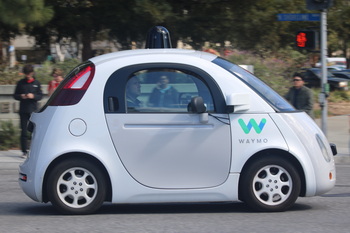
Is natural selection a driverless car? Then where is the software?
Much of the literature about Darwinian evolution uses variations on the term “driver.” Something is “driving” evolutionary change. Who is it? What is it?
- The University of Otago says “environmental change is driving rapid evolutionary shifts in New Zealand’s native species.”
- The University of Sydney says a geological cycle “drives biodiversity.”
- The origin of sex chromosomes was driven by the “recombination landscape,” says Current Biology.
- “Positive selection” could be driving the evolution of a minimal cell, says Nature. That’s like saying selection drives selection.
- PNAS says that “the neural crest was a crucial evolutionary innovation driving the origin and diversification of dermal armor” in the first vertebrates.
- Two evolutionists in Science Advances say that “the teeth of fish and marine reptiles could represent an important driver for greater shell resilience” in the fractal-like, intricate morphologies in the shells of ammonites, but admit that “the driver behind their iterative evolution has remained unanswered since the first hypotheses introduced in the early 1800s.”
Are any of these things the primary drivers of evolution? Or like a row of taxis, can Darwin take any driver available? Does Darwin get into the nearest driverless car to get where he wants to go? If so, how does he give directions?
Fuel and Ignition
Impersonal forces can drive things. Gravity drives the planets in their orbits. The sun’s energy drives the weather. Wind drives the formation of sand dunes. In evolutionary biology, though, something must drive the formation of new functional information-rich structures: eyes, wings, and brains that did not exist before. Evolutionists call these structures “innovations” or “novel structures.” What drives innovations uphill against the drag of entropy? The answer often given is: “selective pressure.”
Some authors writing in Current Biology looked for a “common selective pressure” that drove the evolution of leg-like appendages in a group of benthic-dwelling fish called sea robins. Whatever this pressure is, it seems remarkably focused on helping the fish.
Remarkably, legs appear to have evolved at least three separate times within the Scorpaenoidea superfamily, suggesting a common selective pressure may underlie this adaptation. [Emphasis added.]
Is selective pressure, then, what drives evolution? It might be, but they don’t know.
A longstanding goal in biology is to understand the origins of novel traits. Sea robins represent a particularly clear example of an organism that has specialized for an environmental niche by evolving new organs….
Sea robins are therefore ideally positioned to become a powerful comparative model for illuminating general principles that drive the evolution of biological novelty.
An evolutionist at Columbia University claims that selective pressure makes us fat. It’s a strange kind of pressure, with no units or equations….
Click here to continue reading.
 David Coppedge, B.S. Education, B.S. Physics, founded Creation-Evolution Headlines in late 2000 as a way to share science news he was encountering at NASA. It has grown into a highly-trusted source of news and commentary critical of the pro-Darwin consensus, providing analysis of breaking news of interest to creationists and evolutionists, without the Darwin spin. He has authored over 7,000 entries at CEH since its inception.