


Rewriting Evolution Textbooks Never Ends
One has to wonder how much of
the “science” firmly believed today
will have to be rewritten in the future
The Endless Rewriting of Evolution Textbooks
Now, Another Rewrite Is Needed
by Jerry Bergman, PhD
Evolution requires enormous spans of time to account for the major differences between many forms of life.
Consider, for example, the enormous difference in size between a small dog-like creature and a modern whale (see the cover of my new book). The behavioral differences are equally large between a dog and a whale. Yet despite these profound differences, evolutionary theory proposes that a small dog-like mammal is most likely one of the earliest whale ancestors in the whale’s evolutionary scenario/history/progression to modern whales.
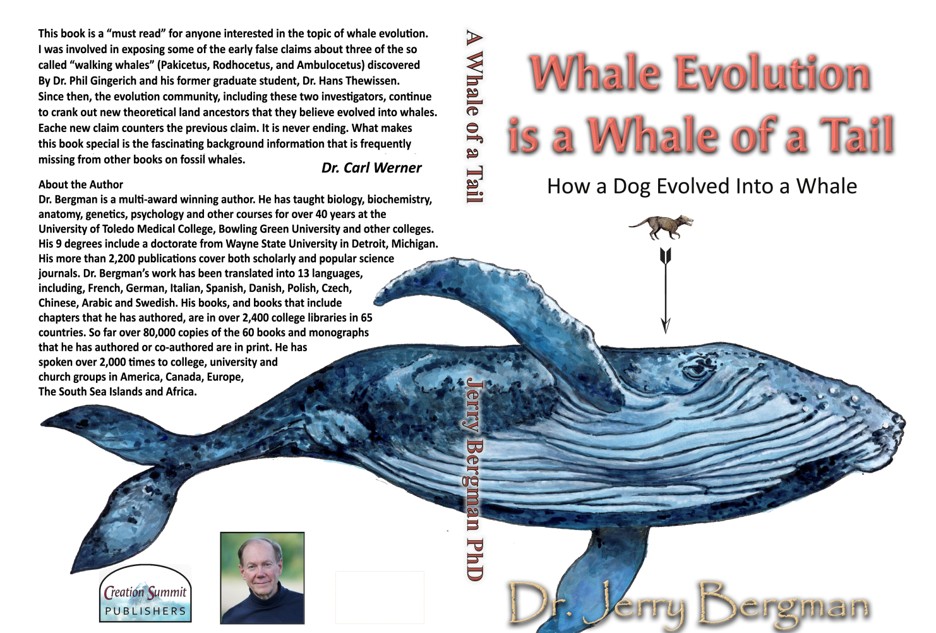
Dr Bergman’s new book. CEH is awaiting information on how to order.
Evolutionists attempt to bridge this gargantuan gap by invoking vast amounts of time. Barbara J. Stahl, Professor of Biology at Saint Anselm College, Manchester, New Hampshire, wrote that the difference between dogs and whales “is so great that the process must have begun at least as long ago as the early Paleocene and possibly even before that time at the end of the Cretaceous period.” In 1985, her explanation of why so much time is required is as follows:
As with most tetrapods secondarily modified for aquatic living, ascertaining the terrestrial stock from which the whales came is exceedingly difficult… the extent of the change involved in the transformation of a terrestrial mammal into a completely oceanic one is so great that the process must have begun at least as long ago as the early Paleocene and possibly even before that time at the end of the Cretaceous period.”[1]
Hear also: Richard Sternberg’s analysis of the changes required to evolve a whale from a four-legged land animal (interviews at Science & Culture Today, part 1, and part 2.
 Under the headline “567-million-year-old fossils rewrite the dawn of animal life,” the American Museum of Natural History announced a remarkable Canadian fossil site that, according to researchers, reveals that animals were moving, reproducing, and evolving (or developing) complex bodies up to ten million years earlier than scientists previously thought.[2]
The creationist worldview posits that the basic forms of life were all created during the Creation Week described in Genesis 1-2. In contrast, the evolutionary worldview teaches that life arose from nonliving matter/molecules, and that, through unguided natural processes, the earliest forms of life eventually gave rise to the vast diversity of extinct and living organisms found on Earth.
According to the standard evolutionary timeline, this process unfolded over billions of years, beginning with simple single-celled organisms that lacked a nucleus. Then complex cells evolved with nuclei and specialized internal structures. Single celled organisms eventually aggregated into colonies and evolved into cooperative complex organisms. Next came diversification, a few million years later, as life separated into major kingdoms, including plants, fungi, and animals.
Eventually, organisms colonized the land, moving from primeval oceans onto dry ground. According to the evolutionary timeline, the transition from single-celled organisms to (colonial or) complex multicellular life took as long as two billion years. The discovery announced by the American Museum of Natural History, however, shortened the two billion-year timeline by approximately ten million years. Even viewed in the most favorable light, that represents only 0.5 percent of two billion years, a small difference which is statistically significant.

Fossil Hall in the Smithsonian Museum of Natural History in Washington DC exalts Darwin and Deep Time everywhere.
A Find That Reportedly Cuts the Time for Motion to Evolve by Ten Million Years
The finding by the senior author Scott Evans, PhD, of the Division of Invertebrate Paleontology, American Museum of Natural History, New York, and Department of Earth, Ocean and Atmospheric Sciences, Florida State University, Tallahassee, FL, USA, was the
discovery of unambiguous fossil communities belonging to the White Sea assemblage from the paleocontinent of Laurentia in the Blueflower Formation, Mackenzie Mountains, Canada. Unlike previous localities, sedimentological and geochronological evidence support an older origin and deeper-water setting for this assemblage, including the oldest motile bilaterians.[3]
 How did the paleontologist decide to move back the origin of early life-forms called the “White Sea assemblage,” dated by evolutionists to some 567 million years ago? This pushes back their known timeline by as much as ten million years, indicating that complex animal life existed much earlier than previously determined.
This discovery includes the oldest known evidence of motile bilaterians—creatures that have a front, back, left, and right side, allowing them to move on their own. The researchers concluded that this significantly revises the traditional timeline of early animal evolution, showing that animal evolution began “far earlier than previously thought,” thereby placing the origin of these animals even closer Earth’s beginning, just as Genesis describes.[4]
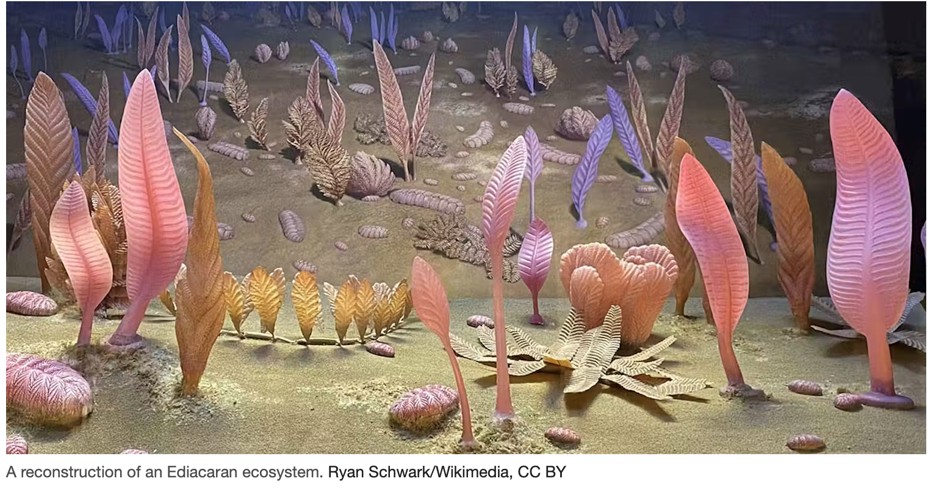
Old picture of Ediacarans: sessile, quiet, no organs, no motion.
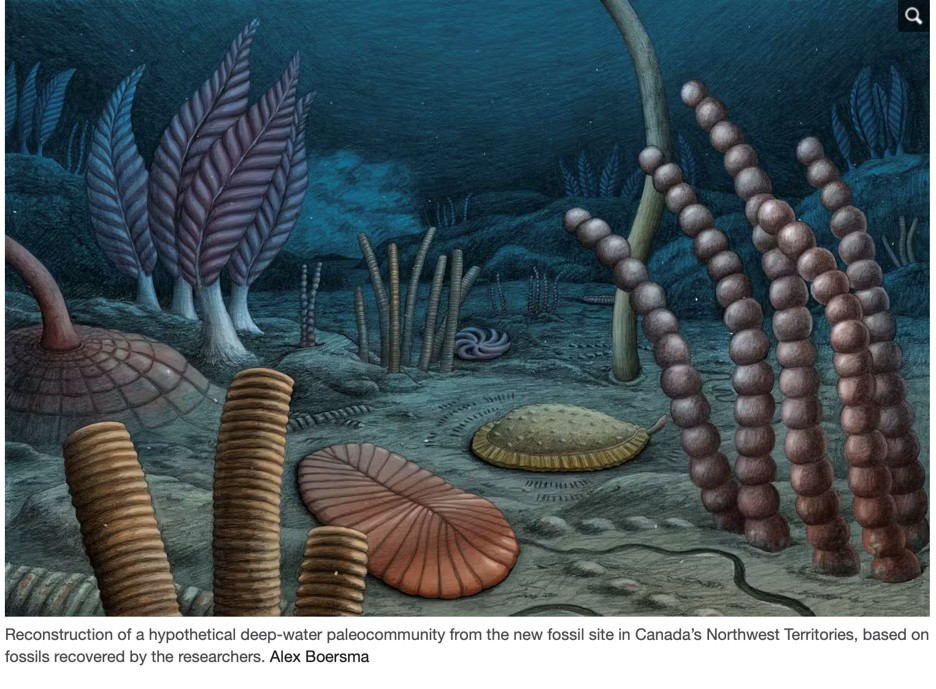
Revised Ediacaran artwork: motility 10 million years earlier than thought.
Summary
New paleontological findings have frequently forced evolutionists to rewrite the textbooks. One has to wonder how much of the “science” firmly believed today will have to be rewritten in the future. In this case, although the new story is still eons removed from the Genesis account, the findings have moved science closer to Genesis, if only slightly, at least in the right direction, showing that the existence of the animals studied occurred closer to the beginning of Creation.
References
[1] Stahl, Barbara, Vertebrate History: Problems in Evolution. Dover Publications, New York, NY, pp. 476-477, 1985.
[2] American Museum of Natural History, “567-million-year-old fossils rewrite the dawn of animal life,” ScienceDaily, www.sciencedaily.com/releases/2026/08/260804034644.htm, 5 August 2026.
[3] Evans, Scott D., Erik A. Sperling, Kimberly V. Lau, Justin V. Strauss, “Discovery of White Sea assemblage fossils from Laurentia,” Science Advances 12(21): DOI: 10.1126/sciadv.aed9916, 20 May 2026.
[4] Kirkland, Chris, “Rare 567‑million‑year‑old fossils refine our understanding of early animal evolution,” The Conversation, https://theconversation.com/rare-567-million-year-old-fossils-refine-our-understanding-of-early-animal-evolution-283260, 20 May 2026.
 Dr. Jerry Bergman has taught biology, genetics, chemistry, biochemistry, anthropology, geology, and microbiology for over 40 years at several colleges and universities including Bowling Green State University, Medical College of Ohio where he was a research associate in experimental pathology, and The University of Toledo. He is a graduate of the Medical College of Ohio, Wayne State University in Detroit, the University of Toledo, and Bowling Green State University. He has over 1,900 publications in 14 languages and 40 books and monographs. His books and textbooks that include chapters that he authored are in over 1,800 college libraries in 27 countries. So far over 80,000 copies of the 60 books and monographs that he has authored or co-authored are in print. For more articles by Dr Bergman, see his Author Profile.