


Elephants Know Medicinal Plants
African elephants may seek out
medicinal plants when sick,
revealing astounding biological
coordination and animal knowledge
How Do Elephants Know?
Medicinal Plants and the Mystery of Animal Knowledge
by Dr. Sarah Buckland-Reynolds
Some of us experienced growing up with our elders (especially grandparents) busy outdoors picking leaves and fruits to make mysterious concoctions when we fell ill with a cold or some other illnesses. While debates continue in conventional medicine circles about the effectiveness and safety of directly using natural plants for treatment, the animal kingdom reveals that much of the same ‘natural prescriptions’ happen in the wild! A recent intriguing article explored this innate knowledge of natural medicine:
 African elephants putatively self-medicate with medicinal plants in the Mount Elgon region, Kenya (Schultz et al, Nature Scientific Reports, September 24, 2026). The authors explain how generations of African elephants have been found to specifically forage through even kilometres of dense forests, bypassing countless edible plants, only to stop at a specific species of plants to mix for their young calves!
If these reports are confirmed through further research, the implications extend far beyond elephant behaviour, as they point to an astonishing convergence of botanical chemistry, animal cognition, and ecological interdependence.
This article reflects further on the implications of these observations on the origins debate and raises profound questions about the origins of biological knowledge.
Natural Medicine: An Ancient Art and Science
For centuries, people have marveled at the apparent wisdom animals display in nature. Long before the rise of modern pharmacology, humans relied heavily on remedies derived from plants, minerals, and other natural resources. Across cultures and civilizations, people learned that certain plants could ease pain, fight infections, aid digestion, reduce inflammation, or promote healing. Yet one of the enduring mysteries of natural medicine is this: How did such functionalities originate? And, how was such knowledge first discovered?
The Bible itself contains several references to medicinal substances found in nature. One of the clearest examples appears in the account of King Hezekiah. After the prophet Isaiah announced that Hezekiah would recover from a serious illness, a practical remedy was prescribed:
“Let them take a lump of figs and apply it as a poultice on the boil, and he will recover” (2 Kings 20:7, NIV).
In Hezekiah’s case, divine healing and a natural medicinal treatment worked together, complementing several other Biblical references that point to the medicinal value of natural substances. Balm from Gilead was renowned in the ancient Near East for its healing properties (Jeremiah 8:22), while olive oil was frequently used for treating wounds (Isaiah 1:6; Luke 10:34). Such examples reveal that the use of medicinal plants was deeply embedded within ancient cultures long before the emergence of formal medical science.
Yet the search for healing knowledge was not confined to humans. Ancient observers often paid careful attention to animals. In fact, there is an entire field of study called zoopharmacognosy, which refers to the study of how animals use natural substances to prevent or treat illness. Even in ancient Greece, renowned philosophers Aristotle, Pliny the Elder, and other ancient writers recorded observations of animals consuming specific plants when injured or sick.
But, even with all the ancient documentation, how exactly do we know that this is not ordinary feeding behaviour and coincidence?
The African Elephants Case Study
Schultz et al’s (2026) study, based in Mount Eglon, Kenya took an in-depth qualitative approach, interviewing experienced indigenous Sabaot elders, wildlife scouts, guides, and a retired ranger who had collectively spent decades observing elephant populations. Additionally, the researchers collected 35 physical plant samples from those identified by the participants and had them taxonomically identified, alongside four mineral or clay resources. From their research, Schultz et al mentioned the following as supporting evidence of elephants’ medicinal resource use:
“(1) Elephant uses or consumes resource in unusual way (e.g., mixing plant with breast milk); (2) Elephant resource use is associated with a specific ailments; (3) Plant is associated with specific ailment in another local animal species; (4) Elephant targets resource infrequently or seasonally; and (5) Elephant travels far distance to resource without stopping to feed on other plants, e.g., “For example [if the resource] is 20 km away, they go straight there without eating anything to get there quickly”
With these multiple strands of evidence, the authors concluded that this indicated “…a targeted rather than random foraging behavior.” This is especially the case for evidence for point five, where elephants would bypass multiple edible plants and traverse kilometres to pick specific plants. In their descriptions, the authors described how mother elephants also carefully gather parts of plants, mix them with her milk, and feed the mixture to her calf, while eight of these plant species were also classified as possible examples of targeted therapeutic behaviour, where elephants appeared to seek out specific plants when sick or administer them to their calves.
More Than Eating Plants:
Why these Observations Imply Intelligent Design
To appreciate the significance of these findings, there are many processes and requirements that must be considered before any medicinal behaviour can even occur; both on the part of the plant design and animal recognition of such.
In an evolutionary framework, why do medicinal plants exist in the first place?
Puzzle #1: Medicinal Capacity of Plants: While the photosynthetic ability of plants already presents significant questions to an evolutionary worldview, an additional parallel functionality of multiple portions of a plant contributes to immense levels of complexity.
Many plants manufacture extraordinarily complex chemical compounds with antibacterial, antifungal, antiparasitic, antiviral, anti-inflammatory, or digestive properties. These compounds are produced through intricate biochemical pathways involving enzymes, genes, regulatory networks, energy systems, and environmental signals.
The medicinal value of these plants depends upon exact molecular structures. Slight alterations in chemical composition can reduce effectiveness, eliminate usefulness, or even create toxicity. The compounds must be synthesized at appropriate concentrations, stored safely within plant tissues, withstand environmental challenges, and remain biologically active when consumed. In other words, medicinal plants require highly specific biochemical information.
In Mount Elgon, elephants reportedly utilize species such as Aloe arborescens, Bersama abyssinica, Coleus barbatus, Ficus natalensis, and several Dombeya species. Many of these already possess documented ethnomedicinal uses among local communities and have known pharmacological activity. This raises pertinent questions:
How (and why) did so many plants acquire the precise molecular machinery needed to synthesize helpful medicinal compounds in the first place?
Is it reasonable to believe that unguided evolutionary action could produce such functionality, and especially in parallel with other functions?
Puzzle #2: Animal Recognition: While these plant properties on their own pose significant challenges to evolutionary explanations, Schultz’ work highlights another component that adds further complexity to the puzzle of evolution: The elephants must somehow recognize these plants.
As the study reports observations of elephants appearing to seek particular plants under specific circumstances (sometimes traveling considerable distances to obtain them_, this suggests selective behaviour. This would imply that these elephants somehow associate a particular plant with a beneficial outcome. The animal must therefore distinguish among hundreds of available species, recognize appropriate conditions for use, remember the resource’s location, and modify its behaviour accordingly.
The study acknowledges that there are several unresolved questions, noting that “the mechanisms through which elephants acquire or transmit medicinal knowledge remain unknown.” Amidst this, the authors also interestingly describe these processes as indicating “high intelligence”. Quoting from the article, Schultz et al state:
“…. both African and Asian elephants possess high intelligence and social acuity that would enable cognitive learning and intergenerational information transfer…. Elephants are known to socially transmit behavioral and ecological information, including information on diet…. within their close-knit social units, with younger individuals learning essential survival strategies from experienced herd members… Consequently, the potential propagation of medicinal behaviors in elephants is likely influenced by an intricate interplay of physiological mechanisms, social structure, and herd dynamics.”
As well described by the authors, the observations show significant intergenerational communication mechanisms that appear to exist within the elephant community. The researchers reported multiple accounts of elephants administering medicinal resources to offspring, a behaviour that is documented elsewhere and known as allocare or allo-medication.
One especially remarkable observation in Schultz et al’s study involved elephants reportedly mixing Coleus barbatus, Ficus natalensis, and Bersama abyssinica with milk before giving the mixture to calves. Informants described this as functioning like “a kind of immunization.” If accurately interpreted, the behaviour requires chemical recognition, social knowledge, timing, parental investment, memory, and intentional transfer of health-related benefits.
How did such information communication capacity originate?
Whether knowledge is transmitted genetically, learned individually, culturally inherited, or some combination of all three, the information must first exist before it can be transmitted. These requirements challenge materialistic evolutionary explanations.
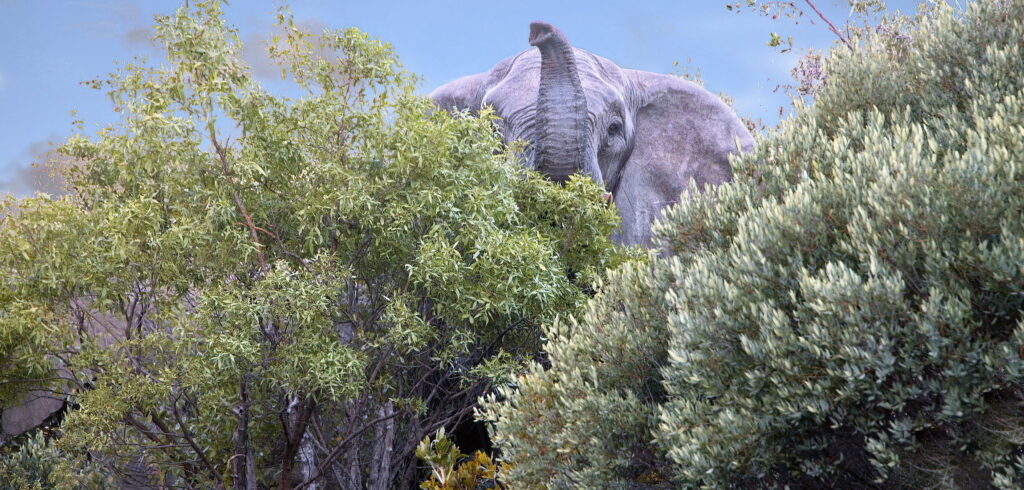
Elephants in the bush: Entabeni Nature Preserve, South Africa (DFC)
Evolutionary Explanations and Challenges
While the authors did not directly invoke evolutionary explanations, they cited two articles that gave interpretations from other examples in the animal world (ants and apes) that document similar observations. From a Darwinian perspective, medicinal behaviour is generally interpreted as an adaptive trait shaped by natural selection. Evolutionary researchers frequently invoke instinct, trial-and-error learning, cultural transmission, or combinations of these mechanisms.
Despite these attempts of explaining the origins of animal self-medicating naturally, several questions remain particularly difficult, including:
How do highly specific medicinal compounds arise before they become useful?
How do animals identify correct medicinal resources among thousands of possibilities?
How does medicinal knowledge originate before social transmission begins?
How do coordinated plant-animal relationships emerge when both sides depend on complex preexisting systems?
How do plants contain sophisticated biochemical “solutions” that frequently exceed human understanding?
If even trained scientists often require years of laboratory work to identify medicinal compounds within plants, how do animals apparently recognize which species to use, which parts to consume, when to seek them out, and in some cases how to pass that knowledge to their offspring?
Darwinian evolution typically relies upon the cumulative preservation of advantageous changes. Yet the medicinal behaviour described by Schultz et al (2026) appears to involve an intriguing integration of information-rich biological systems.
While evolutionary theory faces these challenges, from a creation science perspective, these findings are consistent with a world designed with purpose, functionality, and interdependence. A design framework predicts that organisms will exhibit abilities that contribute to flourishing within their environments. It predicts integrated biological systems rather than disconnected accidents. It predicts meaningful relationships between animals and the resources they require.
Amidst the intriguing descriptions from the study, it is also important to acknowledge that the study has limitations as the researchers relied heavily on interviews and firsthand observations rather than experimental verification. They repeatedly note the need for pharmacological testing, long-term behavioural monitoring, and further investigation. Despite these limitations, there is cumulative evidence with more rigorous testing from other species cited. For instance, chimpanzees have been observed consuming bitter plants with antiparasitic properties, orangutans have been reported applying medicinal plant extracts to wounds and birds, dolphins, insects, and many other creatures appear capable of selecting resources that benefit their health.
Wisdom Embedded in Creation
Schultz et al’s paper presents yet another example of creation as a testimony to wisdom and design. Reflecting just as Scripture itself alludes, animals can teach humans about the natural world. For instance, just as it is written in Job 12:7-8, Job:
“Ask the animals, and they will teach you, or the birds in the sky, and they will tell you.”
The observations from Mount Elgon bring these words to mind. Our created world is characterized by foresight, functionality, and purposeful relationships. From a Biblical perspective, these discoveries are consistent with a creation filled with purpose and provision. The same God who created the plants also created the animals that depend on them.
Seen through this lens, the medicinal resources embedded within nature and the apparent ability of creatures to benefit from them are not merely accidents of history but reflections of an intelligently ordered world in which living things are equipped to flourish within their environments.
 Dr. Sarah Buckland-Reynolds is a Christian, Jamaican, Environmental Science researcher, and journal associate editor. She holds the degree of Doctor of Philosophy in Geography from the University of the West Indies (UWI), Mona with high commendation, and a postgraduate specialization in Geomatics at the Universidad del Valle, Cali, Colombia. The quality of her research activity in Environmental Science has been recognized by various awards including the 2024 Editor’s Award from the American Meteorological Society for her reviewing service in the Weather, Climate and Society Journal, the 2023 L’Oreal/UNESCO Women in Science Caribbean Award, the 2023 ICETEX International Experts Exchange Award for study in Colombia. and with her PhD research in drought management also being shortlisted in the top 10 globally for the 2023 Allianz Climate Risk Award by Munich Re Insurance, Germany. Motivated by her faith in God and zeal to positively influence society, Dr. Buckland-Reynolds is also the founder and Principal Director of Chosen to G.L.O.W. Ministries, a Jamaican charitable organization which seeks to amplify the Christian voice in the public sphere and equip more youths to know how to defend their faith.