


Why Most Evolution Papers Are False
When stripped of imaginative reconstructions,
what remains is not rigorous empirical science,
but idle theoretical speculation
Why Most Papers on Evolution Are False
With Examples
by Jerry Bergman, PhD
A new review of medical research by John Ioannidis, Professor of Medicine at Stanford University, claims that 94 percent of contemporary medical treatments lack solid evidence of clear health benefits.[1] One reason is that most published research findings are, to some degree, false; thus, most medical findings based on these papers are likely unreliable. Ioannidis says,
For example, there are very strong conflicts of interest. There is research that is run with a specific ideology in mind. There is very poor use of statistical methods and questionable research practices that lead to “significant” results that are not really significant. There is a lot of uncontrolled bias. There are poor study designs. There is fragmentation of research in small studies that are meaningless, where if they do get some signal, it’s very likely that it will be false.
A similar problem undermines evolutionary biology. In both fields, basic methodological errors and vested interests heavily compromise research outcomes.[2]
Vested interests that effect a research conclusion include securing tenure, obtaining promotions, obtaining grants, and enjoying the prestige that comes with publishing new significant findings. Medical researchers must believe that the treatment or drug they are evaluating has a viable chance of success in treating a medical condition. Otherwise, they would not invest the time, effort, and funding required to do the research. When applying for grants, researchers must present arguments persuasive enough to convince expert review panels that their project—often requiring millions of dollars—warrants the money investment.
Another problem/major issue is fraud, which is accelerating with the rise of artificial intelligence. A large number of papers are generated by AI—entirely fabricated, fraudulent, and fake, yet sounding thoroughly professional and grounded in research. A recent well-documented study found that scientific fraud is expanding at a much faster pace than the scientific enterprise itself.[3]
Likewise, to publish in a scientific journal, researchers must at least imply acceptance of evolution. At the minimum, they cannot indicate any skepticism toward an atheistic evolutionary worldview. I have documented numerous cases where, after a peer-reviewed article was published, the author was revealed not to be a committed Darwinist, prompting the journal to withdraw and scrub the paper from its website. Prominent examples of peer-reviewed scientific papers that were retracted or disavowed after being found to question evolution and to promote, imply, or lean toward creationism or intelligent design, include the following six well-documented examples:
- The “Creator” Hand Paper (2016): A study titled “Biomechanical characteristics of hand coordination in grasping activities of daily living” was published in the journal PLOS One. The paper sparked immediate outrage when readers noticed that the authors attributed the functional architecture of the human hand to “design by the Creator.” Following an intense backlash from the scientific community over the inclusion of what critics labeled “pseudoscientific creationist concepts,” PLOS One formally retracted the paper. The hostility toward any hint of the existence of a Creator God was so strong that, as The Independent reported, “The paper’s perceived references to intelligent design have provoked anger and calls for a boycott of the journal.”[4] Only dogmatic naturalism is permitted in mainstream “science”/scientific journals.
- The Mitochondria “Body and Soul” Paper (2008): The journal Proteomics published an article online titled “Mitochondria, the missing link between body and soul: Proteomic perspective evidence.“ The paper explicitly rejected the endosymbiotic theory—long held as a foundational premise of modern evolutionary biology. The paper argued that endosymbiotic theory lacks a solid empirical foundation and asserted instead that mitochondria are the work of a “mighty creator. Once science bloggers became aware of the controversy, they aggressively pushed the view that criticism against endosymbiotic theory is irresponsible because the evidence in favor of the theory is overwhelming, the journal moved quickly to retract the piece.[5] In fact, the evidence against endosymbiosis is overwhelming.[6] Within mainstream scientific publishing, openly questioning evolutionary origins or suggesting an intelligent creator remains strictly forbidden even if the evidence against it is overwhelming.
- The International Journal of Anthropology and Ethnology Case (2019): A paper by Sarah Umer, a researcher at the Lahore College for Women University in Pakistan titled “A brief history of human evolution: challenging Darwin’s claim,” which argued that Homo sapiens appeared “suddenly and fully formed” aligning with instant-appearance creation models) was published by the Springer Nature journal International Journal of Anthropology and Ethnology. The paper argued against Charles Darwin’s theory of gradual human evolution. It pointed out that the fossil record lacks any viable transitional forms and that, referring to numerous published research papers, modern human consciousness, language, and culture must have emerged suddenly. Thus, humans must have appeared on Earth fully developed rather than evolving from a lesser species. Following the aggressive immediate public pushback by evolutionary biologists, the editor-in-chief retracted the paper, claiming it had been “published in error” after post-publication peer review concluded the manuscript was unsuitable for the journal.[7]
- Another example: All six papers I submitted were originally accepted by the peer-reviewed journal then edited by Giuseppe Sermonti (1925–2018). Sermonti directed and shaped the publication for nearly three decades (from 1979 through the late 2000s). While not a creationist, he was widely known for his rigorous scientific critique of the standard modern evolutionary theory of evolutionary synthesis (Neo-Darwinism), advocating instead for a paradigm shift that moved away from pure natural selection toward an organic form of evolution, and morphological transformationism.
Following Professor Sermonti’s death, a new editor took charge. As an orthodox Darwinist, he summarily rejected every subsequent paper I submitted without offering a single substantive review or rationale. Both he and I understood why: the tenets of Darwinian evolution were beyond question. Tellingly, in 2012—reportedly in response to its willingness to publish heterodox and creation-friendly perspectives—the journal discarded its historic title, Rivista di Biologia / Biology Forum, rebranding as Theoretical Biology Forum.
My six articles accepted and published during Sermonti’s editorship (all of my submissions) are as follows:
- “The History of the Human Female Inferiority Ideas in Evolutionary Biology,” Rivista di Biologia/Biology Forum 95(2):379-412, September-December 2002.
- “A History of the Piltdown Hoax,” Rivista di Biologia/Biology Forum 96(3):457-484, January-February 2003.
- “Darwinian Criminality Theory: A Tragic Chapter in History,” Rivista di Biologia/Biology Forum 98(1):47-70.January-April 2005.
- “Ancon Sheep: A Now Disproven Example of Microevolution,” Rivista di Biologia/Biology Forum 98(3):435-448, September-December 2005.
- “The History of Hesperopithecus: The Human-Ape Link that Turned Out to be a Pig,” Rivista di Biologia/Biology Forum 99(2):205-224, May-August 2006.
- “Pangenesis as a Source of New Genetic Information: The History of a Now Disproven Theory.” Rivista di Biologia/Biology Forum 99(3):425-444, September-December 2006.
Following the appointment of the new editor, however, every subsequent manuscript I submitted was rejected without explanation:
- “Darwin’s Ape-Men Theory and the Exploitation of Deformed Humans.”
- “Does Virus Resistance Provide Evidence for Darwinism?”
- “The Galileo Myth and the Facts of History.”
- “Intelligent Design and Evaluating SETI Data.”
- “Human Embryonic Gills and Gill Slits.”
- “Why the Miller-Urey Research Argues Against Abiogenesis.”
In academia, securing tenure, promotion, and prestige demands unwavering adherence to the premise that evolutionary processes account not only for the variety of biological life on Earth, but also for the origin of the planet itself, the Solar System, and the entire physical universe.
I am currently working on a study evaluating the evidence for evolution presented in high school textbooks published between roughly 1900 and 1940. During that era, the primary evidence marshaled in support of human descent came from the fossil record—specifically Piltdown Man, Java Man (Pithecanthropus), Heidelberg Man, and Neanderthals. For example, in her 1939 textbook Exploring Biology (New York: Harcourt, Brace and Company), Ella Thea Smith noted:]
“What species gave rise to modern man has not yet been proved. But all biologists agree that man, like other animals, arose not suddenly in his modern form, but by a gradual series of changes in some pre-existing primitive species, changes that have been going on through a period of from one to two million years” (pp. 528-529).
Evidence marshaled to support human evolution centered on four primary discoveries: Piltdown Man (later exposed as an outright forgery), Java Man (pieced together from a skull cap fragment and a human leg bone fragment found meters apart), Heidelberg Man (Homo heidelbergensis), and especially Neanderthals. Long promoted as the premier evolutionary link—depicted as stooped, ape-like ancestors bridging the gap to modern humans—Neanderthals are now widely recognized by paleoanthropologists to have been fully human.
When Beliefs Trump Science
A frequent device used to promote evolutionary theory is arranging an ordered sequence of fossils to suggest that a dog-like land mammal, such as a mesonychid, evolved into a multi-ton modern whale. As seen in this illustration, fossils are lined up sequentially in accordance with the evolutionary assertion that each creature represents an ancestor of the next in the progression toward modern cetaceans. In short, the claim is that one distinct body plan directly transformed into an entirely different one.
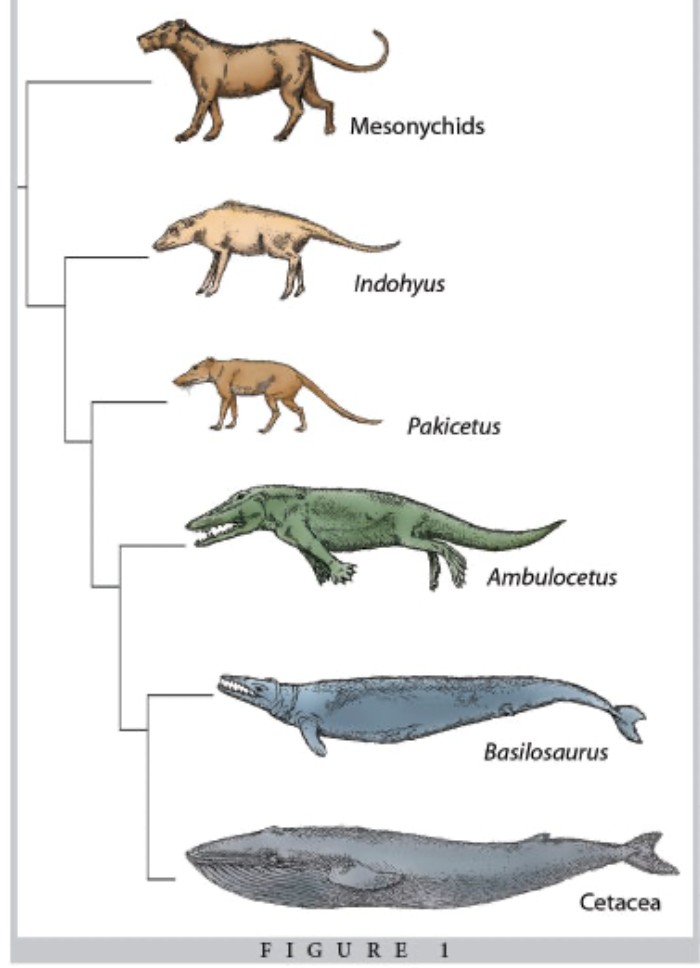
Supposed whale phylogenetic tree (Wikimedia Commons)
In reality, paleontology cannot demonstrate that any of these fossil specimens left viable offspring, let alone that one transitioned directly into the next animal in the chart. Arranging isolated fossils into an apparent lineage is not empirical demonstration, but speculative reconstruction guided by prior evolutionary assumptions. Tellingly, various textbooks and museums present competing whale evolution sequences featuring disparate sets of transitional candidates—underscoring the lack of consensus even within the evolutionary community.
A similar flaw underlies the historical claim that Piltdown Man evolved into Neanderthals. Today, it is undisputed that human phylogeny never involved Piltdown Man transitioning into Neanderthals—or into any other putative hominin branch—despite what was once dogmatically asserted and accepted by the evolutionary establishment. In the same way, no empirical evidence demonstrates that an ancient land mammal evolved into a whale. In both cases, the common denominator is clear: when stripped of imaginative reconstructions, what remains is not rigorous empirical science, but idle theoretical speculation.
References
[1] Ioannidis, John P.A., “Why most published research findings are still false. John Ioannidis claims that 94 percent of contemporary medical treatments lack solid evidence of benefits,” https://iai.tv/articles/john-ioannidis-ai-is-generating-false-fraudulent-and-fake-medical-research-auid-3703, 14 October 2026.
Now available! Dr Bergman’s new book on whale evolution.
[2] Howick, Jeremy, et al., “Most healthcare interventions tested in Cochrane Reviews are not effective according to high-quality evidence: A systematic review and meta-analysis,” Journal of Clinical Epidemiology 148:160-169, August 2022.
[3] Tichardson, Reese, et al., “The entities enabling scientific fraud at scale are large, resilient, and growing rapidly,” PNAS122(32), https://www.pnas.org/doi/10.1073/pnas.2420092122, 4 August 2025.
[4] Bolton, Doug, “Scientific paper which says the human hand was designed by a ‘Creator’ sparks controversy. Independent, 4 March 2016.
[5] “Creationism Slips Into a Peer-Reviewed Journal,” Reports of the National Center for Science Education 28(3), May-June 2008.
[6] See Bergman, Jerry, “Research has overturned endosymbiosis: The unbridgeable gap between prokaryotes and eukaryotes remains,” Journal of Creation 35(1):38-47, 4 June 2022.
[7] Oransky, Ivan, “Journal retracts creationist paper ‘because it was published in error’,” Retraction Watch, https://retractionwatch.com/2019/03/05/journal-retracts-creationist-paper-because-it-was-published-in-error/, 5 March 2019.
 Dr. Jerry Bergman has taught biology, genetics, chemistry, biochemistry, anthropology, geology, and microbiology for over 40 years at several colleges and universities including Bowling Green State University, Medical College of Ohio where he was a research associate in experimental pathology, and The University of Toledo. He is a graduate of the Medical College of Ohio, Wayne State University in Detroit, the University of Toledo, and Bowling Green State University. He has over 1,900 publications in 14 languages and 40 books and monographs. His books and textbooks that include chapters that he authored are in over 1,800 college libraries in 27 countries. So far over 80,000 copies of the 60 books and monographs that he has authored or co-authored are in print. For more articles by Dr Bergman, see his Author Profile.