


Cultural Evolution Is Imaginary Science
Scientific explanations should be evaluated on
the strength of their evidence, not simply because
they have become conventional scientific beliefs
Belief, Not Facts, Dominate in Acceptance of Evolution
Humans evolved through culture more than biology
University of Sussex School of Life Sciences professor Jonathan Loh, author of Life Story: From Cells to Civilizations and Beyond,[1] in the paper reviewed below attempts to explain how Homo sapiens came to dominate the Earth.[2]
His central thesis is that human life on Earth has evolved not once, but twice. The first evolution, he writes, was biological, beginning with single-celled organisms and eventually producing the astonishing diversity of life we see in the natural world today. The second evolution was cultural, taking humanity from simple hunter-gatherer societies to global civilizations.
According to Loh, the first evolution was not driven by intelligence, but rather by mutations, time, natural selection, and chance. The second, cultural evolution, was driven by human intelligence. The following is a summary of his theory, which will be examined and critiqued below. After stating that “Our biology is central to our survival. This is the evolutionary story and one we take to apply to all living beings equally,” Loh goes on to acknowledge that “humans are special in a fundamental way.”
Loh’s Radical New Idea
He then proposes what he calls a radical new idea: “the transmission of cultural characteristics is more important for human survival than biological ones. We pass down our cultural traits using language, which allows us to transcend our ancestry and reach beyond our tribe.”[3]
When we compare life in 2000 BC with life in our modern world of 2026, it is obvious that culture has played an enormous role in the development of human societies. No informed person would argue that the dramatic cultural changes of these past 4,000 years were accompanied by comparable changes in human life. Loh makes a compelling case for the importance of culture.
However, when explaining the extraordinary success of Homo sapiens, he points to a biological explanation. Consider his observation: “By any measure, Homo sapiens is an exceptional species. The world’s 8.3 billion humans collectively weigh around 400 million tons, while all wild mammals combined make up only about 60 million tons.” What, then, accounts for this extraordinary success?
Loh: Humans Are Animals Evolving Biologically
Loh turns to biological evolution for the explanation. He writes: “Something quite extraordinary happened early in the evolutionary history of humans. Our ancestors three million years ago were apes, not much bigger than chimpanzees or bonobos—our closest living relatives—and at least as intelligent” as our closest living ancestor. Loh adds,
“And then, sometime between 3 and 2 million years ago, the earliest humans—hominins of the genus Homo—underwent the most significant evolutionary transition of any species since the origin of life on Earth.”[4]
What evidence establishes that this remarkable evolutionary transition since the origin of life? And how do we know that the proposed transition occurred through the mechanisms described by evolutionary theory, namely mutations, natural selection and eons of time? The fact is we don’t.
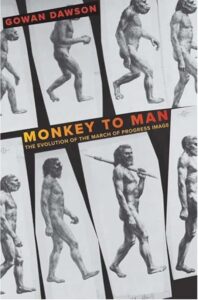
In his 2024 book, Professor Gowan Dawson documents the fraud in each example used in the iconic evolutionary illustration called “The Progression”, which purported to show the ape-to-human evolutionary transition.
Background: The familiar popular image of an orderly progression from ape to human gave the impression that human evolution was a straightforward, well-established sequence from ape to men. The actual history of how this image developed and how it has influenced public understanding of human origins, was examined in considerable detail by Professor Gowan Dawson in his book Monkey to Man: The Evolution of the March of Progress Image, published by Yale University Press in 2024. It was endorsed by several of the most eminent paleontologists of today, including Ian Tattersall.
Demolishing the progression as Dawson did, has destroyed the links from ape to man, resulting in several extinct ape families and man separated by large gaps once filled in by the progression. Gone is the evidence for the evolution of man from some hypothetical progression linking him some hypothetical common ancestor. Enter the fact that mankind stands alone, created separately from the lower animals.
Loh’s Explanation of Biological Evolution Before the Emergence of Cultural Evolution
Loh describes the evolutionary process that supposedly produced the biological diversity of life before human cultural evolution began as follows:
“ … evolution had produced species that were adapted to survive and reproduce in their environment through the action of natural selection. Natural selection operates on variations between individuals within a population that can be inherited by genetic (and epigenetic) mechanisms—the fittest pass on to their offspring those traits that helped them survive and reproduce successfully; those that don’t survive, don’t. And evolution continues to operate that way in the natural world.”[5]
He further explains, “The source of genetic variation within a population is random copying errors—mutations. Most mutations are mistakes—natural selection gets rid of them—but a rare few turn out to be beneficial.”5 The important question is: Just how much biological innovation can be attributed to mutations and natural selection? Bacteria are an excellent model for studying the evolution of higher organisms due to their rapid replication rate, ease of laboratory analysis, and the wide diversity of laboratory-generated mutants that they produce.[6]
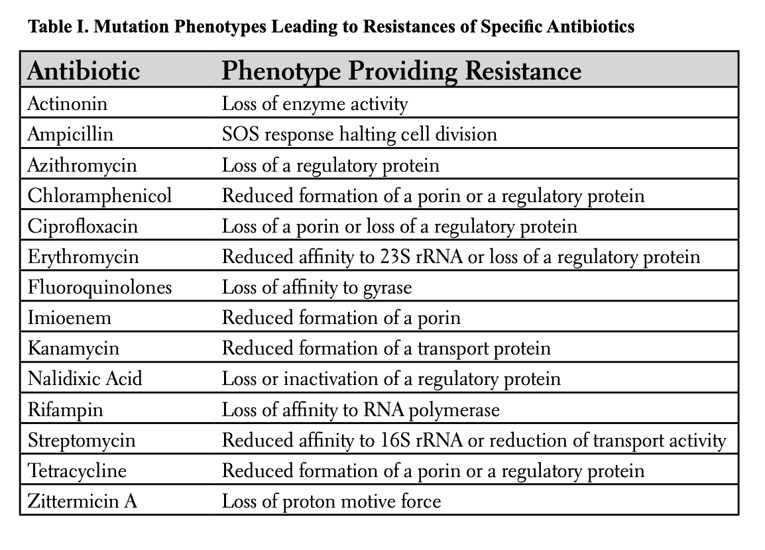
Acquiring resistance to a specific antibiotic results in a clear benefit to the bacterium when exposed to certain antibiotics. Thus, the acquisition of antibiotic resistance is commonly cited as an example of “evolutionary change” and has become a popular example of the so-called “evolution in a Petri dish.” See the accompanying chart by Kevin Anderson. An important question remains: Does demonstrating that bacteria can acquire antibiotic resistance also demonstrate how random mutations and natural selection produced the enormous biological diversity and complexity of life?
From Anderson, Kevin. “Is bacterial resistance to antibiotics an appropriate
example of evolutionary change?,” CRSQ 41(4): 318-326, March 2005.
Such changes can provide a genuine selective advantage under antibiotic pressure, but they do not represent the creation of new biological systems or functions. Consequently, demonstrating antibiotic resistance through mutation does not, by itself, establish that the same mechanisms can account for the origin of the biological complexity found in living organisms.
Furthermore, antibiotic resistance mutations can result in a reduction in relative fitness, sometimes a substantial one. In a few cases, this disadvantage can be reduced through subsequent compensatory mutations or genetic reversion. Thus, the survival advantage gained under antibiotic pressure may come with a corresponding biological cost when that pressure is removed.
Although rare, Anderson shows that beneficial mutations do occur, but any survival advantages provided are achieved by reducing or eliminating existing cellular functions rather than creating new genetic systems. Certain mutations, for example, can make bacteria resistant to specific antibiotics, providing a survival advantage in environments where those antibiotics are present.
The problem for evolution is that these mutations do not add information to the genome, but rather the opposite. As illustrated in Anderson’s chart, many of these mutations involve diminishing or disrupting pre-existing cellular functions, including transport proteins, porins, enzyme activities, protein-binding properties, and regulatory systems.[7] Anderson argues that these losses do not demonstrate the type of constructive genetic changes necessary to explain the origin of new biological systems through common descent with modification.
Such mutations may provide a selective advantage under particular environmental conditions, but they can also carry a biological cost through the loss or impairment of existing cellular functions. It is important to distinguish between a mutation that helps an organism survive under a particular environmental pressure and a mutation that contributes to the development of new biological capabilities. Demonstrating the former does not establish the latter.
Loh continues, describing the evolutionary process that supposedly produced the biological diversity of life before human cultural evolution began, writing evolution
produced species that were adapted to survive and reproduce in their environment through the action of natural selection. Natural selection operates on variations between individuals within a population that can be inherited by genetic (and epigenetic) mechanisms—the fittest pass on to their offspring those traits that helped them survive and reproduce successfully; those that don’t survive, don’t. And evolution continues to operate that way in the natural world.”[8]
He further explains: “The source of genetic variation within a population is random copying errors—mutations. Most mutations are mistakes—natural selection gets rid of them—but a rare few turn out to be beneficial.”[9]
The important question is: Just how much biological innovation can actually be attributed to mutations and natural selection? Because of their rapid replication rate, ease of laboratory analysis, and wide diversity of laboratory-generated mutants, bacteria are an excellent model for studying evolution.[10]
Yet demonstrating that bacteria can survive antibiotic exposure does not explain how random mutations and natural selection produced the enormous biological complexity of life. Although rare beneficial mutations do occur, they typically confer resistance by reducing or eliminating existing cellular functions rather than creating new genetic systems.[11] Anderson argues that such losses do not represent the type of constructive genetic changes needed to generate new biological systems through common descent with modification.
Furthermore, antibiotic-resistance mutations often impose a substantial reduction in relative fitness once the antibiotic is removed—a disadvantage that can sometimes be mitigated only through subsequent compensatory mutations or genetic reversion. Ultimately, we must distinguish between a mutation that helps an organism survive a specific environmental pressure and one that builds new biological capabilities. Demonstrating the former does not establish the latter.
Cultural Evolution Does Not Necessarily Demonstrate Biological Evolution
Evolutionary theory attributes biological change to mechanisms such as mutation, genetic recombination, and natural selection. However, natural selection itself does not generate new genetic information or biological structures. Rather, it acts upon existing genetic variations, favoring those mutations that provide a reproductive advantage under particular environmental conditions. Natural selection, on the other hand, simply serves as a quality control mechanism, eliminating less healthy life-forms. Loh then turns his attention to cultural evolution and explains:
Culture isn’t just art, music, and literature; it’s much more than that. Ways of dressing, cooking, speaking, religious beliefs, games, ceremonies, and customs are all elements of culture. Cultures are made up of traditions. These include any kind of behavior, practice, technology, knowledge, or belief that’s not innate, but learned from others. They’re transmitted socially, not genetically. Some socially learnt behaviors are copied for a while, then forgotten, but others persist. A set of traditions transmitted from generation to generation within a social group constitutes a culture.[12]
Cultural evolution provides an interesting example of how societies can undergo enormous changes without requiring corresponding biological changes. Consider the encounters between European colonists and African populations during the nineteenth century. The Europeans brought technologies, agricultural practices, educational systems, and other cultural traditions that were far more advanced than those of many African societies. African populations adopted, adapted, and incorporated many of these technologies and practices, sometimes quite rapidly. Yet this cultural assimilation did not require the African populations to undergo corresponding biological changes. They were not biologically less evolved before adopting European technologies and customs.
This illustrates an important distinction: cultural development can be transmitted through learning and social interaction rather than through genetic inheritance. Loh makes a case for cultural evolution, which is readily observable and well-documented, but he provides no evidence how cultural evolution could cause biological evolution. The ability of human societies to acquire, develop, and transmit increasingly sophisticated knowledge and technology does not, in itself, explain how biological evolution supposedly produced the human capacities that make such cultural development possible.
Neanderthals: Biologically Similar, Culturally Different
Research into Neanderthals is now revealing that these ancient human relatives were biologically much more similar to modern humans than popular portrayals have often suggested. Despite differences in their physical characteristics and material culture, they shared many fundamental biological features with us.
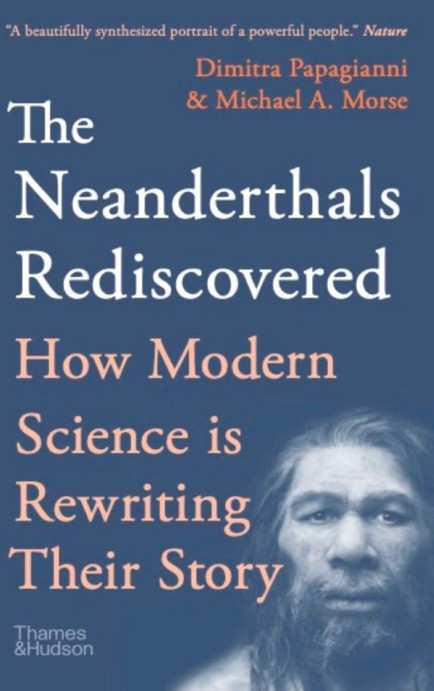 Professors Rebecca Wragg Sykes and Silvana Condemi, and others, have contributed to changing our understanding of Neanderthals. In their book The Neanderthals Rediscovered: How Modern Science Is Rewriting Their Story, Dimitra Papagianni and Michael A. Morse examine the growing evidence that challenges traditional assumptions about less developed Neanderthal capabilities and behavior.
Summary
Loh’s argument concerning the two forms of human evolution—biological and cultural—rests on the assumption that orthodox biological evolution explains the origin and development of life. He contrasts this assumed biological history with cultural evolution, which is readily observable and well-documented. The central problem of Loh’s argument is demonstrating cultural evolution does not establish the validity of biological evolution. The two involve different processes, and evidence for one cannot be used as evidence for the other.
Loh’s central observation that culture evolves is compelling. Human societies continually develop new technologies, knowledge, customs, and practices, then passing them from one generation to another through learning rather than genetic inheritance.
Had Loh concentrated on this observable process and its importance in explaining the development of human civilizations, his argument would have been considerably more persuasive. Instead, he uses the well-documented reality of cultural evolution alongside a biological evolutionary history whose proposed mechanisms and historical interpretations deserve critical examination.
Ultimately, we should distinguish between what we can observe, what we infer from the evidence, and what we assume about events in the distant past. Scientific explanations should be evaluated on the strength of their evidence, not simply because they have become conventional scientific beliefs.
References
[1] Loh, Jonathan. Life Story: From Cells to Civilizations and Beyond. New York, NY: Vintage Press, 2026.
[2] Loh, Jonathan. “Humans evolved through culture more than biology,” IAI (The Institute of Arts and Ideas) News, https://iai.tv/articles/humans-evolved-through-culture-more-than-biology-auid-3722, 9 November 2026.
[3] Loh, IAI News, 2026.
[4] Loh, IAI News, 2026.
[5] Loh, IAI News, 2026.
[6] Mortlock, R.P. Microorganisms as Model Systems for Studying Evolution. Plenum Press, New York, NY, 1984.
[7] Anderson, Kevin. “Is bacterial resistance to antibiotics an appropriate example of evolutionary change?,” CRSQ 41(4): 318-326, March 2005.
[8] Loh, IAI News, 2026.
[9] Loh, IAI News, 2026.
[10] Anderson, 2005.
[11] Anderson, 2005.
[12] Loh, IAI News, 2026.
 Dr. Jerry Bergman has taught biology, genetics, chemistry, biochemistry, anthropology, geology, and microbiology for over 40 years at several colleges and universities including Bowling Green State University, Medical College of Ohio where he was a research associate in experimental pathology, and The University of Toledo. He is a graduate of the Medical College of Ohio, Wayne State University in Detroit, the University of Toledo, and Bowling Green State University. He has over 1,900 publications in 14 languages and 40 books and monographs. His books and textbooks that include chapters that he authored are in over 1,800 college libraries in 27 countries. So far over 80,000 copies of the 60 books and monographs that he has authored or co-authored are in print. For more articles by Dr Bergman, see his Author Profile.