



More Dinosaur Blood Evidence Revealed
Will the confirmation of intact
red blood cells in dinosaur bone
lead deep time advocates to repent?
No more explaining it away. It’s real. Heme from dinosaur blood found preserved in bone. It hasn’t decayed.
 Dinosaur red blood cells recovered from 115-million-year-old fossil (New Scientist, 2 Nov 2026). “A bit of leg bone from an Aratasaurus dinosaur fossil collected in Brazil has preserved abundant 3D red blood cells in stunning detail,” writes reporter James Woodford, his artwork of the dinosaur adorned with a coat of imaginary feathers.
Woodford acknowledges that these blood cells are not the first to be found in dinosaur bones. He refers to Mary Schweitzer’s discovery in 2005, and other published examples.
A nondescript 115-million-year-old fragment of leg bone has yielded spectacularly preserved red blood cells, which may be the earliest ever found in dinosaurs.
Red blood cells have previously been found in dinosaur remains, including 75-million-year-old bone fragments collected in Canada in 2015 and the femur of a Tyrannosaurus rex that died 68 million years ago, found in Montana in 2005.
He never questions the millions-of-years claims. But do the math and think: 115 million years is 47 million more Darwin Years than Schweitzer’s dinosaur. If 68 million years was shocking to the paleontologists interviewed on 60 Minutes, eliciting a famous gasp from Lesley Stahl, and an exclamation that this is impossible, how much more unbelievable to find “spectacularly preserved red blood cells” that are 70% older on the evolutionary timeline? Moreover, the bone was discovered in 2008 and was only studied now after sitting in museum storage for 18 years.
Kliti Grice from Curtin University got emotional about what her team found:
Grice cut thin sections of bone, mounted them onto glass slides and used hydrochloric acid to remove surrounding rock – and she was shocked at what she saw.
“I was jumping up and down,” says Grice. “I ran up to my head of school’s office and was so excited that he gave me a whisky to calm me down. No one has ever seen dinosaur red blood cells in high resolution before.”
This was not just rock, soft tissue that had become entirely mineralized. They detected molecular evidence of heme-B, a constituent of blood. The team also ruled out contamination. The evidence was published in PNAS, a leading mainstream science journal. Like Nature, this publication establishes the presence of original molecules from dinosaurs that cannot be denied after years of hypotheses put forth to explain away its survival over geological time.
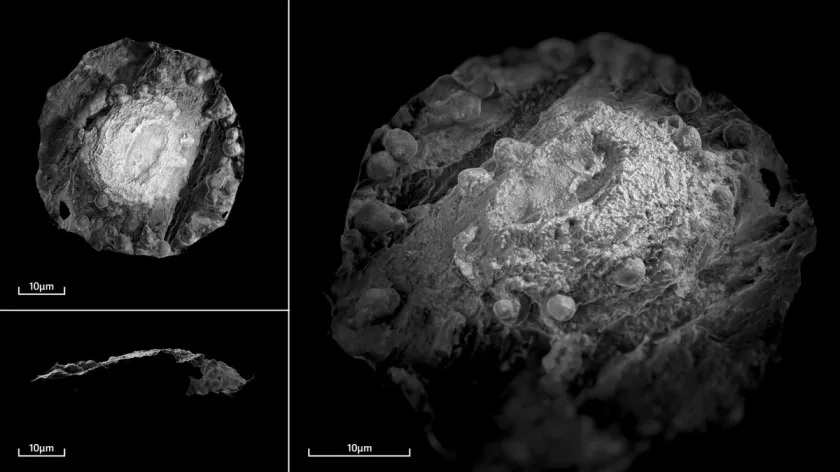
Microscopic images of structures resembling red blood cells from the fossilised limb bone of Aratasaurus museunacionali.
Credit: Curtin University.
 Heme signatures in mineralized red blood cells within vascular canals of a 115-million-year-old dinosaur bone (Grice et al., PNAS, 2 Nov 2026). The structure of the canals and cells was mineralized, but the presence of original biomolecules in the bone is confirmed in the opening statement of Significance:
This research is significant because it provides strong evidence that original biological molecules can survive in dinosaur fossils, challenging the long-held assumption that such compounds degrade over millions of years. Crucially, it reports heme signatures localized within structures that are interpreted as fossilized red blood cells, strengthening the link between chemistry and preserved microanatomy. By identifying heme-derived molecules—key components of blood—and confirming their spatial association, the study reduces the likelihood of contamination. For scientists outside this field, it expands the potential of fossils beyond morphology, opening alternative ways to investigate ancient physiology, oxygen transport, and evolutionary biology through molecular evidence once thought unrecoverable.
The team found well-preserved fossilized structures like Haversian canals, osteocytes, blood vessels, and spherical structures interpreted as red blood cells (RBCs) that contained the remnant constituents of hemoglobin molecules. Their evidence fit the four criteria for establishing original RBCs: similar appearance, similar size, high abundance, and characteristic biomarkers. “Together, these results demonstrate that heme-derived biomolecules can persist in dinosaur bone,” they concluded.
When they leached the minerals away with hydrochloric acid, the RBC-like structures remained. As a control, they analyzed the chemical content of a surrounding microbial mat from the formation containing the bone. They showed that “the tetrapyrrole inventory of the fossil bone is dominated by heme-derived compounds, whereas the surrounding sediment contains chlorophyll-derived tetrapyrroles, indicating distinct sources.” The microbial mat, therefore, had plant photosynthetic material, but the heme B in the bone derived from animal hemoglobin in blood.
The restriction of these RBC-like structures to vascular canals, their consistent size distribution, and their distinctive in situ Raman signatures distinguish them from the surrounding matrix and support an endogenous origin.
Here’s the summation of their results:
Overall, the occurrence of numerous ellipsoid microstructures, exclusively within vascular channels from a dinosaur and containing hemoglobin derived heme products, identified in situ using multiple analytical techniques and supported by extraction, are collectively consistent with dinosaur red blood cells. Several potential alternatives—including fungi, ooids, peloids, and pyrite nodules—have been effectively excluded on the basis of the analytical data presented. Mineralized RBCs from dinosaurs have not previously been reported, and their fossil morphology remains unknown; this work provides evidence for their appearance in this preserved form. These findings support the identification of the oldest known mineralized dinosaur RBCs containing molecules derived from heme.
So Is Deep Time Falsified?
Our readers know that evolutionists will never give up on Deep Time. Belief in Deep Time is the Law of Misdeeds and Perversions that cannot be altered. All data must fit that assumption. Even though the authors understand that intact biomolecules challenge “the long-held assumption that such compounds degrade over millions of years,” they still believe that the dinosaur bone was 115 million years old. They refer to their Aratasaurus as “a 115-million-year-old theropod dinosaur.” The long age is mentioned in the title of the paper.
New Scientist reporter Woodford did not call any creation paleontologist to argue that the preservation fits a much more recent burial. Instead, he only calls testimony from another evolutionist:
Susannah Maidment at the Natural History Museum in London says previous studies reporting red blood cells in fossils tens of millions of years old are contentious, with some researchers suggesting they could be the result of bacteria or artefacts of the fossilisation process. “This paper is further evidence that fossilised soft tissues such as red blood cells can preserve over geological timescales,” she says.
Creation researchers, though, are not silent. They are conducting their own searches for original dinosaur biomolecules, even taking dangerous expeditions to remote places in Alaska to find specimens (21 Oct 2026).
Another Soft Tissue Find with Heme
“Soft tissue preservation” was also reported in Science Advances a few months ago. This specimen is over twice as old in Darwin Years as the previous example:
Highly aquatic marine stem archosaur with soft tissue preservation (Wang et al., Science Advances, 29 July 2026). This team found detailed anatomical structures in a swimming archosaur with a long neck, claimed to be much older: 245 million years old. It’s not clear from the paper if original biomolecules were detected. Still, finding exquisite preservation of “internal organs, such as the stomach, liver and intestines” calls into question the ability of delicate structures to survive the ravages of deep time.
Here we report on a well-preserved Triassic reptile representing the earliest stem-archosaur to evolve unequivocal aquatic specializations. This taxon exhibits a suite of aquatic adaptations previously unknown in stem-archosaurs, such as hyperphalangy, enhanced paddle-like forelimbs, and a loss of articulation between the sacrum and pelvis, indicating an advanced aquatic lifestyle. The fossil exhibits the oldest known stomach, liver, and intestinal preservations in reptiles.
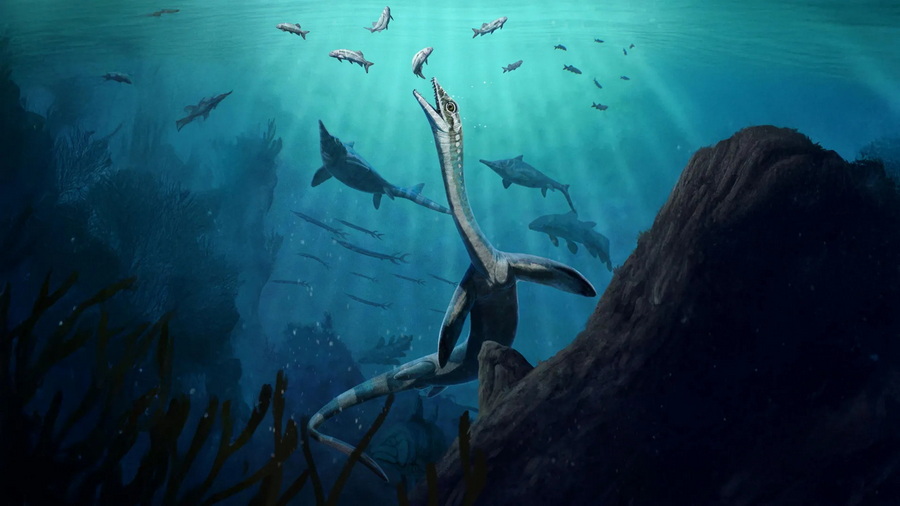
Reconstruction of the long-necked marine reptile Austronaga minuta. Credit: Gabriel Ugueto, edited. Despite being listed as a “stem archosaur,” it was already fully adapted for marine life with flippers and a digestive tract suited to its prey.
Heme was detected in this fossil as well, according to a press release from the State Museum of Natural History in Stuttgart, Germany:
“Compared with the highly specialized body shape of Austronaga, its internal organs seem less modified. The preserved organs include a large, sac-like stomach at the front, followed by a strikingly red liver in which traces of haemoglobin can still be detected. Behind this is a long, simple tube forming the small and large intestines. The overall arrangement shows that the digestive system of Austronaga was relatively simple in structure,” says Dr Wei Wang, lead author of the study and marine reptile expert at the Institute of Vertebrate Palaeontology and Palaeoanthropology in Beijing. “This fossil is the oldest known example of a largely complete digestive system in a reptile.”
Here’s how the paper puts it:
The conspicuous color of the liver is assumed to be a derivative of hemoglobin, as shown by the enrichment of iron indicated by the scanning electron microscopy (SEM) analysis relative to the sediment (Fig. 6 and fig. S14).
In spite of the evidence they presented, their belief in evolution and deep time remained intact.
Deep Time mineralizes in the brains of evolutionists, resisting decay or dissection by logic. That’s why it is essential to reach young science students whose brains are still pliable to the implications of evidence.
Once hardened, only one force is known to be strong enough to bring repentance to a fossilized Darwinist brain. “Is not My word like a fire?” says the Lord, “And like a hammer that breaks the rock in pieces?” (Jeremiah 23:29).
If you are an evolutionist, have you ever picked up a Bible and read it? Having a hardened brain busted open by the blows of a spiritual hammer sounds painful, but is actually beneficial. Our Creator is also a perfect surgeon, willing and able to restore brains to their original purpose.
For the word of God is living and powerful, and sharper than any two-edged sword, piercing even to the division of soul and spirit, and of joints and marrow, and is a discerner of the thoughts and intents of the heart. And there is no creature hidden from His sight, but all things are naked and open to the eyes of Him to whom we must give account. (Hebrews 4:12-13).
Your blood cells will travel more easily through living cerebral soft tissue.