


Phantom Evidence Lurks in Evolutionary Media
Some of the most famous
scientific illustrations of
all time are wrong
Evolution Is Infected with the Three Monsters of Science
Monster 1: Phantom Evidence
by Jerry Bergman, PhD
Is science an accumulating body of verified truth? Consider what monstrosities lurk in the halls of Big Science, where scientific “truth” is generated, and in the offices of Big Media, where the monsters are propagated and perpetuated.
 A Field Guide to the Monsters of Science: Part 1 (James Smoliga, Beyond the Abstract, Substack, 22 October 2026). This is part 1 of a series by James Smoliga, a researcher and professor at Tufts University. He describes three such monsters – Phantom Evidence, Zombie Research, and Vampire Claims – and gives examples of each.
As we will document, evolutionary theory is severely compromised by all three of the systemic flaws described and illustrated by Professor Smoliga.[1] In this article, we will focus on the first one: the “Phantom Evidence” monster.
 Phantom Evidence refers to data or studies that have been discredited, debunked, or retracted, yet continue to be cited as though they were still valid.
To illustrate how this monster operates within peer-reviewed literature, Smoliga highlights a study published in CHEST, the official journal of the American College of Chest Physicians—a very reputable journal specializing in pulmonology, critical care, and sleep medicine. The retracted paper, titled “Effects of Omega-3 Polyunsaturated Fatty Acids on Inflammatory Markers in COPD,” concluded:
“…we propose that nutritional treatment with n-3 PUFA-rich diet might be an effective and safe anti-inflammatory practical strategy for treating COPD.”
The critical issue with the CHEST study was that investigators uncovered clear evidence of widespread data falsification, prompting the journal to formally retract the paper in 2008. In short, the data were fabricated.
The lead author, Dr Wataru Matsuyama—then a prominent respiratory surgeon and associate professor at Kagoshima University’s Graduate School of Medical and Dental Sciences in Japan—eventually had 17 papers retracted for similar misconduct.
Yet despite its formal retraction, Matsuyama’s fraudulent article continued to be cited uncritically and positively by hundreds of medical researchers for more than a decade. As one science ethics report observed, “Twelve years after it was retracted, the omega-3 article is still regularly cited by other scientific articles as if it were valid.”[2]
To determine how such misinformation persists, researchers from the University of Illinois and the University of Adelaide traced the Matsuyama fraudulent paper’s citation history over time. They identified 35 subsequent papers published between 2010 and 2019 that directly cited Matsuyama’s study without mentioning its retraction.
Next, the researchers mapped what they termed “second-generation citations”—publications promoting the therapeutic benefits of omega-3 for lung disease that, rather than citing Matsuyama directly, cited one of the 35 papers that did. They uncovered 152 such references spread across review articles, clinical nutrition guides, and medical reference texts. While the archived copy of the paper on the CHEST website now carries a clear retraction notice, that warning was conspicuously absent from several major bibliographic databases that host the study’s abstract.[3]
Phantom Evidence in Evolution

Michael Richardson of St. George’s Hospital Medical School (London) proves Haeckel’s drawings, shown in the top photo, are fake, as evidenced by the actual photographs below the pictures. The differences are not of minor details but, as is obvious from the above comparisons, indicate outright falsehoods.
Examples of phantom evidence in evolutionary theory are widespread.
A. Haeckel’s Embryos
A classic case is Haeckel’s embryos, in which the 19th-century German biologist and artist Ernst Haeckel (1834–1919) used comparative embryology to advocate for Charles Darwin’s theory of common descent. Haeckel proposed “The Biogenetic Law”: that an organism’s development from embryo to adult (ontogeny) retraces the evolutionary history of its species (phylogeny).
To manufacture support for this claim, Haeckel doctored his illustrations, exaggerating early-stage similarities across different vertebrate classes. As shown in the illustration, comparing Haeckel’s original drawings (top row) with actual photographs of vertebrate embryos at corresponding developmental stages (bottom row) reveals the extent of the distortion.
Despite being exposed as inaccurate, these drawings remained a staple of standard biology textbooks for well over a century, and variations of them still surface occasionally today.
B. The “March of Progress”
A prominent modern example of phantom evidence is arguably the most recognizable visual in the history of evolutionary advocacy and is still promoted in modern media.
This ubiquitous and influential illustration—frequently referred to as “The Progression” or the “March of Progress”—has been instrumental in convincing millions of people to accept human evolutionary descent, even though anthropologists have long recognized its linear narrative as misleading and reliant on obsolete reconstructions.[4]

The now refuted evolutionary progression showing evolution from ape to human. From Wikimedia Commons.
The graphic presents a seemingly irrefutable visual case for human ancestry without requiring a single paragraph of text.
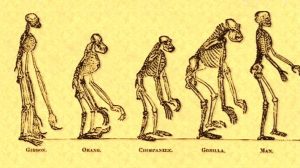
It all started with Huxley & Haeckel
In his comprehensive study, Professor Gowan Dawson traces the interconnected history of the image’s two most influential iterations across more than a century—from Victorian Britain to Space Age America. These include the frontispiece to Thomas Henry Huxley’s Evidence as to Man’s Place in Nature (1863)[5] and Rudolph Zallinger’s iconic fold-out illustration, “The Road to Homo Sapiens,” featured in F. Clark Howell’s best-selling Time-Life volume Early Man (1965).[6]
Dawson documents how the endless reproduction of this imagery reflected shifting cultural and scientific perspectives, shaping public perception far more effectively than the fragmented fossil evidence itself.
History of the Progression
One of the earliest public three-dimensional installations of the “March of Progress” was a series of sculpted plaster busts displayed in the “Hall of Man” at the Yale Peabody Museum of Natural History in New Haven, Connecticut. Installed in 1925—the same year the Scopes Trial thrust the evolutionary debate into the global spotlight—the exhibit presented an orderly lineage moving from ape-like ancestors to modern humanity.
The busts from 1925 include the following, all of which have been refuted by modern research:
1. Java Man (Pithecanthropus erectus): Presented as a primitive, transitional proto-human prehuman. Creationists and several anatomical specialists have long pointed out that Homo erectus fits squarely within the range of true human variability rather than representing a sub-human precursor.
2. Piltdown Man (Eoanthropus dawsoni): Showcased at the time as a pivotal “missing link” confirming human brain evolution, it was exposed in 1953 as an outright forgery constructed from an altered modern human cranium and an orangutan jaw.
3. Neanderthal Man (Homo neanderthalensis): Originally reconstructed as a stooped, brutish, ape-like caveman; modern genetics and physical anthropology have since demonstrated that Neanderthals possessed sophisticated culture, made complex tools, and interbred with anatomically modern humans, affirming they were fully human.
4. Cro-Magnon Man (Homo sapiens): The final stage shown in the progression, representing modern European man, is an anatomically modern Homo sapiens.
These anatomical restorations of prehistoric busts were installed in 1925 in response to the 1925 Scopes Trial. I collect postage stamps and have over 100 stamps that illustrate ‘The Progression,’ which has enabled evolutionists to present Phantom Evidence of human evolution to people groups around the globe. As of 2026, The Progression is still displayed in many countries around the world.
The visual momentum of this sequence was carried far beyond museum walls. For instance, postage stamps from around the globe have repeatedly depicted the progressive silhouettes, popularizing evolutionary transitions in households worldwide.
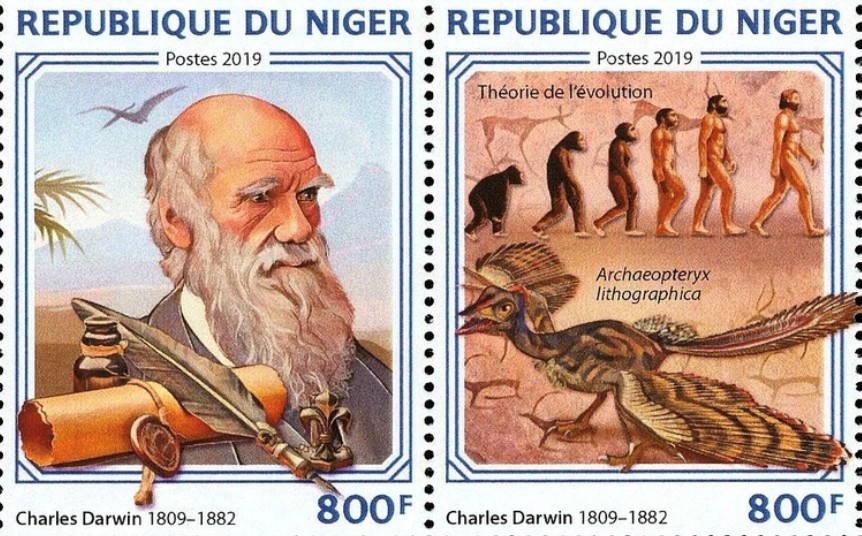
Two of the hundreds of worldwide postage stamps honoring Charles Darwin. Like many such issues, they prominently incorporate the “March of Progress” motif.
I have over 100 stamps in my collection commemorating this world-famous evolutionary illustration referred to as ‘the Progression.’ Decades after the scientific obsolescence of linear human progression was recognized, variants of this imagery continue to appear on public monuments, educational posters, and commercial designs worldwide.
Phantom Evidence Lives On
The modern image expanded dramatically beyond the 1925 museum display. Instead of four busts, it features 15 successive figures—none of which, upon closer examination, serve as legitimate transitional links to modern man. Formally titled “The Road to Homo Sapiens” in the 1965 Time-Life volume Early Man (part of the Life Nature Library), this illustration is now universally known as the “March of Progress.” Created by Yale artist Rudolph Zallinger, it originally appeared as a fold-out spread spanning four and a half pages, depicting the 15 figures shown below.
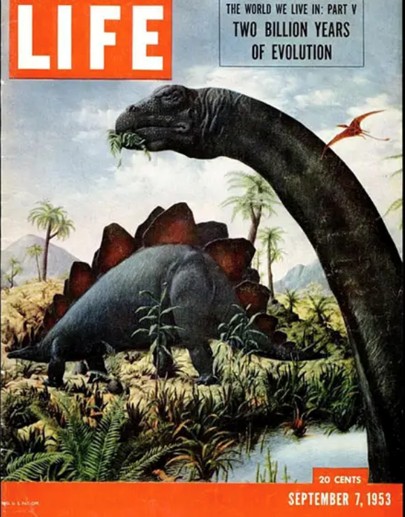
The Sept 7, 1953 issue of Life Magazine featured a large fold-out of Zallinger’s evolutionary artwork.
He also painted The Age of Reptiles, a 110-foot (34-meter) mural at the Yale Peabody Museum illustrating the prehistoric era when evolutionary theory posits that reptiles dominated the Earth. A section of this celebrated fresco was featured on the September 7, 1953, cover of Life magazine.
The widespread acclaim and numerous awards garnered by Zallinger’s grand murals helped cement his position as a prominent member of the Yale University faculty.
The rejection of the “March of Progress” as an accurate representation of human origins is well-documented, even among secular scientists. One notable critique comes from Dr. Kevin Blake, a researcher holding a PhD in Plant and Microbial Biosciences and the Scientific Editor and Program Manager at the Washington University School of Medicine. Regarding the illustration, Blake observed:
The image is iconic… At the rear is an ape-like figure, crouched-over and walking on all fours. Ahead of it is a similar-looking figure, but one who’s walking on two feet. This trend continues, with each successive figure becoming a little taller, a little less hunched, and little less hairy until, at the front of the line, you reach Homo sapiens. Hairless, fully upright, with close-cropped hair and a neatly-trimmed beard, “Modern Man” boldly strides into the future. Instantly recognizable and universally understood to depict the evolution of man, this image is one of the most famous scientific illustrations of all time. It is also wrong.[7]

Learn about other blunders made by evolutionists in this book by Dr Bergman. Click to order.
References
[1] Smoliga, James, “A Field Guide to the Monsters of Science: Part 1,” https://beyondtheabstract.substack.com/p/a-field-guide-to-the-monsters-of Science, 22 October 2026.
[2] “Article proves resilient after retraction,” PesquisaFapesp, Issue 297, https://revistapesquisa.fapesp.br/en/article-proves-resilient-after-retraction/, November 2020.
[3] “Article proves resilient after retraction,” 2020.
[4] Dawson, Gowan, Monkey to Man: The Evolution of the March of Progress Image, Yale University, New Haven, CT, 369 pages, 2024.
[5] Huxley, Thomas Henry, Evidence As to Man’s Place in Nature, D. Appleton & Company, New York, NY, 1863.
[6] Howell, Clark, and the editors of Time-Life Books, Early Man, Time-Life Books, New York, NY, 1965.
[7] Blake, Kevin, “On the Origins of “The March of Progress,” https://sites.wustl.edu/prosper/on-the-origins-of-the-march-of-progress/ 17 December 2018. Boldface added by Jerry Bergman.
 Dr. Jerry Bergman has taught biology, genetics, chemistry, biochemistry, anthropology, geology, and microbiology for over 40 years at several colleges and universities including Bowling Green State University, Medical College of Ohio where he was a research associate in experimental pathology, and The University of Toledo. He is a graduate of the Medical College of Ohio, Wayne State University in Detroit, the University of Toledo, and Bowling Green State University. He has over 1,900 publications in 14 languages and 40 books and monographs. His books and textbooks that include chapters that he authored are in over 1,800 college libraries in 27 countries. So far over 80,000 copies of the 60 books and monographs that he has authored or co-authored are in print. For more articles by Dr Bergman, see his Author Profile.
Comments
Haeckel’s doctored embryos predate and are similar to Kettlewell’s experiment with moths. Both have been shown to be fraud.