


Is Homo Habilis understood yet?
A new specimen is
the most complete
H. habilis ever found
The Continuing Trials and Tribulations of Homo habilis
A new find still leaves doubt about who or what Homo habilis is
by Jerry Bergman, PhD
For decades, Homo habilis has been widely presented as one of the earliest members of the genus Homo. However, ongoing analyses continue to raise significant questions about its classification and even whether the fossils attributed to it represent a single species.
This highlights an important point: many past statements presented as settled conclusions were evidently overstated and based on limited and fragmentary evidence. These claims are now being reexamined. For example, sources such as Wikipedia still describe Homo habilis as “one of the oldest species of archaic humans,” even though its exact place in human origins remains debated.
Examples of Overstatements
A book on human evolution for young readers explains that Homo habilis, described as an adept tool user, “was larger than earlier manlike creatures and also had a much bigger skull size.” H. habilis was pictured on the cover of the book in a progression leading up to modern humans, leaving readers little doubt about its status as a missing link.[1]
Similarly, the Handbook of Paleoanthropology, a highly regarded academic reference published by Cambridge University Press, describes Homo habilis as the “first true humans” and “an intermediate between australopithecines and Homo sapiens [modern humans]”.[2]
The Princeton Guide to Evolution likewise presents anatomical details consistent with this view, noting that H. habilis had larger brain sizes (500–750 ml) and smaller teeth than earlier australopithecines, evidence that supports transitional status between humans and australopithecines.[3] However, despite these confident descriptions, the same source acknowledges that “it remains unclear whether H. habilis was ancestral to H. sapiens, and scholars disagree about how many species these early specimens represent.”[4]
In fact, debate over the classification and evolutionary role of Homo habilis has persisted from its initial discovery to the present. Even what is described as its “general acceptance” has depended on additional fossil finds—such as those from Koobi Fora in northern Kenya—and has not resolved ongoing disagreement about its significance.
Piecing Together Tiny Fragments
As a result of the overly confident picture often conveyed in popular, and even academic summaries, many readers—myself included—have assumed that Homo habilis represents a well-established transitional form, proven beyond reasonable doubt. Yet a closer examination of the scientific literature reveals a more tentative and debated picture. When the details of the H. habilis discoveries are examined, the long-standing debate surrounding this species is not surprising. From the time of its initial discovery, questions have been raised about both its classification and the significance of its role in human evolution.
One notable very early specimen, originally designated Olduvai Hominid 62 (OH 62), illustrates the challenges involved. Excavation of the site yielded more than 18,000 bone and tooth fragments across an area of about 40 square meters. The vast majority of these remains were from non-hominid animals, and only 302 fragments were attributed to OH 62. These fragments had to be painstakingly assembled from roughly 300 pieces.[5]
Such a highly fragmentary condition inevitably requires a significant degree of reconstruction and interpretation, which can contribute to differing conclusions among researchers. Some have also suggested that the condition of the remains may have been affected by later disturbances, such as a dirt road which was located near the site as travelers may have passed over the area. While the extent of this impact is uncertain, it highlights the potential complications involved in interpreting the fossil evidence. Taken together, these factors help explain why H. habilis has remained a subject of ongoing debate rather than a clearly established transitional form.
Paradoxes and Uncertainties
This tension between confidence and uncertainty has been noted even within the scientific community. As one researcher observed,
“Homo habilis is a paradoxical species. On the one hand, they have a famous name and hold the status of being the first members of our genus Homo—the first humans, if you like. On the other hand, we have never known that much about them, and what we do know is kind of weird. How can a species be simultaneously well known and little known?”
This paradox highlights the central issue: although H. habilis is often presented as a key transitional species in human evolution, the actual fossil evidence is very limited, fragmentary, and open to differing interpretations. Its prominence in textbooks and popular presentations may therefore convey a level of certainty that exceeds what the underlying data can firmly support.[6]
Science journalist Michael Marshall states in New Scientist that the name is “one of the few things we can be sure about,” explaining that the discoverer of H. habilis
applied the name to a collection of bones and teeth they had found in Olduvai/Oldupai gorge … The remains were rather miscellaneous: a lower jaw with teeth, an upper molar, skull bones called parietals, and some hand bones. The trio interpreted them as belonging to a single juvenile individual…. The researchers asserted that Homo habilis were the makers of Oldowan stone tools, which had been found in the locality. By saying this, they made the broader claim that making tools was a defining feature of the genus Homo. The researchers asserted that Homo habilis were the makers of Oldowan stone tools, which had been found in the locality. By saying this, they made the broader claim that making tools was a defining feature of the genus Homo…. That is a lot of interpretation to put on a handful of fossils.”[7]
A Wastebasket Taxon
Over the following 62 years since the first bones said to belong to H. Habilis were discovered or hypothesized, researchers found more fossils that they assigned to H. habilis. However, the additional remains haven’t completely clarified our understanding of the species. On the contrary, H. habilis has languished. “It’s what they call a wastebasket taxon,” says Ian Tattersall at the American Museum of Natural History. According to Tattersall, whenever researchers found a bone “that they weren’t quite sure what it was, they just chucked it into Homo habilis. And so pretty soon, Homo habilis became a rather unwieldy assemblage of stuff that you would find it very difficult to define.”[8]
However, a new article was recently published implying that the status of H. habilis (as a link in human evolution?) has finally been decisively confirmed. But is that really the case? Does the new find support the claim that H. habilis was part of the progression leading to modern humans? In a word, “No.” As Marshall explains,
The new specimen is the most complete H. habilis ever found. It includes a collarbone (clavicle), fragments of the shoulder blade (scapula), both upper arm bones (humerus), both of the two lower arm bones (ulna and radius), and fragments of the base of the spine (sacrum) and hip bone (os coxae). There’s still a lot missing: the head, ribcage, spine, hands, legs, and feet.[9]
It must be noted that many of the key skeletal elements needed to determine whether H. habilis represents a transitional form are missing. Among the features that can be assessed, some evidence suggests relatively long arms—more comparable in proportion to those of apes than to modern humans. Whereas living apes typically have arms that are long relative to their legs, modern humans have proportionally shorter arms. Such traits have led some researchers to question whether certain fossils attributed to H. habilis may be more appropriately classified as ape-like rather than clearly human.
Motley Clues
The fragmentary nature of the evidence further complicates the picture. As Ian Tattersall has observed, the fossils assigned to H. habilis over the past six decades constitute a “motley assortment” of bones. In many cases, only a single example of a given skeletal element is available, making it difficult to determine whether these remains are truly representative of a single species or instead reflect a diverse collection of individuals, both ape and human. According to Tattersall, there “are few H. habilis bones that we have more than one copy of, so we can’t be confident that the ones we have are representative.” This
has led to decades of uncertainty…. Some researchers have even argued that the entire species is a sort of mirage: a bunch of bits and pieces of late Australopithecus and early Homo, lumped together for no good reason.”[10]
Nonetheless, because most paleontologists interpret the fossil record within an evolutionary framework (i. e. they look at the data through their evolutionary glasses), the available evidence is typically understood in a way that supports evolutionary relationships.
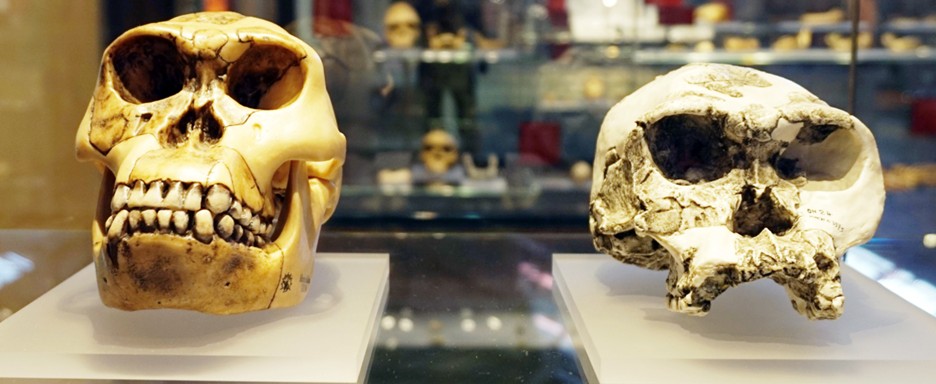
Fossil casts claimed to be Homo Habilis. Note the one on the left looks like a gorilla and the one on the right looks like a Chimpanzee. From Wikimedia Commons.
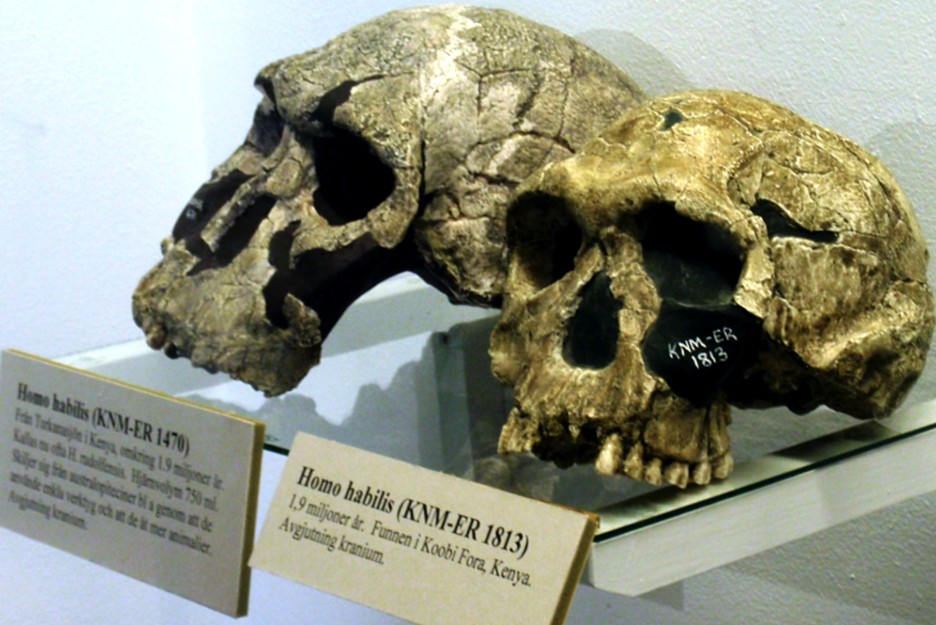
The actual fossils used to make the casts in the above picture. From Wikimedia commons.
Summary
This brief overview highlights more than a century of efforts to identify fossil evidence for human evolution from a proposed common ancestor, often envisioned as chimpanzee-like in form. While researchers typically interpret the available fossils within an evolutionary framework, the evidence itself is frequently fragmentary and open to differing interpretations. As this review has shown, the data do not always provide a clear or consistent picture, and in some cases, at best, only offers weak support for specific hypothesized evolutionary reconstructions.
References
Marshall, Michael, “We’ve only just confirmed that Homo habilis really existed,” New Scientist, 9 March 2026.
[1] Howell, Clark., Early Man. Time, Inc., New York, NY, p. 31, 1968.
[2] Schrenk, F., O. Kullmer, and T. Bromage, “Chapter 9: The Earliest Putative Homo Fossils.” In Henke, W., and I. Tattersall (eds.). Handbook of Paleoanthropology. Springer, New York, NY, pp. 1611–1631, 2007.
[3] Losos, J. (ed.), The Princeton Guide to Evolution. Princeton University Press, Princeton, NJ, pp. 185-186.
[4] Losos, 2014, p. 186.
[5] Johanson, D., et al., From Lucy to Language. Simon and Schuster, New York, NY, p. 188, 2006.
[6] Marshall, 2026.
[7] Marshall, 2026.
[8] Marshall, 2026.
[9] Marshall, 2026,
[10] Marshall, 2026.
 Dr. Jerry Bergman has taught biology, genetics, chemistry, biochemistry, anthropology, geology, and microbiology for over 40 years at several colleges and universities including Bowling Green State University, Medical College of Ohio where he was a research associate in experimental pathology, and The University of Toledo. He is a graduate of the Medical College of Ohio, Wayne State University in Detroit, the University of Toledo, and Bowling Green State University. He has over 1,900 publications in 14 languages and 40 books and monographs. His books and textbooks that include chapters that he authored are in over 1,800 college libraries in 27 countries. So far over 80,000 copies of the 60 books and monographs that he has authored or co-authored are in print. For more articles by Dr Bergman, see his Author Profile.