


The Mystery of the Flipping Forams
Scientists find evidence of ‘rapid reversals’ of
foraminiferal coils that occur “far too abruptly
to be explained by gradual trait evolution”
The Flip that Defies Evolution
New Discoveries on Planktonic Foraminifera Coils
by Dr. Sarah Buckland-Reynolds
When we visit the oceans or coastal lagoons, we are often interested in the scenic aura of these locations. However, out in these oceans and coastal regions live several microscopic creatures that hold significant information about the history and environmental conditions of a region.
Among the most significant of these organisms are foraminifera (‘forams’ for short), which are tiny marine organisms that secrete calcitic spiral shells. Because different varieties of forams thrive in distinct ranges of temperature, moisture and water depth, their concentration has been studied by palaeoclimatologists for several years to reconstruct the environmental history of coastal regions, including estimating the historical frequencies of hurricanes, tsunamis, and other extreme events.
Coil Reversals
Beyond extreme environmental reconstruction, recent research has found yet another astonishing observation from examining foraminifera, that significantly defies evolutionary expectations: sudden, global reversals in shell coiling direction. The findings were published in an article titled:
 Flipping Plankton (Bridget Wade et al., PNAS, 20 April 2026). Wade et al.’s findings recorded details of this rapid flipping phenomenon and how it perplexes scientists, as their speed of reversals directly challenge long‑held evolutionary assumptions.
Wade et al. describe the coiling flips as occurring
“…. on timescales of thousands of years or less, across diverse taxa and ocean basins, far too abruptly to be explained by gradual trait evolution.”
This admission sets the stage for a deeper reflection on assumptions of evolutionary mechanisms and timelines. Is there reason to believe these rapid flips actually facilitate useful functions as hallmarks of design?
More on the Abruptness of Coil Reversals
Evolutionary theory often emphasizes gradualism, the slow accumulation of traits over vast timescales. Yet, these new findings from forams add to mounting evidence from the fossil record of foraminifera that defies gradualistic evolutionary expectations.
“It seems truly puzzling that a species could exist for millions of years coiling one way, and then suddenly reverse, for no apparent reason.”
According to the evolutionary timescale described by the authors, during the Miocene epoch, a species of forams (specifically, the Globorotalia scitula) lineage “flipped twice: mixed to sinistral at 15.14 Ma, then sinistral to dextral at 10.02 Ma.”
With ‘sinistral’ flips (left-handed/anticlockwise) then transforming to dextral (right-handed or clockwise) in such a relatively brief period, the authors candidly admit to being baffled:
“It seems truly puzzling that a species could exist for millions of years coiling one way, and then suddenly reverse, for no apparent reason.”
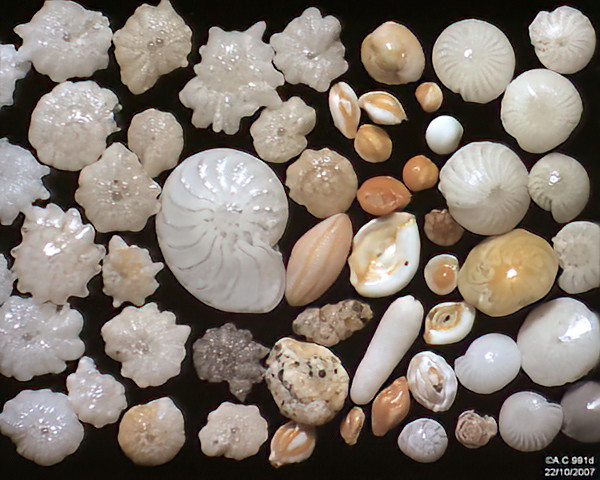
The microscopic beauty and variety of foraminifers. (Wikimedia Commons)
In further expounding upon their findings, the authors examine this trait in other specific species of planktonic forams. Another such species discussed was the case of Pulleniatina obliquiloculata, which was described as even more dramatic than the average observations. According to Wade et al., this species, thought in evolutionary terms to have evolved 4.2 million years ago (and still thrives today), experienced “a series of rapid shifts, sometimes resulting in sinistral or dextral dominance and other periods of mixed coiling.” These shifts occurred “worldwide and within a few thousand years.”
In addition to the shock of its relatively rapid reversals, the authors were shocked about the global synchronicity that further defies the expectation of slow, localized evolutionary change. Instead, the reversals resemble programmed switches, as if populations were designed to toggle between states in response to ecological cues.
Case Studies Across Epochs
The authors traced other examples of changes in their paper. They found evidence that a genus presently thought to be extinct (Morozovella), shifted from dextral (clockwise/right-handed) to sinistral (anticlockwise/left-handed) coiling soon after warming began during the Early Eocene Climate Optimum. What made these flips even more interesting was that the authors found that these flips were not arbitrary but had significant correlations with ecological strategies.
According to their findings, shells that had clockwise flips “show lower carbon isotope values, suggesting reduced reliance on photosymbiotic algae.” These ‘photosymbiotic algae’ reside inside or on the shell of the foraminifera, capture sunlight and produce sugars through photosynthesis, which the foram can use as an energy source. In return, the algae benefit from the protection and mobility of their host. Given this interdependence on sunlight, the sinistral forms may have been better suited to tolerate warmer conditions, suggesting purposeful adaptation rather than random mutation.
The authors further mention other examples with similar synchronous switching across nine sites spanning different ocean basins. The sheer breadth of this reversal underscores its global character, rather than isolated emergence. This pattern directly contradicts key tenets of evolutionary expectations that would often posit that in diverse environments, traits would emerge independently, determined by the environment. However, the fact that these are not isolated anomalies but recurrent features, defies the expectations of environmental determinism and the assumption of isolated trait emergence.
Purpose Behind the Reversals?
Despite expressing surprise about the unfulfilled expectations of the evolutionary predictions of coil reversal, the authors maintained a stance that described the coiling flips as ‘random’ or ‘accidental.’ In their words:
“….coiling direction itself may offer no inherent advantage: Instead, it serves as an accidental marker for hidden genetic and ecological differences.”
However, several questions arise when presented with this logic. For example:
If coiling direction were merely a neutral trait, why would entire populations flip so suddenly? Why would such a binary trait consistently mark ecological shifts?
Based on the global synchronicity of the reversals, these may appear purposeful, signaling transitions in ecological niches. Could it be that coiling direction functions as a visible marker of invisible ecological strategies, pointing to design rather than chance?
More Flaws in Evolutionary Expectations: Flipping the Script of Environmental Determinism
The phenomenon of flipping plankton exposes additional flaws in evolutionary orthodoxy. Environmental determinism in particular proved inadequate as an explanation as the authors cited that early studies linked coiling to temperature, but later evidence showed that “temperature does not account for the pattern, because these coiling flips show up everywhere, from the tropics to the high latitudes, and during both warm periods and ice ages.”
Another default evolutionary explanation that is being challenged is that of the classical species concept. The authors note that lasting divergence is not the outcome of isolation. In their words:
“At least in the case of the planktonic foraminifera, it seems reproductive isolation alone is not sufficient to produce lasting divergence.”
The authors further express mystery on genetic predisposition to specific coiling traits as an unresolved issue. In their words: “Why certain genes favor left or right coiling remains a mystery.” These admissions reveal the inadequacy of evolutionary narratives. The repeated surprise expressed by scientists underscores the gap between theory and observation.

Fire and ice. (Photo by Jenny Wise)
Other expectations of continuous transitions are violated as coiling flips are discontinuous, appearing as sudden replacements, with no specific environmental correlation, as flips occur “during both warm periods and ice ages,”
Despite the authors’ admission to numerous violations of evolutionary expectations, they conclude that:
“…. shell coiling direction thus serves not as an adaptive trait, but as a fortuitous marker of hidden evolutionary dynamics shaping marine microplankton diversity…”
Is evolutionary theory continuing to be stretched to accommodate data that fundamentally resists its framework? While the authors do admit to failed evolutionary predictions, the conclusions remain that these are hidden evolutionary dynamics – rather than concluding that there is a deeper mismatch between theory and reality.
Conclusion: Toward Further Research
Wade et al.’s research on flipping plankton presents yet another case study of a challenge to evolutionary orthodoxy at multiple levels: gradualism, environmental determinism, species definition, and genetic causation. The repeated surprise expressed by scientists underscores the inadequacy of current models.
Further research is needed, particularly at the molecular level, to uncover the mechanisms behind coiling reversals. However, based on Wade et al’s findings, the abruptness, synchronicity, and ecological purpose of the flips appear to align more naturally with design than with chance.
As the article concludes, “Thus, now we await advances at the molecular level to resolve the enigma of these flipping plankton.” But perhaps the enigma is not a flaw in our understanding of evolution, but a clue to the reality of design, as evolutionary theory proves to be inaccurate.
As we reflect on these findings, let us continue to advocate for research completed with integrity and transparency. That is unafraid to challenge the status quo of evolutionary thought. May we also maintain a spirit of awe as we appreciate that both in the macroscopic and microscopic worlds, there is proclamation of God’s creativity, purposefully engineered for the good of our planet.
 Dr. Sarah Buckland-Reynolds is a Christian, Jamaican, Environmental Science researcher, and journal associate editor. She holds the degree of Doctor of Philosophy in Geography from the University of the West Indies (UWI), Mona with high commendation, and a postgraduate specialization in Geomatics at the Universidad del Valle, Cali, Colombia. The quality of her research activity in Environmental Science has been recognized by various awards including the 2024 Editor’s Award from the American Meteorological Society for her reviewing service in the Weather, Climate and Society Journal, the 2023 L’Oreal/UNESCO Women in Science Caribbean Award, the 2023 ICETEX International Experts Exchange Award for study in Colombia. and with her PhD research in drought management also being shortlisted in the top 10 globally for the 2023 Allianz Climate Risk Award by Munich Re Insurance, Germany. Motivated by her faith in God and zeal to positively influence society, Dr. Buckland-Reynolds is also the founder and Principal Director of Chosen to G.L.O.W. Ministries, a Jamaican charitable organization which seeks to amplify the Christian voice in the public sphere and equip more youths to know how to defend their faith.