


Space Pioneer in Awe of Creation
If a piano requires a piano-maker,
how much more does a universe
require a universe-maker?
THE WONDER OF IT ALL
by Henry L. Richter, PhD, PE
I sometimes write a short piece about a scientific article that caught my eye, but I want to stand back and look at the BIG picture. From the tiny, tiny atom to the immense universe. To me it all fits together so perfectly it is no accident. So many different systems and materials that fit together so perfectly in man.
Let’s talk cases just a slight change in one parameter and they would not fit. It gives the appearance of a design. A design demands a designer. I would suggest that it is that being we call God.
Let’s talk about the need for a designer. I love the illustration my friend the late Kenny Poore used to use. He said,
“I do not want to talk about the universe; it is too complicated. Let’s talk about this piano behind me. Two thoughts come to mind: either there is a piano maker, or it just happened. Maybe a fierce windstorm in a junk yard and all pieces just came together. The sides, the keyboard, the strings, the foot pedals, and the rest. I think not.”
The Universe and The Atom
But let me go to the big picture, from the tiny tiny atom to the galaxies. Atoms consist of a nucleus with one or more electrically positive protons, one or more neutrons (except hydrogen) and a number of electrically negative electrons which spin around the nucleus in well defined orbits. They are arranged in shells with two electrons in the first, with 8 in the second, and so forth.

Packing structure of sodium chloride (NaCl, salt)
Why the negative electrons are not attracted in to the positive nucleus, is a mystery to me. Some of the atomic arrangements are unstable, making them radioactive, some with a long half life, and some with a very short half life.
When the atoms bunch together to make chemical elements, each is radically different. As atoms grow in size by having more protons, they move up the periodic table with higher atomic number. They are metals, alkalis, gasses, and a couple are liquids at room temperature.
Then when elements join together by sharing one or more electrons they make a compound that does not resemble any of the elements, like sodium chloride (NaCl) made from sodium and chlorine. Sodium is a metal that reacts with water and chlorine, a poisonous gas. Yet when they come together, salt is an essential ingredient for our health.
But on to the BIG picture, the universe: an amazing subject! It is believed there are a hundred billion galaxies, each with a hundred billion stars. And if a few stars have a few planets, what are the chances they have life? PARTICULARLY INTELLIGENT LIFE?
 And going back to my simple example of a piano needing a piano maker with a design, it is even more so with the universe. Did it all come into existence as an accident of nature? Many think so and try to explain that everything came from a “Big Bang,” where all matter supposedly originated from a tiny singularity that exploded.
This is a made-up way to explain the origin of everything. Many cannot admit the possibility that God exists and created all things. They claim that the entire universe came from a tiny singularity that exploded, and that everything we see is a condensation of the result.
Lets see, where did the starting thing come from? What was there before? Oh, we cannot ask these questions. Too bad!
Conditions for Habitability
What is required to allow life?
 A stable star is required.
- The star must be of the proper temperature to heat the planet to a livable temperature.
- The planet’s orbit must be in the “goldilocks” zone to have a reasonable temperature.
- The planet must have a circular orbit for temperature stability
- The planet must rotate every 24 hours for reasonable day/night ratio. Two hours would not work; 100 hours would be too long for activity then rest.
- A large amount of water implies a sea, which requires a moon about the size of ours and at roughly the same distance to help oxygenate the water. A large amount of water implies a sea, which requires a moon about the size of ours and at roughly the same distance to help oxygenate the water. I’ve heard that if the moon were 10% closer, the tides would be so extreme that they could erode much of the land. If it were 10% farther away, it would not generate enough tidal movement to properly oxygenate the water, making it difficult for plants and marine life to thrive. The full moon also seems to trigger reproductive behaviors in sea animals, such as corals.
- The atmosphere must contain enough oxygen to allow life to process fuel, but not too much as to spontaneously ignite.
- The atmosphere must have additional gas to absorb harmful radiation from the sun but let visible light through. Nitrogen has this property.
- A magnetic field is necessary — strong enough to create a magnetosphere that diverts solar winds and energetic particles away from the planet, but not so strong as to cause other problems.
- The planet needs a source of carbon from which all organic compounds are made.
- The planet needs to have other elements such as calcium from which bones are made and iron from which blood cells are made.
- It must have many other elements as well, such as magnesium. The contents of a bottle of vitamin supplements gives you a hint at other nutrients required for human life.
- The planet needs to have a source of oxygen. Plants transform carbon dioxide made by animals back into oxygen.
Probability and Logic
Now, what does this show?
What is the probability that a planet has all these features and materials? Even if we generously assign a 5% probability to each of these features, the chance that a planet has all of them is roughly 1 in 10²². Moreover, if we assume one planet for each of the 10²⁰ stars in the universe, the expected number of such planets is only 0.01 — less than a 1% chance for the entire universe.
Logically, our earth is really out of the range of chance. So it must have been created that way.
But that is not enough. It must also have life. And that is all background for my main amazement – life.

The basic organelles of a cell. From Wikimedia Commons.
The Wonder of Life
From the simplest cell to the human body: where did life come from? Some propose that it somehow emerged spontaneously when some organic chemicals combined in a “primordial soup.” Fat chance!
Even the smallest(simplest) single cell is extraordinarily complex. It has an outer membrane with ports that selectively admit nutrients and oxygen while eliminating waste. It has a nucleus containing DNA that governs virtually everything. Could this arise by accident, simply from thousands of organic chemicals assembling in the right combination, order, orientation, and position? And even if that were somehow possible, it still would lack the quality we call life.
The Wonder of Humanity
Then consider the most complex – the human body.

Suppose you were assigned the job of creating the body. You could have as many design teams as you want. What design criteria or specifications would they use?
- Structural/bone
- Muscles
- Nerves
- Circulation
- Skin
- Vision
- Hearing
- The digestive system
- The reproductive system
- Brain
Consider the additional requirements for each of these:
– For structural/bone – arms/legs with joints, spine, shoulders/shoulder blades, pelvis, ribs, feet.
– For muscles – all moving joints, diaphragm.
– For nerves – two types, to relay sensory inform to brain and to control muscles.
– For circulation – heart, arteries, veins, capillaries (between 2.5 t0 7 miles in average adult), lungs for oxidation. The blood passes through the kidneys to remove waste products. The blood besides has antibody particles to attack bacteria and toxins.
– For skin – to contain body flesh, pores for sweating, follicles for hair, nerves for touch.
– For vision – the eyeball, muscles for moving, iris with muscles for controlling light, retina for converting image to electrical impulses, nerves to carry impulses to brain, eye sockets in skull, glands and ducts for salty tears to wash eyeball and keep it moist.
– For hearing – ears to collect sound, ear canal, ear diaphragm, transducer to convert sound waves to electrical impulses, nerves to carry impulses to hearing center in the brain.
– For the digestive system consisting of the mouth, teeth, tongue, salvia glands, throat, stomach, intestines, and rectum for elimination of waste products. The food stuffs get digestive help from fluids from the liver. The intestines contain billions of friendly bacteria to aid digestion.
– For the reproductive system to produce new generations of the body. Bodies are created male and female to allow mixing of DNA strands to override defective or damaged genes. The male and female sex organs fit each other perfectly and joining them creates much pleasure, urging frequent coupling.
– For the Brain to control the body and to process information from body sensors, to store memories, to have ten billion neurons each with hundreds of cross connections.
And there are many shared features between systems such as the necessary holes lined up in the spine which nerves from the brain pass through to different parts of the body and muscles which move the diaphragm which in turn operates the lungs.
So, what about all this? It shows that the human body has been created by an intelligence way beyond our own. So, who created the design and implemented it? Was it God?

Credit: J. Beverly Greene
My Journey
As a scientist, for a long time I never doubted the existence of a God who created the universe. If God existed, who was He? I used to have the feeling that if God existed, He was in his heaven someplace unaware of me. How wrong I was! The universe showed a design and fine tuning and thus required a designer – must be God.
Watch and share the Short Reel about this article. Click to view it now.
I found that God is a personal God who loved me and wanted a relationship with me. However, that was not possible because of something called sin. Sin is disobedience to God’s commandments. The penalty for sin is death.
I knew I had the sin problem but God had a solution. His son Jesus Christ came to pay that penalty if I just accepted Him as Savior. He died on the cross so I could be forgiven and could become righteous in the sight of God. I do not understand all of it, but that is what the Bible promises to those who believe on Him and receive Him.
Trusting what the Bible says, I have led a life of peace since then. It was not an easy one at all times, but satisfying. That is because I know who in charge!
Ed. note: For more on Dr Richter’s journey of faith from secular scientist to Christ follower, see our Site Map and order his book Spacecraft Earth: A Guide for Passengers, available from CMI and from the Creation Superstore.

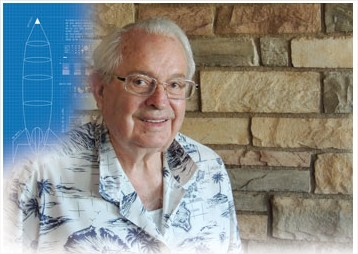
Dr Henry Richter, a contributing science writer to Creation-Evolution Headlines, was a key player at NASA/JPL in the early days of the American space program. With a PhD in Chemistry, Physics and Electrical Engineering from Caltech, Dr Richter brings a perspective about science with the wisdom of years of personal involvement. His book America’s Leap Into Space: My Time at JPL and the First Explorer Satellites (2015), chronicles the beginnings of the space program based on his own records and careful research into rare NASA documents, providing unequaled glimpses into events and personnel in the early days of rocketry that only an insider can give. His next book, Spacecraft Earth: A Guide for Passengers, co-authored with David Coppedge is available from CMI. For more articles by Dr Richter who turned 98 this year, see his Author Profile. And be sure to read our Biography of Henry Richter.