


Metamorphosis Defies Evolution
Asking the wrong question
traps a science reporter
in Mobius circularity
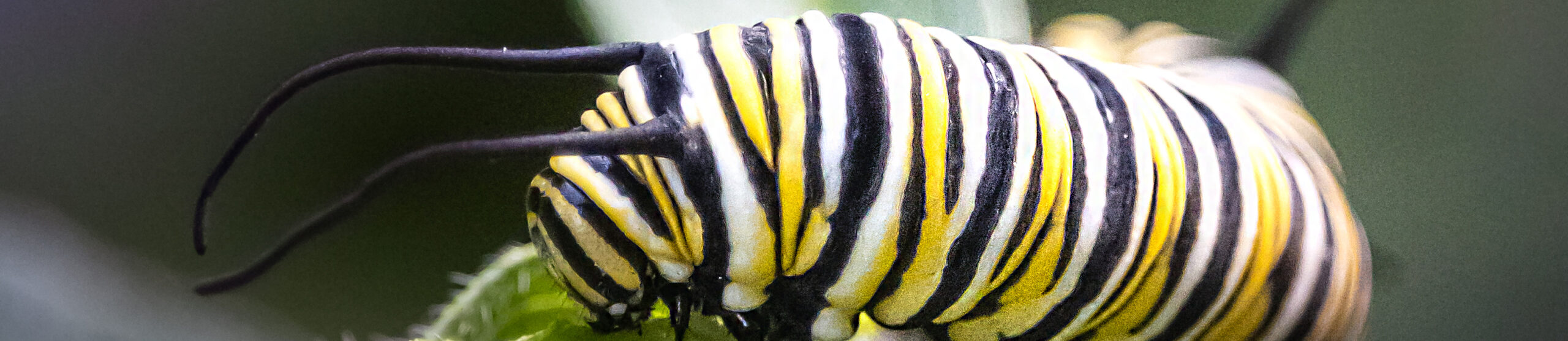
The transformation of a caterpillar into a butterfly is one of the true marvels of nature. Everyone acknowledges that. In the case of the Monarch butterfly, another wonder must be added to its metamorphosis: the delicate insect’s ability to fly 3,000 miles from Canada to Mexico, landing on the exact trees where its great-grandparents had roosted. These and other butterfly wonders were beautifully described with exquisite videography in Illustra Media’s classic documentary, Metamorphosis. (See excerpt on the life cycle at TheJohn1010Project.com, and excerpt on the migration there.)
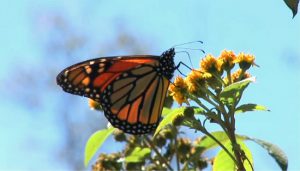
People need a sense of awe, and nature gives it in abundance.
This marvel is so mind-boggling, many people go to great lengths to protect the butterflies. Researchers at Texas A&M are gathering data on collisions of monarchs with vehicles on Texas highways in an attempt to preserve as many of the butterflies as possible. Conservationists are trying to restrict the spraying of crops that kills the milkweed on which Monarchs depend. Some private companies encourage the public to document sightings and even grow their own Monarchs from eggs. In fact, Illustra Media’s producer regularly buys milkweed and Monarch eggs to grow at home. One company allows consumers to buy chilled Monarchs for children or partygoers to release from paper folders. Once warmed by the sun, and lifting off on the wing, the little butterflies with their stained-glass-window-like wings know which direction to fly.
The magnificent migration of Monarch butterflies means that the insect’s transformation from a crawling, plant-eating caterpillar into a flying creature with entirely new body systems (including powered flight), must also construct navigation systems built on a sun compass as well as magnetic field sensors that were not present in the caterpillar. Illustra’s film compared the transformation to a Model T entering a hangar, tearing down and melting all its parts, then reconstructing them into a flying helicopter. Dr Andy McIntosh discussed these wonders in a presentation for Logos Research Associates this month, adding the fact that another butterfly species—the painted lady—migrates twice as far as the Monarch, all the way from the Arctic Circle to the Sahara!
What’s an evolutionist to do with these observational facts?
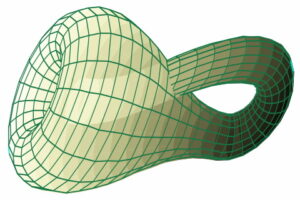
In a Klein bottle, the inside is the outside.
One reporter trapped herself on a Mobius strip of explanation. If you put an ant on a Mobius strip, it will walk forever and never get anywhere. The Klein bottle is another topological illusion. Trapped in a Klein bottle, a reporter would go around and around, looking for an evolutionary explanation, only to retrace her steps endlessly. This is what Marilyn Perkins does at Live Science when she practices the Darwinian art of asking the wrong question.
 How did metamorphosis evolve? (Live Science, 17 Nov 2025). A truth-seeking science reporter should be searching through all possibilities that could provide a necessary and sufficient cause to explain a phenomenon. Instead, Marilyn Perkins, with the approval of Live Science’s editors, asks ‘How did metamorphosis evolve?‘ instead of ‘Did metamorphosis evolve?’. Stuck in Darwin fogma before even starting to think, she is doomed to ride a Hegelian Klein bottle roller coaster till tired of writing, getting off where she got on and calling it progress.
As usual, the reporter tosses the hot potato of evolutionary explanation to a presumed ex-spurt, Dr James Truman of the University of Washington. (That way, Marilyn can claim ‘he said it, not me.’ She only drives the getaway car.) Truman points to hemimetabolous insects that grow from nymph to adult without a chrysalis stage, thinking that it might represent a semi-miraculous transformation on the way to the miracle of complete metamorphosis.
Today, there are about 5.5 million insect species on Earth, and more than 80% of them undergo complete metamorphosis. Metamorphosis has likely been such a success because it provides insects with many evolutionary advantages, the first of which was flight. Hemimetabolous insects were the first animals to develop functional wings, and they took to the skies far before any vertebrates did.
“For 100 million years, the insects had the air as their playground,” Truman said. “It’s this ability that really allowed insects to take over.“

Watch and share the Short Reel about this story! Click to view it now.
A semi-miraculous transformation is still a miracle in the way that half-infinity is still infinity. James and accomplice Marilyn try to soften the miracle with euphemisms: hemimetabolous insects “developed” functional wings. They “took to the skies” as their playground. The ability “allowed” them to take over. STOP! How did a creature without wings “develop” functional wings? This miracle talk is worse than claiming a cow jumped over the moon. Neo-Darwinism’s concepts of random mutations and natural selection are, neither separately nor in combination, necessary or sufficient to explain powered flight!
Deep Time as a Magic Wand
Oh, but the fake science ex-spurt and fake news reporter say, the bugs had 100 million years to do it. In his new book False Messiah: Darwinism as the God That Failed (Discovery Institute Press, 2025), Professor Neil Thomas blasts the idea that adding time helps Darwinism do the impossible. He cites Fleeming Jenkin, a colleague of Lord Kelvin, who “scorned the idea that an infinity of time could produce large changes” (p 184 fn 41).
Darwinists treat deep time like a magic wand. When intelligent design threatens to convince the public that Darwinism is dumb, they wave the magic wand of Deep Time and presume all is well. ‘Objection overruled!’ shouts the pro-Darwin judge.

illustration by Brett Miller
Advantage Is Not a Cause
Another flaw in the evolutionary explanation is the assumption that if a trait would be advantageous for an organism, it will evolve:
Complete metamorphosis has even more advantages. Because the larval and adult life stages are so different, juveniles and adults can specialize in different things; generally, larvae spend most of their time eating, whereas adult insects are more concerned with reproducing. In some cases, the adults of some species, such as luna moths (Actias luna), don’t even have functional mouths; after metamorphosis, they spend the rest of their short lives finding a mate and never eat again.
Metamorphosis also brings benefits related to resource competition, Truman said, because adults and larvae can eat entirely different diets….
Let us think this through. Pity the poor pill bug (called a rolly-polly by some): it has no wings. Let’s do a mind-meld with the pill bug under the rock. ‘Oh, you poor creature. Don’t you realize that you are exposed to predators? If you had wings you could escape your enemies, and fly away. The air would become your playground! You and your fellow pill bugs could take over! Wouldn’t that be nice? Think of the advantages!’
The pill bug just sits there.
‘My poor pill bug, I’m going to allow you to evolve. We give you permission to develop wings. Nothing holds you back from becoming a flying pill bug. I suggest you roll yourself into a little casket-like enclosure, and let mutations design wings and flight muscles and flight software while you sleep. Your dead rolly-polly body will rise again as an aerobatics machine better than a helicopter. No, go forth and evolve!’
The pill bug just sits there.
‘Oh, dear little pill bug. Avail yourself of chance mutations. The ex-spurt James Truman gives you his blessing, saying that’s how your fellow insects did it:’
After roughly another 50 million years, Truman said, more genetic mutations changed the early life stages of insects even further. These genetic shifts created holometabolous insects, which are insects that undergo complete metamorphosis. Rather than hatching out of their eggs as nymphs, these insects started to emerge as larvae — worm-like creatures that look nothing like their parents.
‘Where is your faith in the Stuff Happens Law, little pill bug? If you only had faith as small as an imaginal disk, all things would be possible for you!’
The pill bug just sits there and then crawls away.
Do you see why we believe that Darwinism is doomed to become the laughingstock of science history?
Comments
Great points in the article. Again, must love the terminology evolutionists use (“evolutionary advantage”; “random mutations”; “Stuff Happens Law”).