


Jellyfish-Like Fossils Fit Recent Creation, Not Evolution
Remains of a soft jellyfish-like animal
should not have been preserved but
were found in abundance in Quebec
Charles Darwin once wrote,
“No organism wholly soft can be preserved.”¹
Because soft-bodied creatures lack shells or bones, he argued they would rarely fossilize under the slow, gradual processes assumed by his theory. As a result, he expected the earliest fossil record—dominated by such organisms—to be sparse and incomplete.
That’s exactly why modern discoveries of soft-bodied fossils are so significant—they represent the very kind of rare preservation Darwin said would be required to observe early life.
Recently, a major discovery has brought this issue into focus. New research² describes an ancient jellyfish-like organism, highlighted in the article “450 Million Year Old Jellyfish Relative Reveals New Species and Clues to Early Evolution.”³
 450‑Million‑Year‑Old Jellyfish Relative Reveals New Species and Clues to Early Evolution (Discover Magazine, 26 April 2026). The subtitle reads, “Learn how a newly discovered jellyfish species fossil from Quebec reveals how early jellyfish evolved and why soft-bodied life is so rarely preserved.”
The authors note:
“This discovery is particularly significant given the scarcity of nonbiomineralized organisms… and underscores the crucial role of exceptional soft-tissue preservation…”
In simple terms: soft-bodied fossils are extremely rare, so finds like this are highly valuable.
What Was Found
In Quebec, Canada, researchers uncovered 135 exceptionally well-preserved specimens of a previously unknown tube-dwelling organism called Paleocanna tentaculum. These fossils come from rock layers that evolutionists date to about 450 million years ago (Upper Ordovician).
What makes this discovery stand out is the level of preservation. Even delicate tentacles and internal organs are clearly visible—something Darwin believed would be nearly impossible.
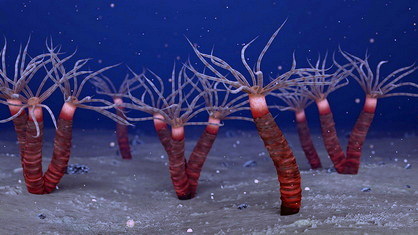
This creature was a small polyp that lived inside a protective tube anchored to the seafloor. It had a ring of about 12 feathery tentacles and a simple digestive system. In other words, it already displayed multiple modern-looking, functional features.

Jellyfish and their relatives are anything but simple. (Long Beach Aquarium, photo by DFC)
The Evolutionary Story
Evolutionists point to this find as filling a gap. They argue it shows jellyfish-like organisms were already diverse and “surprisingly modern-looking” 450 million years ago.
At the same time, they describe the preservation as exceptional, remarkable, and rare, since soft-bodied organisms typically decay within hours or days.
But There’s Another Way to Look at This
Remove the evolutionary assumption, and the picture changes completely.
This level of preservation doesn’t require invoking rare causes—it’s exactly what you would expect from rapid, catastrophic burial.
Consider the evidence:
- All specimens on each slab are oriented in the same direction
- None show any signs of scavenging or decay
- Extremely delicate structures, like fine tentacles, are intact
This is classic catastrophic burial (obrution). Modern jellyfish decay quickly, so preservation of this quality strongly points to sudden, overwhelming burial—not millions of years of slow, gentle sedimentation.
Not Primitive — Fully Formed
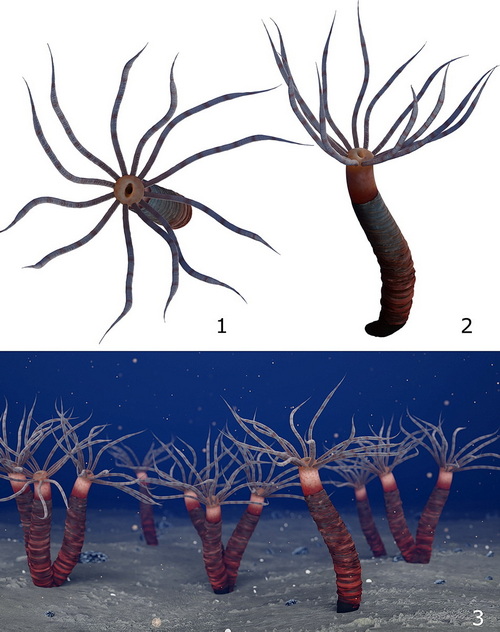
Interpretive drawings of Paleocanna tentaculum n. gen. n. sp. as living organisms. (1) Oral view showing a circle of tentacles. (2) Lateral perspective of the tube, highlighting the tube aperture and annular striations. (3) Depiction of individuals living in single tubes, as well as clusters of two or three tubes attached together. Fig. 5 from the paper in Journal of Paleontology.
Equally important is the organism’s complexity.
Paleocanna is not a primitive or transitional form. It is fully functional and well-developed from the start—complete with tentacles, a protective tube, and a working digestive system.
Rather than showing a gradual build-up of complexity, the evidence shows these organisms appearing fully formed and well-adapted.
There is no compelling need to place it on an evolutionary “stem-group” tree. It fits more simply as variation within a created cnidarian kind—the broader group that includes jellyfish, corals, and sea anemones.
The claimed 450-million-year age is also open to question, as radiometric dating methods continue to face serious challenges.4-7
Seen in this light, these fossils fit naturally as part of pre-Flood marine ecosystems, rapidly buried as rising waters overwhelmed seafloor environments.
The order seen in the fossil record, then, reflects not millions of years of evolution, but simply ecological sorting—organisms buried according to where they lived and how mobile they were—it’s not when they lived but where.
Bottom Line
This discovery doesn’t strain the creation/Flood model—it fits it.
These fossils appear to be the remains of pre-Flood seafloor communities, suddenly buried early in the Flood as waters rose and sorted organisms by habitat.
The exceptional preservation, uniform alignment, and advanced complexity are exactly what we would expect from rapid, catastrophic burial—not slow, gradual processes over deep time.
What is described as surprisingly “modern-looking” or a “rare” instance of preservation” becomes far less remarkable when the assumption of deep time is set aside.
Instead of a “missing link,” this jellyfish relative is exactly what the title suggests—too advanced and far too well preserved to fit the evolutionary story.
Recommended Resource: Illustra short video about jellyfish locomotion.
References:
- Darwin, C. (1859). On the origin of species by means of natural selection, or the preservation of favoured races in the struggle for life (1st ed., pp. 287–288).
- Ramirez-Guerrero, G., Alghaled, H., Bateman, L.-P., Cournoyer, M., & Cameron, C. B. (2026). Thecate stem medusozoan polyp from the Upper Ordovician of Québec. Journal of Paleontology. Advance online publication. https://doi.org/10.1017/jpa.2025.10211
- Scott, A. (2026, April 22). 450-million-year-old jellyfish relative reveals new species and clues to early evolution. Discover Magazine. https://www.discovermagazine.com/450-million-year-old-jellyfish-relative-reveals-new-species-and-clues-to-early-evolution-49004
- Carter, R. (2024, May 29). A biblical timescale for radiocarbon dating. Answers Research Journal, 17, 1–28. https://answersresearchjournal.org/radiometric-dates/biblical-timescale-radiocarbon-dating/
- Thomas, B. (n.d.). Radiometric dating. Institute for Creation Research. Retrieved April 28, 2026, from https://www.icr.org/creation-radiometric/
- Hayes, R. (2017, January 31). Paper spotlights key flaw in widely used radioisotope dating technique. NC State News. https://news.ncsu.edu/2017/01/radioisotope-dating-flaw-2017/
- Kriger, B. (2026, February). Critical analysis of radiometric dating of meteorites: Accuracy, assumptions, and potential limitations. Global Science News. https://medium.com/global-science-news/critical-analysis-of-radiometric-dating-of-meteorites-accuracy-assumptions-and-potential-a88aba53209f

Ronald D. Fritz, PhD, is a retired research statistician whose career spanned 27 years. Before entering the field of statistics, he worked as an engineer and engineering manager in the defense industry. He earned his doctorate in Industrial Engineering, with a minor in Mathematical Statistics, from Clemson University, where he was honored as a Dean’s Scholar. Dr. Fritz served as a consulting statistician across a broad range of industries, culminating in a 12-year role as a global statistical resource at PepsiCo. During his time at PepsiCo, he led significant research on gluten contamination in oats and its relationship to celiac disease, publishing several articles on the subject.
In retirement, Dr. Fritz developed a deep interest in creation science, sparked by a visit to the Creation Museum in Petersburg, Kentucky. As he delved into the topic, he shared his findings with his pastor, which led to an invitation to speak at their church. This initial presentation opened the door to further speaking engagements at churches throughout the region. Dr. Fritz has been married for 35 years to his wife, Mitzie. They live in the mountain community of Bee Log, North Carolina, within sight of the church where they were married and now worship. In his free time, Dr. Fritz tends a small chestnut orchard on their property, working to revive what was once a cherished local delicacy. The couple has two adult children.
Comments
Creation and the Worldwide Flood are the best explanation for jellyfish-like fossils.