

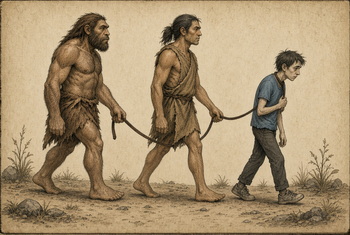

Are Modern Humans Degenerate Neanderthals?
The science is showing that
human ancestors were bigger
and stronger than we are,
and probably smarter
Here’s a paradigm shift for you: what if we modern humans devolved from Neanderthals and Denisovans? What if we would stand in fear and trepidation in the presence of their might and height? And what if they lived together with so-called “modern humans” not that long ago?
What if the Bible was right about human origins, and Darwinism has misled the experts for 167 years?
In many ways, our mightiest men and most stalwart women today are wimps compared to our ancestors. Their mighty deeds are evident in megalithic structures. The only reason they didn’t have smartphones and rockets is that it takes time to accumulate and share knowledge. Two centuries ago we didn’t have cars, motors. or even electric lights. But human ancestors traveled far and wide between continents, built cities with massive stones, and mastered the use of fire.
If you dismiss the Darwin Years timeline, the human beings that evolutionary racists disparage with labels like “Neanderthal” and “Denisovan” were intermarrying with so-called “modern humans” not that long ago—providing strong evidence that they are members of our own species. The two types comprised successful people groups, most likely healthier, taller, and stronger than we are today. Like Nimrod, the ‘mighty hunter’ of Genesis 10:8–9, they were sinners as well—fully capable of overpowering and enslaving us. We would have been left trembling in their presence with no recourse.
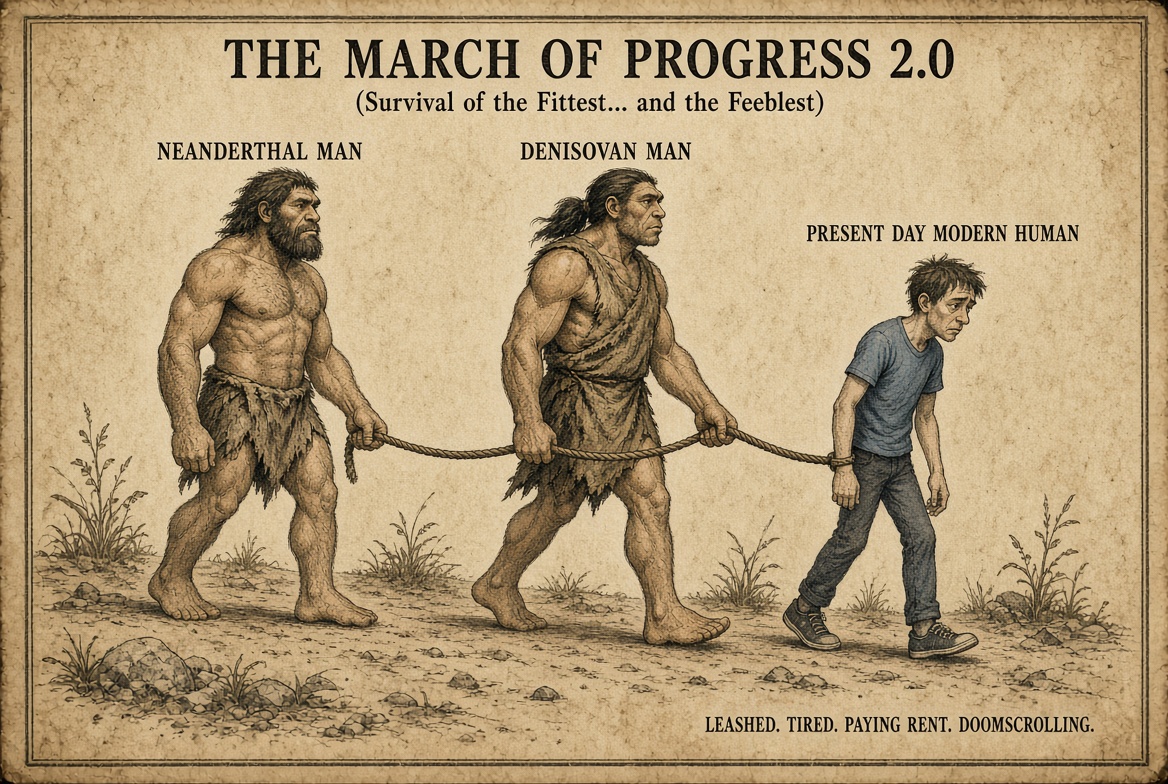
The new progression (Grok)
The Bible indicates that our ancestors lived for centuries before and after the Flood. Lifespans declined as mutations accumulated. Despite our advanced technology and modern medicine, we remain subject to the accumulation of mutations, leading to genetic diseases, biological vulnerabilities, and the broader effects of genetic entropy. Dr Jake Hebert at ICR gave a presentation this week for Logos Research Associates about the long lifetimes of Genesis patriarchs. From scientific evidence primarily from published mainstream sources, Dr Hebert showed that other animals appear to have lived longer in the past as well.
It’s long overdue for scientists to step off their pride pedestals and give our ancestors respect (see 27 Jan 2019). Recent findings listed below should help, if we can scrape off the evolutionary assumptions, dismiss the Darwin timeline, and evaluate the evidence on its own merits.
 Neanderthals passed on a gene that helps modern humans pack on more muscle — but only a few people have it (Live Science, 11 Aug 2026). Look at the illustration showing a Neanderthal competing with a modern human in weightlifting. Instead of seeing evolution somewhere, is it possible that the first humans possessed the more-muscle gene from the start, but the branch of so-called “modern” humans had lost it? Would our ancestors have triumphed over us in modern Olympics competitions?
Denisovans may have dwarfed other ancient humans (New Scientist, 11 Aug 2026). James Woodford looks at evidence of leg bones recently found near Taiwan, labeled Denisovan, that suggests the two individuals stood over 6 feet tall.
Two Denisovans who lived around 45,000 [Darwin] years ago were among the biggest humans of their time, with one, at a height of 190 centimetres, estimated to be around 20 centimetres taller than the average man today.
The evidence was published August 8 in the preprint server bioRxiv., which states:
Our findings demonstrate that the Denisovan population at the northern circle had larger body size than earlier Homo erectus as well as Late Pleistocene Homo sapiens in eastern Asia.
Insights into hominin body size, locomotion, and behavior from Early Pleistocene trackways in northern Kenya (Hatala et al, PNAS, 27 July 2026). This paper makes a big deal out of the size of the big toe (hallux) on trackways in Kenya. They try to link the tracks with Paranthropus boisei and with Homo erectus. They claim that the big toe prints look different from ours. Without the evolutionary presuppositions, though, it appears that the track-makers, most likely ancestral humans, were bigger than we are.
However, the tracks indicate body sizes that exceed the largest skeletal estimates for P. boisei, raising the possibility that they may belong to H. erectus. Depending on their attribution, the tracks demonstrate a) larger body sizes and greater size variation in P. boisei than previously recognized, or b) levels of intraspecific anatomical and locomotor variation in H. erectus that far exceed those yet observed in modern humans or other fossil taxa. Regardless of their attribution, these tracks indicate larger than average body sizes.
Was the locomotor variation evolutionary? They don’t have much to say about that, and they don’t know, because they weren’t there. For all we know, the human trackmakers were practicing some dance moves or sports. Or maybe the mud was just slippery.
Homo erectus fossils are rare, but are considered part of the human family even by evolutionists (within our genus Homo). One should not discount the possibility that some irregular skulls like Homo erectus, or like the Hobbits (Homo floresiensis), represent individuals with genetic disease from inbreeding in small people groups. The evolutionary classification is a confused muddle anyway, and some H. erectus fossils show these brethren were strong and tall as well (29 June 2013).
Long-term cultural continuity across the Neanderthal–modern human sequence at Üçağızlı II Cave, northern Levant (Baykara et al, PNAS, 29 July 2026). Well, what do you know. Humans got along with humans for a long time. Humans acted like Neanderthals, and vice versa. In the following excerpt, remember to translate the Darwin Years down to Genesis years for it to make sense; otherwise, evolutionists will lead you to think that none of them thought about farming or riding a horse for 47,000 years, much longer than all recorded human history. That’s absurd (see 9 March 2023).
Of particular significance for the evolution of our own species, Homo sapiens, during the Late Pleistocene is the geographic and temporal proximity to our closest relatives, the Neanderthals. However, the behavioral record documenting such between-species proximity during this period often lacks associated diagnostic fossil data. Here, we present archaeological evidence from the Levant—a primary corridor between Africa and Eurasia—demonstrating that a local population of H. sapiens in the northern Levant within the chronological range of 59,000 to 47,000 y ago was characterized by a behavioral repertoire consistent with that of the preexisting Neanderthals at the same cave. The evidence demonstrates that different human species shared similar, local behavioral patterns, extending from subsistence strategies to nonutilitarian practices.

Sanford’s book examines the impact of near-neutral mutations that are invisible to selection.
Nonutilitarian practices; what might those have been? Philosophizing around the campfire? Recalling the Flood and the stories of Genesis? Making exquisite art on cave walls? Planning the next sailing trip to faraway islands?
Other considerations
Around the world, there are impressive earthworks and structures that boggle the minds of historians and archaeologists. At Macchu Picchu, stones many tons in weight, quarried up the mountain from long distances, have been fit together so perfectly it is hard to stick a knife blade between them. Places in ancient Greece impress archaeologists with stones so large they have been named “cyclopean” stones, as if mythical giants put them there. (See this YouTube example of the evidence. We do not endorse the worldview or conclusions of the narrator, but read the caption about the wall’s similarity to sites in Lebanon and Peru.) Of course, Stonehenge is a classic mystery, considering that the quarry was far away, and the perfection of the Egyptian pyramids remains astonishing. Why did the Mayans also build pyramids on the other side of the world? And new evidence is coming to light, using Lidar, of massive earthworks in the Amazon rainforest (16 June 2026). Our ancestors were not dumb. Wicked, often, but not dumb.
Indeed, evidence around the world, from Asia to South America, has led some to propose that space aliens with greater knowledge and power made some of the structures. Even up to Roman times, abilities of earlier humans to build huge walls, dig tunnels, design aqueducts and mausoleums without the benefit of powered machines, electric motors and sky cranes cannot fail to impress visitors to the sites. These were made by humans like us, only bigger, stronger, and probably innately smarter.
Next time someone calls you a Neanderthal, thank them for the compliment. And then sing “Praise to the Lord, the Almighty, the King of Creation” by Joachim Neander, whose surname was borrowed to label the first Neanderthal bones found on his land (22 Feb 2016).
Summary
From bones, genes, and artifacts, there is plenty of evidence that our ancestors were larger and stronger than we are today. They were not just muscular brutes evolving upward gradually. They started out smart and strong. They used their brains with the resources available to them. Genesis 5 states that metallurgy, music and ranching was going on within a few generations of Adam. The first son (Cain) knew farming and in his centuries of life, he moved to a city his siblings had built, and married his sister or niece as his wife. In those early days, mutational load was very low, so within-family marriages (the only option from an original couple) were healthy. Laws against incest came after the Flood when the mutational load became a problem.
After the Flood changed the world, how long after the Tower of Babel dispersion did it take people to reach China and south sea islands? Millions of years? No; smart people could have traveled the world in decades, taking their knowledge, memories, and know-how with them.
Today we have the benefit of millennia of collected know-how helping us make technological advances while our bodies and brains degenerate from the accumulation of mutations. This is very different from Darwin’s myth of upward progress, which seems to unravel more and more with every new finding (24 Dec 2024).
Let us return to the Book that got it right, telling us about the Creator who made us and the world, and who did not fail to provide for our redemption after our first parents rebelled.