


Intelligence of Early Humans Debunks Caveman Myth
Avoid today’s artist impressions of
early man. The facts show that early
humans were smart and creative.
New Research Is Causing the “Caveman” Myth to Crumble:
Early Humans Were Actually Remarkably Intelligent
by Jerry Bergman, PhD
The Bible’s account portrays the first created humans as highly intelligent—every bit as capable as modern humans, if not more so. In contrast, for decades, evolutionists have pictured early humans as primitive, intellectually inferior brutes, bent-over cavemen who grunted in their poor attempts to communicate.
New discoveries, however, are steadily moving our picture of early humans toward something much closer to the Biblical description of Adam: intelligent, creative, technologically capable, and fully human. In fact, new discoveries are increasingly making so-called ‘ancient man’ appear not very ancient.[1] The fossil record tends to be sparse when it comes to human beings and for the very earliest evolutionary members of Homo sapiens that evolutionists believe lived about 60,000 years ago, we have no fossils at all which would be expected if Adam was the first human.[2]
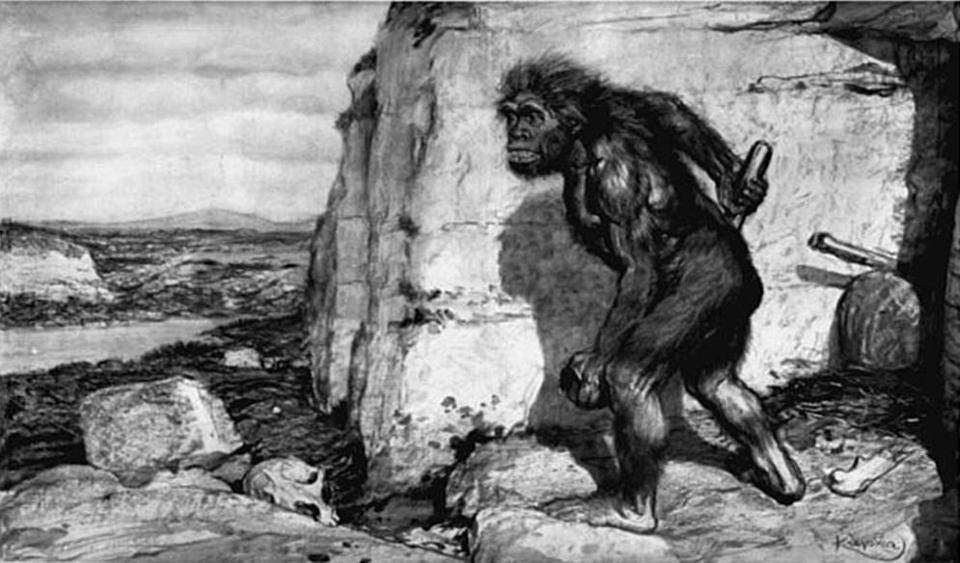
An early depiction by an unknown artist in the late 1800s of a Neanderthal: beetle-browed, bow-legged, stooped over, hairy, and black. Today’s scientists recognize Neanderthals as intelligent and resourceful with genes like ours.
The picture of what these ancient humans actually looked like—and especially how they behaved—was often filled in with artistic reconstructions and assumptions about what a “primitive” human ought to look like (see Figure 1).
New Research Reveals the Surprisingly Sophisticated Mind of Early Humans
A recent archaeological research report in southern Africa led by researchers at the University of Bologna challenges the picture of early humans as primitive brutes.
 60,000-year-old ostrich eggshell engravings reveal a surprisingly sophisticated human mind (ScienceDaily, 9 Aug 2026). The first question that comes to mind is “Why would someone write on fragile ostrich eggshells?” Actually, this was a good choice because ostrich eggshells are the strongest known eggshells. They can withstand up to 220 kg (485 lbs.) of vertical weight and 120 kg (265 lbs.) of horizontal force without cracking. When the weight is evenly distributed, an adult human can even stand directly on an ostrich eggshell without crushing it. The shells’ remarkable strength, combined with their ability to hold liquids, made them an ingenious choice both as a writing surface and as liquid containers.
What the Researchers Learned
Archaeologists led by Professor Silvia Ferrara of the University of Bologna, in collaboration with Professor Enza Spinapolice of Rome’s Sapienza University, have uncovered hundreds of engraved ostrich eggshells at several archaeological sites in southern Africa. These artifacts were created by groups of very early Homo sapiens living in the region. The engravings followed recurring geometric principles involving parallel lines, right-angle relationships, and repeated regular patterns.
The elaborate designs included hatched bands, grids, and diamond-shaped motifs that showed evidence of rotation, translation, repetition, and “embedding” (i.e., building hierarchical levels within the same surface). These patterns on eggshells are significant because they were not merely decorative but suggest that the engravers were working with abstract rules and deliberately applying those rules in systematic ways. The ostrich eggshells were also used as containers for carrying and storing water and other liquids, making them valuable objects in the daily lives of these ancient people.[3] The evolutionists concluded that these Homo sapiens lived more than 60,000 years ago—far earlier than previously recognized—they lived in southern Africa,
engraving ostrich eggshells with intricate geometric patterns that appear far more organized than previously realized. Researchers found recurring grids, parallel lines, right angles, and repeated shapes, suggesting the designs followed deliberate rules rather than being improvised. The engravers may even have planned entire patterns in their minds before carving them.[4]
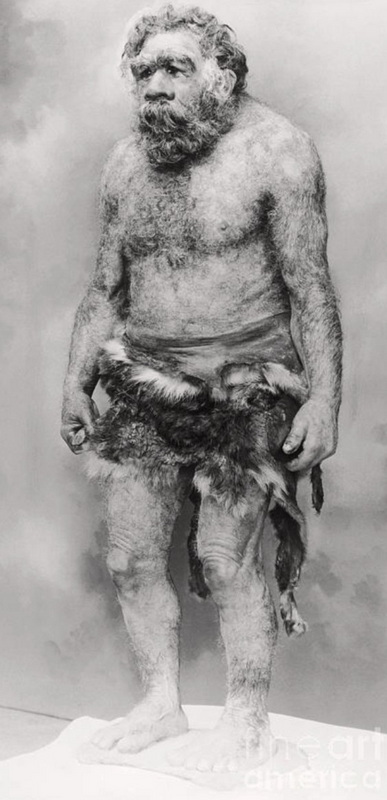
A classic picture of an early human drawn in the late 1800s by an unknown artist, which is now recognized as a grossly distorted picture.
How Does This Compare with the Biblical Picture of Humanity?
The eggshell markings could even have had information about what was being carried in the ostrich eggs. The figures were produced by people who used a “surprisingly structured, geometric way of thinking.” They were drawn by persons who organized the pictures according to recurring symbols, including parallelisms, grids, rotations and systematic repetitions.
To investigate these patterns, the researchers conducted a systematic quantitative analysis of 112 eggshell fragments recovered from two South African archaeological sites. Using advanced sophisticated geometric and statistical techniques, they reconstructed the directions, angles, and paths of the engraved lines.
The irony here is difficult to miss: the more carefully we examine the evidence, the less convincing the old image of the intellectually primitive “caveman” becomes.
Interpreting the engravings within the broader context of human cognitive evolution, the authors wrote: “The capacity to arrange shapes and lines in organized configurations may represent an important sign of” the ability to use abstract thought. The study concluded that these engravings “constitute an early material expression of complex graphic representation, attesting to a species-specific human capacity for organizing geometric thought. Overall, the patterns reflect a system of rules through which Homo sapiens … organized visual forms, revealing the cognitive foundations of structured graphic behavior.”[5]
Notice the researchers are not describing random scratches, but a system of rules, organized geometric thought, abstract representation, and deliberate structuring of visual forms. Whatever worldview one brings to the question of human origins, this is a remarkably sophisticated description of people who, evolutionists propose, lived over 60,000 years ago.
A separate 2026 study provided further evidence of sophisticated symbolic behavior among Paleolithic humans. Christian Bentz, Associate Professor and Chair of Digital Methods and their Application in the Humanities, and his associates, analyzed more than 3,000 signs carved into 260 Paleolithic artifacts.[6] Their study concluded that early humans were engraving symbols onto tools, figurines, and other objects that displayed levels of complexity and information density similar to the earliest known writing system, called proto-cuneiform, which appeared around 3,000 B.C.E.
One example was a small mammoth figurine carved from mammoth ivory. Its surface is marked with rows of crosses and dots, likely used to communicate or store information. The researchers digitized the sequences of signs and analyzed them using quantitative-linguistic methods, statistical modeling, and machine-learning classification algorithms. They then estimated how much information the signs could potentially convey and compared their information density with that of both early cuneiform and modern writing systems.
The researchers found that the complexity and information density of these signs were in several respects comparable to those of proto-cuneiform. This does not prove Paleolithic humans had developed writing in the conventional sense, but it does suggest that sophisticated systems of symbolic communication existed much earlier than previously believed.

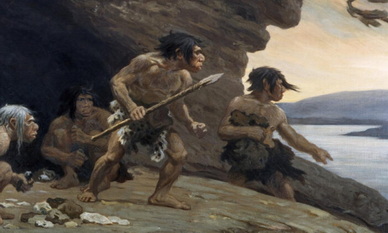
Charles R. Knight’s, “Le Moustier Neanderthals,” 1920 (photo: Public Domain). Such depictions of cavemen are far from the historical record.
Summary
The two findings reviewed above are difficult to reconcile with the familiar image of so-called early Homo sapiens as intellectually primitive “cavemen.” The researchers found evidence that these humans mastered precise, pre-planned patterns based on geometric principles such as orthogonality and parallelism. The fact is “early humans were already carving rule-based geometric designs that reveal a surprisingly sophisticated mind.”[7] This included the Neanderthal people group.
“They also identified a distinct set of cognitive operations—including rotation, translation, iteration, and embedding—that were used to organize the designs. The engravings, therefore, represent much more than random marks or simple decorations. As the researchers concluded, they provide evidence of an early expression of complex graphic representation that attests to the human capacity for organizing geometric thought.[8]
Think about what this means. These were not people struggling toward intelligence. They were people already capable of recognizing abstract relationships, establishing rules, mentally organizing patterns, and intentionally reproducing those patterns on physical objects. The archaeological record may not reveal their deep thoughts, but it does preserve evidence of what their minds were capable of. Neanderthals are now recognized as a human people group, who were not brutish, as shown in this famous painting below, but rather were fully modern.

If you put a Neanderthal in a business suit and had him walk down Broadway, nobody would think he looked unusual. Yet evolutionists have used “Neanderthal Man” as a missing link for over a century. (Grok/XI)
References
[1] Università di Bologna. “60,000-year-old ostrich eggshell engravings reveal a surprisingly sophisticated human mind.” https://www.sciencedaily.com/releases/2026/08/260808235013.htm, 9 August 2026.
[2] Longrich, Nick. “Almost human: Who were the primitive Homo sapiens who lived alongside us?.” https://www.nicklongrich.com/blog/almost-human-who-were-the-primitive-homo-sapiens-who-lived-alongside-us, 11 February 2026; emphasis mine.
[3] Decembrini, Valentina, Ludovica Ottaviano, Mattia Cartolano, Enza Elena Spinapolice, and Silvia Ferrara. “Earliest geometries: A cognitive investigation of Howiesons Poort engraved ostrich eggshells.” PLOS One 21(2):e0338509, DOI: 10.1371/journal.pone.0338509, 11 February 2026.
[4] Università di Bologna. “60,000-year-old ostrich eggshell engravings reveal a surprisingly sophisticated human mind.” https://www.sciencedaily.com/releases/2026/08/260808235013.htm, 9 August 2026.
[5] Decembrini, et al., 2026.
[6] Bentz, Christian, and Ewa Dutkiewicz. “Humans 40,000 y[ears] ago developed a system of conventional signs,” Proceedings of the National Academy of Sciences 123(9), DOI: 10.1073/pnas.2520385123, 23 February 2026.
[7] Università di Bologna, 2026.
[8] Decembrini, et al., 2026.
 Dr. Jerry Bergman has taught biology, genetics, chemistry, biochemistry, anthropology, geology, and microbiology for over 40 years at several colleges and universities including Bowling Green State University, Medical College of Ohio where he was a research associate in experimental pathology, and The University of Toledo. He is a graduate of the Medical College of Ohio, Wayne State University in Detroit, the University of Toledo, and Bowling Green State University. He has over 1,900 publications in 14 languages and 40 books and monographs. His books and textbooks that include chapters that he authored are in over 1,800 college libraries in 27 countries. So far over 80,000 copies of the 60 books and monographs that he has authored or co-authored are in print. For more articles by Dr Bergman, see his Author Profile.
Comments
In the search for human origins, evidence shows humans were intelligent from the start. It’s hard to reconcile with evolutionary thought but is fits perfectly with the biblical account. Between the Creation and the Worldwide Flood, people had knowledge of working with metals.
The latest in a mounting pile of evidence for intelligent behaviors unique to humans. One site has modern human remains (perhaps archaic, but assigned to our species) and was dated to almost 300,000 years ago.* The signs of human-level intelligent behavior are also found in sites inhabited by Neanderthals (which we now know were not a separate species, according to their ability to produce viable offspring through interbreeding) and also H. erectus and other “species” that supposedly existed long before ours.
Hi David. We prefer that comments do not take readers away to other sites. Also, this comment is fairly long. Could you rewrite your comment to summarize your points without putting in external links?
Thank you,
Editor