

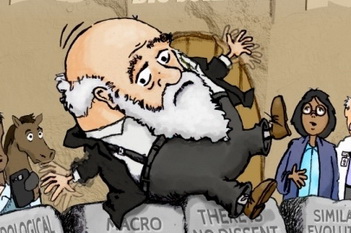

The Tower of Naturalism Is Fracturing into Confusion
There is a certain consistency in
what physicists can agree upon:
some questions ought not be asked.
The ABCs of Modern Physics: Anything But Creation
by John D. Wise, PhD
Most of us grew up in a world in which science, and especially cosmology, was essentially figured out. Sure, there were a few puzzles to solve, but the Big Picture? We know how it all came together. Science means Knowledge, after all.
But the fabled Emerald City has never been that tidy. A massive new survey reveals the Wizard behind the curtain.
 Physicists can’t agree on how the universe works (ScienceDaily, 13 September 2026). Citing a landmark survey led by the Perimeter Institute and University of Waterloo and published in Physics Magazine, the largest worldwide survey of physicists on this topic ever conducted shows that experts are hopelessly divided on fundamental questions about how the cosmos works.
The Consensus Mask
For as long as I can remember, we’ve been told that scientists agree: modern astrophysics has reconstructed cosmic history with high-precision certainty. The survey results, however, make it clear that “scientific consensus” on a variety of fundamental issues is an imaginative ideal that isn’t even being approached, except for one notable exception:
- The Standard Model of cosmology (or Lambda Cold Dark Matter) failed to secure majority support among surveyed physicists. Recent observational surprises (such as shifting dark energy signals from DESI) have left theorists scrambling.
- Dark Matter: Only 17% back the standard hypothesis of an undiscovered low-mass particle. 12% think gravity equations need rewriting, while the largest single bloc (21%) can only suggest “some combination” of conflicting guesses.
- Quantum Gravity? After nearly a half-century of hype, String Theory managed 19% support. Loop Quantum Gravity took 12%, while 18% think gravity cannot be quantized. Others, like Sean Carroll, abandon fundamental spacetime altogether, trying to conjure gravity out of pure quantum abstraction. See below.
- Cosmic Inflation? Alan Guth’s unobserved hyper-expansion engine, concocted to save the secular origins story from its horizon and flatness problems, was one of the rare items to achieve a majority at 51%.
- We agree! The solitary point of solid agreement was telling: 68% agreed that the Big Bang does not represent an absolute beginning of time.
Far from Settled: Respondents at Odds over Greatest Physics Mysteries (Physics, 12 May 2026) Yet the most staggering revelation appeared when researchers asked physicists how to account for the astonishing (and undeniable) fine-tuning of universal constants:
The survey also probed views on the so-called fine-tuning of the constants of nature—often presented as forcing a choice between a multiverse or an intelligent designer. Neither of those options prevailed, with the single most popular choice being that the constants are “brute facts” that need no further explanation. [my emphasis]
There is a certain consistency, then, in what physicists can agree upon: some questions ought not be asked.
Empirical science was born from the conviction that the universe is an intelligible, orderly creation governed by discoverable rational principles. The Principle of Sufficient Reason (that things have an explanation for why they are as they are) is the fuel that drives every experiment, equation, and hypothesis in science.
Yet the moment the “hard-nosed” modern physicist gazes into the fine-tuned mirror of empirical Reality, a statistical miracle by any objective measure, they throw up their hands and declare: “Stop asking questions and seeking reasons.”
“It just is.”
Calling cosmic fine-tuning a “brute fact” is not a scientific conclusion. It is a metaphysical roadblock. Like all evidence filtered by mind, this evidence points somewhere. In today’s physics, however, arbitrarily shutting down the scientific process when the evidence becomes inconvenient passes for sophisticated restraint.
Case Study: Sean Carroll’s Quantum Reincarnation[1]
The surprising upsides of living in a reality that repeats for eternity (New Scientist, 18 August 2026)
If you want to see the bizarre lengths theorists will go to maintain this posture, look no further than this interview with cosmologist Sean Carroll. Faced with the absurd paradoxes that haunt eternal inflationary cosmologies (such as “Boltzmann brains,” where isolated consciousnesses randomly fluctuate into existence in dead space), Carroll proposes a radical way out. His answer? The universe must be trapped in an eternal loop of expansion and contraction where reality repeats itself identically forever. In Carroll’s scheme, every galaxy reforms, every life unfolds again, and every conversation is repeated word for word for eternity.
Consider the spectacle. To escape an absolute beginning and avoid an Intelligent Designer, one of modern naturalism’s foremost spokesmen resurrects Friedrich Nietzsche’s myth of Eternal Recurrence in scientific garb. Under the banner of quantum cosmology, the public is offered cosmic reincarnation (eastern mysticism) and fatalistic determinism. It begins to seem (if you’ve been following my articles here on CEH) that anything, no matter how unobservable, untestable, or wildly speculative is preferable to admitting that “in the beginning, God created the heavens and the earth.”
The Tower of Naturalism Fractures into Confusion
If you read textbook summaries or watch popular science documentaries, you are fed a monolithic narrative: the universe inflated out of nothing, dark matter seamlessly cradles galaxies, dark energy expands the cosmos, and theorists are just dotting the i‘s and crossing the t’s on a grand theory of everything. Disagree and you’re a troglodyte, a science denier of the worst order. This survey shreds that facade. Behind closed doors, the “consensus” is fractured into warring factions. Even the “Standard Model” can’t scrape together a majority.
The primary ingredients of the cosmos (dark matter and dark energy) remain theoretical phantoms after decades of failed detection.
Why is there such persistent disharmony? And why does the mask so seldom slip?
 The answer lies in the one unspoken presupposition uniting all these warring factions: methodological naturalism (in its positive expression), which is (negatively expressed) just the flip side of 19th C. anti–supernaturalism. Heads I win, tails you lose.
Because the secularist guild has dogmatically outlawed intelligent agency from the outset, every theorist is forced to explain a finely tuned, orderly, information-rich cosmos through purely self-assembling, materialistic mechanisms. Evolution is the fiat-coin of the realm, from cosmic to microscopic. When the data stubbornly refuses to match their equations, materialists cannot abandon the currency without giving up the game. Instead, they invent epicycles: unobserved inflation fields, hypothetical exotic particles, multidimensional strings, and multiverse landscapes, each suited to its own niche positions.
Revisit that one survey question that garnered overwhelming agreement: 68% insisted that the Big Bang was not the beginning of time. Why? Because an absolute beginning puts an absolute, transcendent Cause[2] outside of matter, energy, space, and time back on the table. Naturalists will tolerate any infinite regress of untestable cosmic bounces or quantum foam before they will acknowledge that physical reality had an external Beginner.
This survey should remind us that SCIENCE IS NOT SETTLED, and repeatedly insisting that it is, doesn’t make it so. Reality stubbornly pushes back against human hubris.
As I’ve insisted repeatedly, modern secular science is a house divided against itself, sustained only by a shared commitment to anti-supernaturalism.
Footnotes
[1] Sean Carroll makes his debut on CEH in 2011. Apparently he’s still playing in the same sandbox.
[2] Western society, despite notable exceptions, almost uniformly embraced this rational notion across millennia: Plato called it The Good, Aristotle the “unmoved mover,” and the Bible? The Lord Jesus Christ.
Update 9/15/2026: Another article appeared this week on this same subject: “The cosmic coincidences that made our universe – and us – possible” (New Scientist, 14 Sept 2026). Leah Crane admits outright that the universe is finely tuned for our existence. Speaking of solar eclipses and physical constants, she begins:
All this got me thinking about how extraordinary it is that we are here at all. I don’t necessarily mean me in particular, or even humanity – the twin marvels of life arising from non-living matter and evolution are a bit outside my wheelhouse, and frankly too complicated for me to fully comprehend – but the conditions of the universe that make life, and planets, and suns, and even something as fundamental as matter possible.
In her article, she offers 3 anti-supernatural explanations for why this is so, each of them in “Maybe” form, ending with a conclusion, “some things are simply inexplicable.” Like Dr Wise says, “Anything but Creation” is always the go-to answer, even when staring evidence for design in the face. —Ed.
 John Wise received his PhD in philosophy from the University of CA, Irvine in 2004. His dissertation was titled Sartre’s Phenomenological Ontology and the German Idealist Tradition. His area of specialization is 19th to early 20th century continental philosophy.
He tells the story of his 25-year odyssey from atheism to Christianity in the book, Through the Looking Glass: The Imploding of an Atheist Professor’s Worldview (available on Amazon). Since his return to Christ, his research interests include developing a Christian (YEC) philosophy of science and the integration of all human knowledge with God’s word.
He has taught philosophy for the University of CA, Irvine, East Stroudsburg University of PA, Grand Canyon University, American Intercontinental University, and Ashford University. He currently teaches online for the University of Arizona, Global Campus, and is a member of the Heterodox Academy. He and his wife Jenny are known online as The Christian Atheist with a podcast of that name, in addition to a YouTube channel: John and Jenny Wise.