


Bad Methods Get Evolution Super Wrong
Historical biology has no eyewitness testimony
to support its story, and no reliable way to
calibrate its methods to empirical observation
Inventing Evolutionary Stories from Incomplete Data
The Hyper-Rational Scholasticism of Modern Cladistics
by John D. Wise, PhD
The Phantom Ancestor
Cladistics is not an empirical test of common ancestry; it is a tree-generating machine that sorts data according to cladistic axioms. You can feed a matrix of 50 different motor vehicles into phylogenetic software, and the algorithm will gladly output a beautifully resolved, nested cladogram showing how a single-cylinder moped evolved into a Boeing 747. Here is a case of cladistics distorting the data instead of illustrating it.
Recently, in The Courage to Calibrate, we applauded a rare virtue in historical biology: the willingness to test the success of evolutionary reconstructive tools and methods against observable reality. In that study, paleontologist James Napoli discovered that when some of paleontology’s algorithmic methods (Geometric Morphometrics and cladistic ontogeny) were applied to living alligators, the software failed to distinguish distinct living species and actively manufactured false evolutionary trajectories out of juvenile growth stages.
Now, a recent study published in Nature Communications exposes an (apparent)[1] macro-scale twin to Napoli’s micro-scale critique:
 Fossil record biases skew inferences of mammal trait evolution (Graciela Sotelo et al., Nature Communications, 24 August 2026). This team finds that methods of inferring evolution from fossils can go awry. “Our results provide first-order estimates of how fossil record incompleteness can bias our interpretation of deep-time biodiversity change,” the Abstract says.
Here, we simulate a future fossil record of present-day land mammals to quantify the extent to which real evolutionary patterns can be recovered from fragmentary fossil data.
 If We Knew Today’s Mammals Only from Fossils, We’d Get Evolution Super Wrong (ZME Science, 26 August 2026). In this popularized review of the paper, Mihai Andrei summarizes what the research team did and what they concluded. The research team basically executed an ingeniously inverted calibration experiment. Instead of beginning with fragmented fossils from the unobservable past and trusting the algorithm to construct a cladogram (a chart of ancestral relationships), they started with a complete dataset of 3,710 living land mammals whose true body sizes, diets, geographic distributions, and relationships are known. No one, apparently, realized the obvious logical corollary to this title:
“Since all we know of ancient biology are the fossils, we’ve gotten evolution super wrong.”
The researchers then subjected this census of modern animals to real-world fossilization and sampling filters: sediment availability, geographic range, body-size preservation bias, and historic collector tendencies. After running 4,200 simulations across a variety of preservation rates, the simulated fossil record retained as little as 1.3% to 3% of living species. Small creatures (bats, shrews, rodents) and small carnivores vanished entirely.
From Data to Distortion
To see how severe this distortion becomes, the researchers tested standard evolutionary software on a fundamental task: reconstruct the common mammalian ancestor. In evolutionary biology, these algorithms are trusted to trace the branches of a phylogenetic tree, deducing the physical size, diet, and biology of the projected root ancestor.
The team ran two separate software trials:
- The Full-Data Benchmark: Running the algorithms on the complete modern catalog of 3,710 living species.
- The “Fossil” Simulation: Running the same software on the “fossils” left after preservation filters (as few as 47 to as many as 900 species).
When fed the full dataset (1), the software calculated a common-root mammalian ancestor weighing roughly 1.7 lbs (790 grams, the size of a cottontail rabbit) that ate insects and small prey. When fed the “surviving fossil” sample (2), the software did not report ‘missing data,’ nor did it widen its confidence intervals to reflect the vast informational loss. Instead, it confidently fabricated an ancestral mammal weighing 22 to 25 pounds (over 10 kilograms) whose diet had flipped to an herbivore or omnivore.
In other words, the lost data swelled the hypothetical ancestor by more than 1,200 percent in mass, leaping from a tiny, solitary insect-hunter to a 25-pound grazing beast!
And this imaginary creature was not an isolated computational fluke. The paper documented the exact same breakdown rippling across individual mammalian orders:
- Under realistic preservation scenarios, small-bodied clades, such as primates, bats, shrews and moles vanished from the record almost completely. Together with rodents, these groups comprise 76% of all living mammal species.
- Within specific orders like carnivores and rodents, ancestral diet inferences swung erratically between meat, plants, and omnivory depending on which preservation filter was applied.
- While the full dataset indicated gradual, steady trait variation, the degraded fossil data caused the software to invent false signals of “early burst” evolution or random genetic drift out of thin air.
ZME Science reports:
“Paleontologists have known for generations that the fossil record is incomplete. That’s not the problem. The unsettling part is that a fragmented record doesn’t necessarily produce a blurrier or incomplete version of the truth. It can produce a very coherent but false story.” [my emphasis]

This cuts to the heart of the matter. A partial record does not just leave gaps; it empowers algorithms to manufacture compelling hallucinations.
The Dead Witness and the Conceit of Deep Time
Why has this kind of calibration taken so long to arrive? And why does historical biology place such unyielding confidence in its computational genealogies?
The answer lies in an epistemological predicament clearly articulated by C. S. Lewis: in deep-time storytelling, the witnesses against the narrative are dead, and plausibility substitutes for real data.
In laboratory science (such as our previous look at the living, intact retinal circuits analyzed at Yale), the empirical referent is present in the room. If a theorist proposes a simplistic “backward-wired” camera myth, the living tissue under the patch-clamp pipette eventually talks back, shattering the narrative. But in deep time, the creatures are dead, the soft anatomy has decayed, and – so we’re told – the majority of biodiversity was never fossilized. Because the dead witness cannot testify, the speculation encounters no resistance, winning by default because no contrary witness remains to object.
ZME Science unwittingly exposes the hubris underlying this enterprise:
Secular historical scientists routinely toss around spans of tens and hundreds of millions of years as if they have a functional grasp of what that entails. In truth, human minds possess no intuitive or reliable empirical handle on such vast chronological abstractions.
Classical historiography understands this. Secular historians apply hyper-critical source criticism to human written testimony, constantly questioning bias, motive, and transmission errors. Yet in evolutionary paleobiology, this (at times) healthy historiographical skepticism is completely inverted. The discipline treats imaginative fictions built from mute, fractured bone fragments filtered through catastrophic burial and preservation biases with dogmatic certainty – examples below.
At the end of the ZME report, the author attempts to blunt the blow:
“So, ultimately, this doesn’t show that fossil analysis or reconstructions are wrong. Rather, they show that they’re quite likely reaching distorted conclusions because the available information is incomplete.”
This is the classic retreat to protect the consensus. But if your measuring rod makes a rabbit-sized insectivore into a 22-pound vegetarian dog in the present, on what empirical warrant do you trust it to reconstruct hominid lineages, the Cambrian explosion, or the tree of life from the unobservable past?

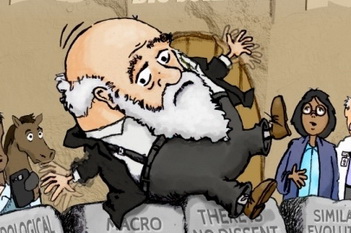
Humpty Darwin sits on a wall of foam bricks held together by decayed mortar. Cartoon by Brett Miller commissioned for CEH. All rights reserved.
Steven Novella Doesn’t Understand Nested Hierarchies
This brings us to the polemical defenders of cladistic consensus.
In his essay titled “Creationists Don’t Understand Nested Hierarchies,” secular skeptic Steven Novella asserts that cladistic methodology, and nested hierarchies (the methodologies exposed in this study) represent an unassailable “home run” for universal common descent. He claims that skepticism of the evolutionary tree stems from an uneducated failure to understand how shared character derivations naturally resolve into nested clades:
“… science follows methodological naturalism, and if you follow the methods of science there is only one logical, evidence-based, and scientific answer to the question of the origin of species. The evidence overwhelmingly shows that all life is descended from a common ancestor in a nested hierarchy of relationships.”
But Novella is trapped inside a subjective nested hierarchy of his own making, seemingly unaware of its circularity:
- Methodological naturalism is axiomatic, an inviolable boundary forbidding non-material cause.
- Universal common ancestry is axiomatic, the only permissible conclusion inside MN’s walls.
- Cladistic software is programmed with these axiomatic rules. All data, by methodological fiat, must resolve into a branching tree.
- The resulting tree is then paraded as “empirical proof” of common descent.
But … what is empirical about this conclusion? Only a smattering of data pulled from (on their own view) a deeply-deficient record of biological history. This is a textbook case of what Immanuel Kant called the “Transcendental Illusion”: mistaking a heuristic tool of rationality for the objective, ontological reality of the external world.
When Novella boasts of nested hierarchies, he confuses an organizational scheme – what he thinks he knows – with the unknown empirical history of the earth. Socrates would have a field day! When tested against living alligators (Napoli 2026), that schematic hierarchy breaks. When tested against modern mammals (Sotelo et al. 2026), it hallucinates phantom ancestors.
Novella fails to understand that his nested hierarchy is a property of his algorithm, and (probabilistically[2]) not the natural world.
Using Cladistics to Demonstrate Creation: Phil Senter
A companion effort to Novella’s polemic was launched years ago by paleontologist Phil Senter, who published papers boldly titled “Using creation science to demonstrate evolution.” [3]
It is important to demonstrate evolutionary principles in such a way that they cannot be countered by creation science. One such way is to use creation science itself to demonstrate evolutionary principles.
Senter took cladistic character matrices of fossils and argued that statistical distance formulas (used by baraminologists) inevitably force separate anatomical kinds into a single, seamless evolutionary continuum. Yet, when we leave the subjective realm of incomplete fractured bone stories we’ve learned about here, and apply cladistic principles to the uncompromising ground truth of modern genomics, Senter’s challenge is turned effectively on its head.
Noisy Orphans
Over the last two decades, whole-genome sequencing has uncovered a massive and pervasive biological reality: Taxonomically Restricted Genes (TRGs), or ORFan genes. These are fully functional, protein-coding genes that possess no sequence homology outside a specific genus, family, or species. They do not sit on gradual ancestral branches. They appear suddenly, fully formed, and uniquely dedicated to lineage-specific physiology and development.
In every sequenced organism, ORFans make up roughly 10% to 30% of the total protein-coding gene catalog.[4] How does cladistics fare against this empirical reality?
- There is no precursor sequence in another lineage (an “outgroup”) to serve as an ancestral starting state. There is no “nest” from which an ORFan gene can be derived.
- Gene trees built from conserved housekeeping genes contradict gene trees built from regulatory and lineage-specific networks.
- To rescue the paradigm, evolutionary theorists are forced to invoke the scholastic miracle of “de novo gene birth,“ an unfalsifiable claim that unguided, non-coding DNA spontaneously arranges itself into complex, error-free, transcribed and translated proteins out of thin air, over and over again in every lineage on earth.
How does it fare? It collapses.
When cladistics is applied to whole genomes, it does not produce a singular, monophyletic Tree of Life. It produces distinct, discontinuous, hierarchically unbridgeable clusters: an orchard of distinct trees, sounding suspiciously like baraminology. In other words, when calibrated against empirical genomic reality, we end up Using Cladistics to Demonstrate Creation.
The New Medieval Scholastics
What we are witnessing in modern historical biology is not empirical science, but a modern resurgence of Medieval Scholasticism.
The caricature of the medieval Scholastic is that he sat in a lecture hall deducing with flawless syllogistic logic how many angels could dance on the head of a pin. Modern cladists, like Novella and Senter are the new Scholastics. They are hyper-rationalists in the precise sense identified by Iain McGilchrist: the left hemisphere spins out an internally consistent, mathematically pristine, self-referential map largely divorced from empirical observation or correction.
As we pointed out in our last article, Imre Lakatos calls a scientific program that must constantly patch itself in response to new data rather than robustly predicting it, a degenerating program. Evolution is certainly that. Under this hyper-rational architecture, the paradigm is effectively insulated from falsification. It explains every contradiction after the fact with epicycles built on epicycles.
The Socratic and Biblical Remedy
True wisdom begins with the recovery of an ancient safeguard: the refusal to claim as objective knowledge that which is merely a projection of our own uncalibrated models. This is Socratic philosophy’s core, recognizing that the pretension of knowledge is the death of understanding. It is also the echo of biblical epistemology:
“The fear of the LORD is the beginning of wisdom… Do not be wise in your own eyes.” (Proverbs 1:7; 3:7)
When the Almighty cross-examines Job regarding the unobservable origins of the earth, He asks, “Where were you when I laid the foundations of the earth? Tell Me, if you have understanding.” (Job 38:4).
Historical biology has spent over a century constructing grand deep time narratives. But it has no eyewitness testimony to support its story, and no temporal access to empirical observation. Until recently, so far as I can tell, it’s made little attempt to calibrate its tools against the present. Now that a handful of researchers are courageous enough to calibrate those tools against living crocodilians and living mammals, the algorithms are being caught manufacturing fictions. Maybe it’s time for a full-scale audit?
It is time for science to put aside its hyper-rational Scholasticism, abandon its algorithmic arrogance, and submit its storytellers to the uncompromising judgment of empirical reality.
Footnotes
[1] I say “apparent” because I didn’t realize until after I’d completed a first draft of this article that the “reality” these researchers were testing their algorithms against was itself a product of the algorithms! Like the proverbial turtles, for evolutionary biology it’s stories all the way down!
[2] Perhaps our CEH colleague Ron Fritz will take up the challenge and calculate the odds?
[3] Senter, P. “Using creation science to demonstrate evolution: application of a creationist method for visualizing gaps in the fossil record to a phylogenetic study of coelurosaurian dinosaurs,” Journal of Evolutionary Biology, 14 July 2010.
[4] Check out this very readable, short and interesting article on ORFan genes by evolutionary biologist Richard Buggs. Here’s a great quote: “Orphan genes are ‘the hard problem’ for evolutionary genomics. Because we can’t find other genes similar to them in other species, we can’t build family trees for them. We cannot hypothesise their gradual evolution; instead they seem to appear out of nowhere.” And this little gem: “Given their ubiquity in all genome sequences orphan genes receive comparatively little attention from the research community. I suspect this is partly because they are such a difficult problem. Science is ‘the art of the soluble’. It may be that little funding finds its way to the origin of orphan genes because it appears to be an insoluble problem.” A problem for whom, Professor Buggs?
 John Wise received his PhD in philosophy from the University of CA, Irvine in 2004. His dissertation was titled Sartre’s Phenomenological Ontology and the German Idealist Tradition. His area of specialization is 19th to early 20th century continental philosophy.
He tells the story of his 25-year odyssey from atheism to Christianity in the book, Through the Looking Glass: The Imploding of an Atheist Professor’s Worldview (available on Amazon). Since his return to Christ, his research interests include developing a Christian (YEC) philosophy of science and the integration of all human knowledge with God’s word.
He has taught philosophy for the University of CA, Irvine, East Stroudsburg University of PA, Grand Canyon University, American Intercontinental University, and Ashford University. He currently teaches online for the University of Arizona, Global Campus, and is a member of the Heterodox Academy. He and his wife Jenny are known online as The Christian Atheist with a podcast of that name, in addition to a YouTube channel: John and Jenny Wise.