


Natural Selection Falling from Grace
Natural selection is a filtering process that
resists evolution, and not a process that creates
new genetic information, as evolutionists claim
Natural Selection: Once a “god,” Now Falling from Grace
by Jerry Bergman, PhD
A report in a podcast by Genesis Apologetics presents a new view that challenges the notion of natural selection.[1] Dr. Guliuzza presents a theory that better explains the events that the ecolution theory natural selection attempts to explain.
Guliuzza’s theory is that all life has an inbuilt mechanism that allows it to adapt to environmental changes. It is called the Continuous Environmental Tracking (CET) model. Developed primarily through his work with the Institute for Creation Research (ICR), CET rejects traditional Darwinian natural selection evolution, and, instead of viewing organisms as passive entities shaped by external natural selection forces, Guliuzza argues that life is engineered with complex, internally built-in control mechanisms designed by the Creator to actively adapt to environmental changes. Specifically, the theory concludes that
For more than a century, biologists have appealed to Darwinian natural selection to explain how living organisms adapt to different environments. But research over the last several decades has consistently dethroned Darwin’s view of natural selection. Rather than corroborating the concept that environments mold creatures through “survival of the fittest,” the research supports the astonishing idea that to a great extent, creatures actively sense their environments and adapt accordingly… Adaptation is a result of brilliant biological engineering rather than trial-and-error death and survival, which flips the mechanism of adaptation completely on its head. This approach views biological adaptation as primarily occurring through internal mechanisms (the ability to actively sense the environment and adapt) rather than external influence (the environment molds creatures through Darwinian natural selection.[2]
The Importance of Natural Selection to Evolution
Evolution is commonly described as the process by which all of the diverse forms of life existing today came into being. At the heart of the modern evolutionary narrative are two proposed mechanisms: mutation and natural selection. The diagram below, created by German Darwinist Ernst Haeckel (1834–1919), illustrates the evolutionary vision that Haeckel worked tirelessly to promote. Haeckel, one of the most influential champions and popularizers of Darwin’s theory on the European continent, helped to shape the way evolution came to be understood by both the public and, later, by Aldolf Hitler.
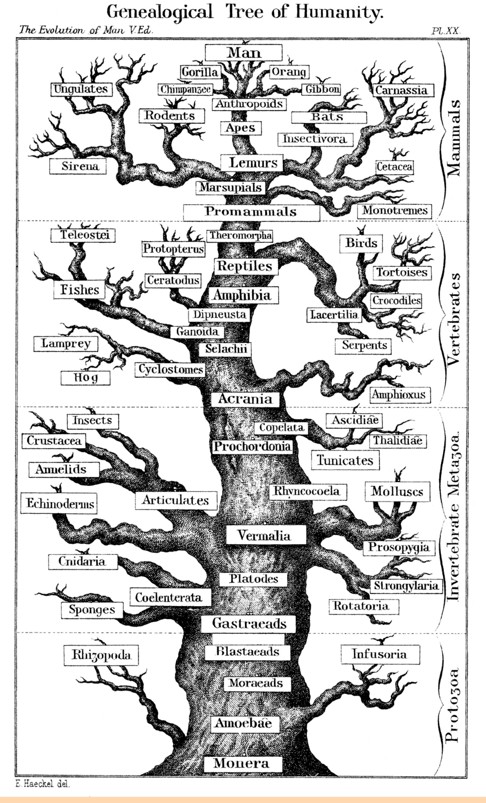
Haeckel’s evolutionary tree of life: debunked but historically influential.
The word evolution comes from the Latin evolutio, meaning “an unrolling” or “unfolding” from ex- (“out of”) and volvere (“to roll”). In other words, the word itself conveys the idea of something unfolding out from what came before by natural selection of mutations.
Darwin’s Faulty Analogy
Charles Darwin originated the modern concept of natural selection in part from his observations of animal breeders, including pigeon breeders—a popular hobby in Victorian England.
Instead of humans breeding animals, Darwin postulated that “nature” selects to produce new animal breeds or varieties.
Breeders intentionally selected animals with desirable characteristics in order to produce new and different breeds or animal varieties. Darwin proposed that a similar process could occur in nature. Instead of humans intentionally selecting which organisms would be allowed to reproduce, he argued that nature “selects” those organisms which are better adapted to survive and reproduce.
Darwin proposed that natural selection could accomplish on its own what artificial selection accomplishes through human intention. Over time, he argued, this process could produce the enormous diversity of plant and animal life that we see in the world today. Natural selection remains a foundational concept in modern evolutionary biology and is widely regarded as a major mechanism of adaptive evolution.
Natural Selection is also commonly invoked by evolutionists to explain how organisms acquire complex, functional features that fit their specific environments. The crucial question, however, is this: How much can natural selection actually accomplish, if anything? Can a process that selects among existing variations truly explain the origin of new genetic information and the complex biological systems required to produce fundamentally new forms of life?
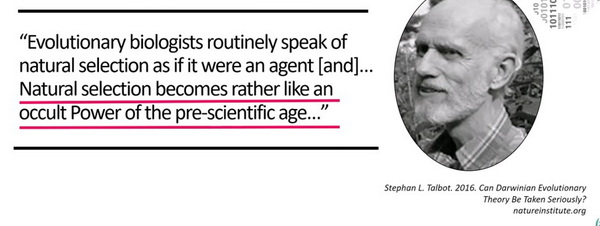
Natural Selection Deified
Natural selection is often treated by evolutionists as a substitute for an intelligent designer, explaining what evolutionary biologist and former Catholic priest, Francisco Ayala famously described as “design without a designer.” The phrase captures the evolutionary claim that the appearance of design, purpose, and complexity in nature can arise, Ayala claimed, “entirely through blind, mechanistic processes without a conscious creator.”[3] The central importance of natural selection in the creation of all life was stated by Ayala as follows:
It was Darwin’s greatest accomplishment to show that the complex organization and functionality of living beings can be explained as the result of a natural process—natural selection—without any need to resort to a Creator or other external agent. The origin and adaptations of organisms in their profusion and wondrous variations were thus brought into the realm of science.[4]
Furthermore, in evolutionary thought, and also in much of mainstream science, natural selection has replaced creation science, and, for many, has also displaced the need for theism as an explanation for biological design. Historically, well into the mid-19th century, creationist and
supernatural explanations, which depended on the unfathomable deeds of the Creator, were accepted as explanations of the origin and configuration of living creatures. Authors, such as William Paley, argued that the complex design of organisms could not have come about by chance or by the mechanical laws of physics, chemistry, and astronomy but was rather accomplished by an Intelligent Designer, just as the complexity of a watch, designed to tell time, was accomplished by an intelligent watchmaker.[5]
 The concept of natural selection was first developed in detail by Charles Darwin (1809–1882) during the 1830s and early 1840s, and was eventually published in his landmark work On the Origin of Species by Means of Natural Selection, or the Preservation of Favoured Races in the Struggle for Life in 1859. The title of Darwin’s book illustrates the central importance of natural selection to Darwin’s theory. Alfred Russel Wallace (1823-1913) independently formulated a similar theory and brought his ideas to Darwin’s attention in 1858, leading to the joint presentation of their work in that same year. To this day, natural selection is still considered to be of paramount importance in evolutionary biology.[6] In fact, Darwin’s greatest accomplishment, according to Francisco Ayala, was
to show that the complex organization and functionality of living beings can be explained as the result of a natural process—natural selection—without any need to resort to a Creator or other external agent. The origin and adaptations of organisms in their profusion and wondrous variations were thus brought into the realm of science.[7]
The Copernican and the Darwinian Revolutions
jointly ushered in the beginning of science in the modern sense of the word: explanation through natural laws. Darwin’s theory of natural selection accounts for the “design” of organisms, and for their wondrous diversity, as the result of natural processes, the gradual accumulation of spontaneously arisen variations (mutations) sorted out by natural selection.[8]
Furthermore, mutation and natural selection are believed by Darwinists to have
jointly driven the marvelous process that, starting from microscopic organisms, has yielded orchids, birds, and humans. The theory of evolution conveys chance and necessity, randomness and determinism, jointly enmeshed in the stuff of life. This was Darwin’s fundamental discovery: that there is a process that is creative, although not conscious.[9]
Darwin considered natural selection,
rather than his demonstration of evolution, his most important discovery, and [he] designated it as “my theory,” a designation he never used when referring to the evolution of organisms. The discovery of natural selection, Darwin’s awareness that it was a greatly significant discovery because it was science’s answer to Paley’s argument from design, and Darwin’s designation of natural selection as “my theory” can be traced in Darwin’s “Red Notebook” and “Transmutation Notebooks B to E,” which he started in March 1837.[10]
Natural Selection Unmasked
As defined by the Stanford Encyclopedia of Philosophy, the word ‘selection’ ordinarily carries the idea of a choice or preference made by an intelligent being: “The premise that the word ‘selection’ implies an intentional choice made by an intelligent being is a prominent concept in both linguistics and the philosophy of science.”[11]
In contrast to the dictionary definition of selection, natural selection is actually a personified attempt to explain the origin of all life-forms. Examples used to document natural selection include the fact that some individual life-forms are diseased and/or contain genetic mutations, which makes them less able to survive in the environment they find themselves in.
Natural selection does not involve a conscious selector. The term is a metaphor describing the biological fact that individuals within a population vary genetically, and some of those variations affect an organism’s ability to survive and reproduce. Some individual organisms are diseased or carry genetic mutations that reduce their ability to survive or reproduce in a particular environment. This is not natural selection in the evolutionary sense.

A Common Claim of Natural Selection
The natural human embryo mortality rate is very high, particularly during the first weeks after fertilization. Medical estimates are that 40 percent to over 70 percent of early embryos are lost before or during implantation and also during early pregnancy. Many of these losses occur even before a woman knows that she is pregnant. The result is fewer than 15 to 40 percent make it to a full-term birth.[12]
Furthermore, in the United States, approximately 20,000 babies die in the first year of life each year from causes including birth defects, malnutrition, and disease. This equals roughly 0.56 percent loss or about 5.6 deaths per 1,000 live births of infants who die during the first year of life.[13] No conscious force or intelligent agent is selecting which embryos or infants should survive. Rather, some individuals survive because they suffer from mutations, diseases, or other conditions that contribute to premature death. The long-term result of this process is to reduce the level of genetic deterioration. It leads to de-evolution, not to cause progressive evolution.
Furthermore, our bodies are designed not to evolve due to the effective DNA mismatch repair (MMR) system. Additional DNA-repair mechanisms further reduce the number of replication errors that could become permanent mutations. Rather than being evolution-producing mechanisms, these systems serve an essential function: namely, preserving the genetic information encoded in DNA. During replication, DNA polymerase’s inherent error rate is about 1 in 100,000 bases, and its built-in exonuclease proofreading activity catches and repairs close to 99.9 percent of these mutations. Biological systems contain sophisticated mechanisms designed to preserve existing genetic information and resist creating new biological information, effectively preventing evolution.[14]
This distinction is important. This is not natural selection from an evolutionary standpoint. Rather the simple fact is that over many generations, the process described above functions to reduce the frequency of harmful genetic variants and preserve the frequency of variants that maintain the organism’s genetic stability. Thus is fundamentally a filtering process that resists evolution, and not a process that creates new genetic information as evolutionists claim. The so-called misnamed ‘natural selection’ can only filter out existing variation—it cannot create new genetic information nor the highly complex biological systems required for fundamentally new forms of life.
Summary
Living organisms possess sophisticated mechanisms that protect the integrity of their DNA. During DNA replication, DNA polymerase errors occur, but its proofreading activity catches and repairs the vast majority of them. Over many generations, this process reduces the frequency of harmful genetic variants and maintains the frequency of variants that ensure genetic status. What was erroneously called natural selection is thus fundamentally a filtering process that resists evolutionary change, not a process that creates new genetic information, producing evolution. The long-term result of this process is to reduce the level of genetic deterioration and de-evolution. I agree with Coppedge in his article that concluded: “whether 156 years of natural selection theory has produced anything of scientific, philosophical, or cultural value.”[15]
References
[1] Guliuzza, Randy, and Dan Biddle. “This New Research Has Left Atheists Completely SPEECHLESS,” 18 August 2026. See 6 minutes, 29 seconds into the podcast; see also 1:17, 1:26, 1:34, 5:17, 6:24, 9:46, 10:28, 12:02, 12:09, 12:16, 13:58, 16:39, 17:03, 26:00, 29:40, 36:57, and 31:34.
[2] ICR Staff Writer. “Exploring Adaptation from an Engineering Perspective.” https://www.icr.org/content/exploring-adaptation-engineering-perspective, 29 October 2019.
[3] Ayala, Francisco J. “Darwin’s Greatest Discovery: Design Without Designer,” Proceedings of the National Academy of Science 104(Suppl. 1):8567-8573, p. 8567, 15 May 2007.
[4] Ayala, 2007, p. 8567.
[5] Ayala, 2007, p. 8567.
[6] Kliman, Richard. Encyclopedia of Evolutionary Biology. Academic Press, New York, NY, p. 7, 2016.
[7] Ayala, 2007, p. 8567.
[8] Ayala, 2007, pp. 8567-8573.
[9] Ayala, 2007, p. 8567.
[10] Ayala, 2007, p. 8569.
[11] https://plato.stanford.edu/entries/natural-selection/, 4 March 2024.
[12] Jarvis, Gavin E. “Early embryo mortality in natural human reproduction: What the data say,” F1000 Research, https://pmc.ncbi.nlm.nih.gov/articles/PMC5443340/, 25 November 2016.
[13] Centers for Disease Control and Prevention. “Infant mortality.” Available at: https://www.cdc.gov/maternal-infant-health/infant-mortality/index.html, 16 September 2024.
[14] Bebenek, Anna, et al., “Fidelity of DNA replication—a matter of proofreading,” Current Genetics 64(5):985-996, doi: 10.1007/s00294-018-0820-1, 2 March 2018.
[15] Coppedge, David. “Op-Ed: Time to ditch natural selection?” Creation-Evolution Headlines, 3 October 2015.
 Dr. Jerry Bergman has taught biology, genetics, chemistry, biochemistry, anthropology, geology, and microbiology for over 40 years at several colleges and universities including Bowling Green State University, Medical College of Ohio where he was a research associate in experimental pathology, and The University of Toledo. He is a graduate of the Medical College of Ohio, Wayne State University in Detroit, the University of Toledo, and Bowling Green State University. He has over 1,900 publications in 14 languages and 40 books and monographs. His books and textbooks that include chapters that he authored are in over 1,800 college libraries in 27 countries. So far over 80,000 copies of the 60 books and monographs that he has authored or co-authored are in print. For more articles by Dr Bergman, see his Author Profile.