


Science In a Crisis of Integrity
Important editorial suggests that
the true extent of unreliable research
may be substantially underestimated
New Study Supports Concerns of a Scientific Integrity Crisis
by Jerry Bergman, PhD
From my many discussions with evolutionists, I have learned that when science makes a claim, most evolutionists automatically assume it is true. This often uncritical and sometimes blinding trust in scientific claims is illustrated by the following examples.
The scientific case for human evolution is supported by a robust, interdisciplinary body of evidence, including thousands of fossil hominin specimens, comparative genomics, and archaeological findings. These studies show that hominins evolved in Africa from quadrupedal ancestors into the upright-walking, large-brained Homo sapiens over approximately 6-7 million years.[1]
 Another example is the National Academy of Sciences which makes these broad sweeping claims about evolution:
Evolution pervades all biological phenomena. To ignore that it occurred or to classify it as a form of dogma is to deprive the student of the most fundamental organizational concept in the biological sciences. No other biological concept has been more extensively tested and more thoroughly corroborated than the evolutionary history of organisms.[2]
These quotes overlook the propensity for scientists to score low on integrity.
 Inside the Scientific Community’s Research Integrity Crisis (The Scientist, 29 April 2026). The Scientist, published by LabX Media Group, is a professional magazine for life science researchers which offers in-depth articles on molecular biology, genetics and other areas of interest to scientists. Recently they published a review highlighting growing concerns about scientific integrity.[3] The article links to eight previous articles discussing cases in which evidence was overlooked or misinterpreted due to flawed assumptions or methodological choices. It contains some graphs and charts illustrating the extent of problematic research.
In one instance, a state-run forensic laboratory set DNA detection thresholds too high, assuming the levels were appropriate for their clientele. As a result, investigators were led to believe that no DNA evidence existed in certain criminal cases when, in fact, it did. This error affected thousands of cases and prompted an official inquiry and laboratory reforms, underscoring the critical role of whistleblowers in protecting both scientific integrity and justice.
Evolution vs Integrity
An example of this same problem in the field of evolution is the assumption that the results of skeletal comparisons are due to evolution, when it could just as well be due to normal variation within the species being evaluated.
This kind of issue also points to a broader challenge across scientific disciplines: the influence of underlying assumptions on interpretation. For instance, in evolutionary biology, similarities in skeletal structures are usually interpreted within an evolutionary framework, meaning that alternative explanations—such as normal variation within a species—are often not given the careful consideration that they deserve. Together, these examples highlight the importance of continually re-examining assumptions, maintaining transparency, and encouraging critical review within the scientific process.
Arsenic and Odd Place
Another example cited in The Scientist involves a 2010 paper published in AAAS journal Science, in which researchers reported that a microbe from Mono Lake, a saline lake in California, could incorporate arsenic into its DNA in place of phosphorus—an extraordinary claim given arsenic’s toxicity. [4] The study quickly drew much criticism, and subsequent research exposed significant flaws in both methodology and interpretation. Despite this, the paper remained in the literature for nearly 15 years.

Mono Lake (photo by David Coppedge).
While this may reflect the scientific norm of preserving the published record rather than removing disputed work, it also highlights how striking or paradigm-challenging published claims can persist even after substantial criticism. As it is more common today due to the ubiquity of online publishing, a note should be published in front of the paper to inform readers that the article results have been refuted and cite the research paper, or papers, refuting it.
Assumptions and Interpretations
This case underscores a broader issue: scientific conclusions are shaped not only by data, but also by expectations, assumptions, and the appeal of novel findings. While such dynamics do not necessarily involve intentional wrongdoing, they can influence how quickly errors are corrected and how prominently certain ideas continue to be discussed.
The reasons why the claim was problematic include the fact that life requires a fixed set of elements (C, H, N, O, S), and that phosphorus is chemically essential for many reasons, including DNA stability. Arsenate esters (arsenic analogs of phosphate) are far less stable in water than phosphate esters, and DNA containing arsenic would rapidly break down. For this reason, all known life uses phosphate in DNA. The arsenate claim suggested that a fundamentally different biochemical architecture could exist, opening the possibility of a “second form of life” with different chemical rules—something highly relevant to both chemical evolution and, especially, exobiology.
Editor note: Is it possible scientists in those fields were hesitant to let the story go?
Fraud, Plagiarism, and Failure to Replicate
Another example highlighted in The Scientist involves an analysis of AI-assisted reviews of preclinical stroke research using animal models. The analysis found that close to 40 percent of published papers on this topic contained potentially fraudulent, manipulated or plagiarized images from other articles. In addition, many therapies that initially looked promising were reported only once, and never independently replicated.
These findings suggest that current publishing safeguards, including peer review and editorial screening, often fail to catch misconduct issues and mistakes before they enter the scientific literature. As a result, flawed or unreliable findings can persist, slowing progress and undermining confidence in the research.
In fields such as medicine, errors in research can have direct consequences for patient health, which tends to prompt more immediate scrutiny and correction. In contrast, in areas like evolutionary biology, where the practical stakes or consequences are less immediate, the incentives to correct errors may differ, potentially influencing how quickly problems are identified and addressed.
Lack of Accountability and Broken Safeguards
Even in medically relevant research, however, significant gaps remain. One analysis found that up to 65% of studies flagged by AI tools as potentially problematic or fraudulent had not been retracted, corrected, or even formally flagged by publishers. This suggests that existing safeguards are not keeping pace with the growing scale and complexity of scientific output, including the increasing volume of papers produced by “paper mills”—for-profit entities that generate large quantities of questionable research to meet academic publication demands.
This leads to an unfortunate conclusion: the true extent of unreliable research may be substantially underestimated. If such problems persist even in the more closely scrutinized field of medicine, it is possible that comparable—or potentially even greater—problems exist in fields subject to less immediate scrutiny, such as evolutionary biology.
Attempts at Improvement
In response to these challenges, Adrian Barnett of Queensland University of Technology has developed screening tools aimed at identifying unreliable publications likely to originate from these “paper mills”. These efforts highlight both the scale of the problem and the need for improved systems of accountability within scientific publishing.
Cancer research may be particularly attractive to such operations because of the field’s high prestige and large number of journals. They also found that several flagged papers appeared in top-tier journals, indicating that concerns about paper mills are not limited to lower-impact publications. These findings suggest that journal impact factors may be a less reliable indicator of research quality than is often assumed.
AI to the Rescue?
Efforts to address this problem include the use of large language models (LLMs) such as ChatGPT. ChatGPT is an AI-powered computer program developed by the OpenAI research company. It relies on large-scale neural networks, machine learning, and extensive datasets to train computer models capable of generating and analyzing text, code, and images. These models are trained on vast collections of written material, including internet and published texts, enabling them to learn patterns in language, factual information, and certain aspects of reasoning.
Through reinforcement learning from human feedback, the models are refined to produce outputs that are more accurate and helpful to researchers. They are based on generative, transformer architectures that enable them to process natural human language and generate human-like responses. The system operates by predicting the next most likely next word in a sequence based on patterns learned from massive datasets, enabling it to write code, compose text, and answer complex questions. In one application, a large language model was used to assess the quality of discredited or retracted articles.
The editors concluded that, although these tools can help researchers identify problematic studies, they cannot replace careful human verification.
Summary
This review documents the fact that peer-reviewed scientific literature can contain statements and claims that fall short of ideal scholarly standards. Consequently, such claims may mislead readers or even support incorrect information, including exaggerations or overstated conclusions that are not based on demonstrable evidence. As a result, some findings may be inaccurate or misleading, generating conclusions that are exaggerated or insufficiently supported by evidence. Similar concerns have also been raised regarding the literature in evolutionary biology.
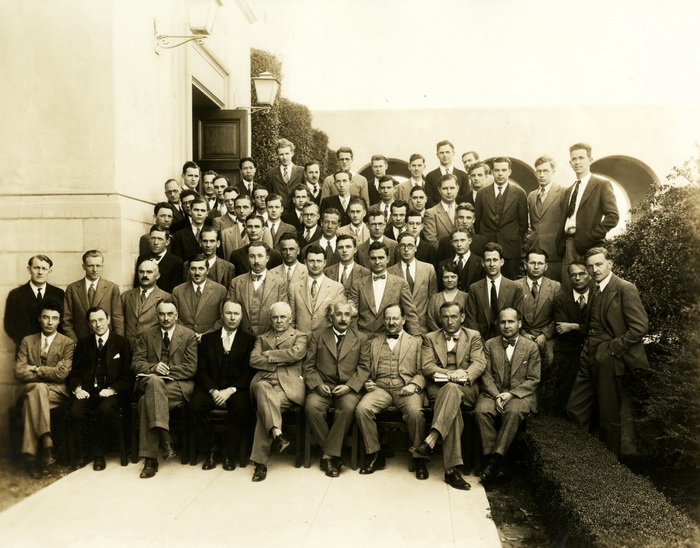
Resting on the shoulders of giants: Caltech scientists, c. 1950, including Einstein. Scientific excellence depends on a worldview that values integrity, reason, mathematics and rigorous explanation based on tested observations.
References
[1] Summarized from Human Evolution Evidence. The Smithsonian. https://humanorigins.si.edu/evidence.
[2] National Academy of Sciences 1984.
[3] The Scientist. 2026. Inside the Scientific Community’s Research Integrity Crisis. April 30, 2026.
[4] The Scientist.
 Dr. Jerry Bergman has taught biology, genetics, chemistry, biochemistry, anthropology, geology, and microbiology for over 40 years at several colleges and universities including Bowling Green State University, Medical College of Ohio where he was a research associate in experimental pathology, and The University of Toledo. He is a graduate of the Medical College of Ohio, Wayne State University in Detroit, the University of Toledo, and Bowling Green State University. He has over 1,900 publications in 14 languages and 40 books and monographs. His books and textbooks that include chapters that he authored are in over 1,800 college libraries in 27 countries. So far over 80,000 copies of the 60 books and monographs that he has authored or co-authored are in print. For more articles by Dr Bergman, see his Author Profile.