


Whales Break Record for Migration Distance
Scientists observe a 15,000 km migratory route
by humpback whales between Australia and Brazil.
We reflect on the purpose and implications of
these observations from a creation perspective
Record-Breaking Humpback Whale Migration Stuns Scientists
by Dr. Sarah Buckland-Reynolds
Whales are often used as symbols of the vast ocean, and popular films such as Free Willy emphasize how whales thrive best in their natural habitat. These depictions depict a truth that scientists continue to discover, where the free migratory movements of marine organisms such as whales have been found to be far more immense than previously documented, with great ecological significance.
One profound example was recently published by the Royal Society:
 First evidence of bidirectional exchange between distant humpback whale breeding populations in eastern Australia and Brazil (Ayala et al., Royal Society Open Science, 20 May 2026). In this article, Ayala et al. documented humpback whales travelling between breeding grounds in eastern Australia and Brazil, traversing a staggering 14,000 to 15,100 kilometres across open ocean. As the article notes,
“These whales were photographed decades apart, by different people, in opposite parts of the world, separated by two different oceans, and yet we can connect their journey.”
This discovery sets a new record for the greatest distances ever confirmed between sightings of individual humpback whales.
Such feats of endurance and navigation invite awe and demand reflection: how can creatures accomplish such journeys with precision, resilience, and purpose? From a Biblical creationist perspective, these migrations testify to design, foresight, and the wisdom of the Creator, revealing marvels that evolutionary explanations struggle to account for.
The Intricate Mechanisms of Migration
To understand the profoundness of whale migration, we should examine the biological mechanisms in place that facilitate such movements. Animal migration is not randomly nomadic, but requires a suite of integrated systems including:
- Navigation by geomagnetic cues: Research from the Massechusetts Institute of Technology show that whales detect Earth’s magnetic fields, enabling orientation across vast distances. Another 2024 study found that baleen whales (blue, bowhead, fin, gray, humpback, right whales) systematically inhabit areas where magnetic declination aligns with multiples of Earth’s axial tilt, showing non-random use of magnetic orientation. Some scientists propose whales may have magnetite in brain cells, enabling sensitivity to geomagnetic lines. Strandings often occur in areas where magnetic fields are distorted, supporting this theory.
- Celestial navigation: Whales have been found to use the stars and sun as guides, much like ancient mariners.
- Memory, learning and social coordination: Whales have also been documented to recall routes across decades, passing knowledge culturally through song and social groups.
- Physiological preparation: Research also shows that fat reserves, muscle endurance, and oxygen storage in blood and tissues sustain whales through weeks of fasting.
The combination of the biophysical structures and social organization was also documented in this record-breaking case. In the words of Ayala et al. (2026), for example, the role of cultural transmission was evident:
“Occasional individuals moving between distant breeding grounds can help maintain genetic diversity across populations and may even carry new song styles from one region to another – humpback whale songs are known to spread culturally across ocean basins, much like music trends in human populations.”
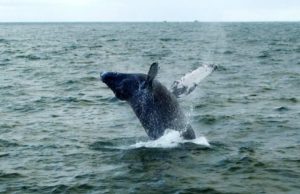 Remarkably, just as we can recognize people groups by cultural markers, whales appear to carry cultural markers in their migration. Could this apparently purposeful communication evolve by chance?
Recommended Resource: Learn more about humpback whales in Illustra Media’s documentary Living Waters.
Ecosystem and Global Benefits
Beyond the intricate internal mechanisms that have to be in place to facilitate whale migration, there are numerous external benefits to their movement, particularly in ecosystem maintenance. For example:
- Nutrient transport: Whales carry nutrients across oceans, fertilizing plankton blooms that support marine food webs.
- Carbon cycling: Their feeding and defecation stimulate phytoplankton, which absorbs carbon dioxide, linking whales to climate regulation.
- Genetic diversity: Rare crossings, like those documented, maintain population health.
- Cultural exchange: Songs spread across basins, enriching whale communities, and demonstrating complex social intelligence.
The benefits are mutual to both the ecosystem and whale health itself. Quoting from the article:
“Despite their rarity, these exchanges matter for the long-term health of whale populations.”
Evolutionary Explanations of Migration
Amidst the complexities involved in whale migration, evolutionary biologists continue to frame whale migration as an adaptive survival mechanism shaped by ecological pressures. The article references the “Southern Ocean Exchange hypothesis”: whales from different breeding populations meet on shared Antarctic feeding grounds, and some individuals follow different paths home, ending up in new breeding regions. Climate-driven changes, such as shifts in sea ice and krill distribution, are said to make such crossings more likely.
From this perspective, migration is explained as a product of chance encounters, genetic selection, and environmental pressures. The narrative suggests that over millennia, whales gradually developed the ability to cross oceans, with rare individuals pioneering new routes. But, with all the internal mechanisms and external benefits to the environment involved in whale migration, is it reasonable to conclude that this is all the product of unguided chance processes?
Bearing in mind the numerous biological structures that are in place within whales to facilitate such long-distance migration, to argue that whales randomly developed the ability to cross 15,000 kilometres of ocean is implausible. Navigation requires multiple systems working together: geomagnetic sensing, celestial orientation, memory, physiology, and social communication. A whale with only partial navigation ability or insufficient fat reserves would not survive such a journey. Piecemeal development cannot explain integrated systems.
Even though migration at such distances are rare findings, the mechanism that enables even shorter migration routes requires multiple systems working together to be in place. The evolutionary narrative remains speculative, leaning on hypotheses rather than demonstrating how such complexity could arise incrementally.
Marvels That Raise Questions
Ayala et al.’s documentation of whales crossing between Australia and Brazil expands our understanding of whale biology, showing that individuals can connect distant populations. It also highlights the role of rare crossings in maintaining genetic diversity and cultural exchange. This wonder challenges evolutionary narratives, and raises questions about how such complexity could arise through piecemeal processes.
While the authors do not explicitly refer to evolution (since evolutionary mechanisms continue to be put forward in whale migration literature), it is relevant to point out that the findings open more questions for evolution than they answer. Questions remain such as: How could random processes produce integrated systems of navigation, endurance, and communication? and How could a four-footed land animal evolve into a huge marine creature that spends its entire life in the ocean?

Don’t accept the propaganda.
From a Biblical creationist perspective, whale migration reflects purposeful design. The Creator endowed whales with the ability to traverse oceans, linking ecosystems and sustaining life. This interpretation is far more reasonable than evolutionary speculation. It acknowledges the foresight required for survival. It explains why whales can cross oceans with precision, why their songs spread culturally, and why their journeys sustain ecosystems. Rather than attributing these marvels to random emergence, creationist reflection sees them as evidence of intelligent design.
The marvels of whale migration should also propel us as humans to fulfill our stewardship mandate and protect these creatures and their pathways, as whale migration stands as more than a biological phenomenon. Whales’ appointed times and routes testify to design, opening our eyes to the marvels of nature and our responsibility to care for them.
 Dr. Sarah Buckland-Reynolds is a Christian, Jamaican, Environmental Science researcher, and journal associate editor. She holds the degree of Doctor of Philosophy in Geography from the University of the West Indies (UWI), Mona with high commendation, and a postgraduate specialization in Geomatics at the Universidad del Valle, Cali, Colombia. The quality of her research activity in Environmental Science has been recognized by various awards including the 2024 Editor’s Award from the American Meteorological Society for her reviewing service in the Weather, Climate and Society Journal, the 2023 L’Oreal/UNESCO Women in Science Caribbean Award, the 2023 ICETEX International Experts Exchange Award for study in Colombia. and with her PhD research in drought management also being shortlisted in the top 10 globally for the 2023 Allianz Climate Risk Award by Munich Re Insurance, Germany. Motivated by her faith in God and zeal to positively influence society, Dr. Buckland-Reynolds is also the founder and Principal Director of Chosen to G.L.O.W. Ministries, a Jamaican charitable organization which seeks to amplify the Christian voice in the public sphere and equip more youths to know how to defend their faith.