


Your Genome Has a Guardian
As We Learn More About the Genome,
It Becomes Increasingly Clear That
It Did Not Evolve, but Was Designed
p53 Stands Guard Over the Genome
by Jerry Bergman, PhD
Much of my work in medical school involved studying how the genome functions, particularly what happens when mutations damage parts of it. In short, mutations cause disease, which is why we studied them.
Our research focused on understanding how and why mutations lead to cancer and how cancer can be detected at an early stage, when treatment is often more effective. One thing that I learned from my research was that evolution was impossible. Apes will never become people by mutations as Darwinian “theory” teaches, no matter how many billions of years evolutionists claim it took.
21st Century Genomics Meets AI
Geneticists once thought we had a very good handle on how the genome functions. Our knowledge has greatly increased since the time I was doing research in medical school. As a result, we discovered that the genome is far more mysterious and complex than we had previously assumed.
Today, its complexity continues to challenge even the most advanced brain in the world—that of Artificial Intelligence. As one writer observed, the human genome is “less a script than a puzzle that gets harder the closer we look.”[1] While working in this field, I often had the impression that genes behaved almost like intelligent agents—continually evaluating conditions within the cell and intelligently responding appropriately to those conditions.
The Guardian of the Genome
What is clear is that mutations can impair a cell’s ability to function properly. One of the most important regulators overseeing these critical decisions is the tumor-suppressor protein p53, often called the “guardian of the genome.” Its primary role is to regulate the cell cycle, coordinate DNA repair, and initiate programmed cell death when damage is beyond repair. The importance of p53 is illustrated by the fact that mutations in this gene are found in more than half of all human cancers. Without p53 and the protection it provides, cancer would become far more common to the point of threatening the survival of complex life itself.
P53 Is Remarkably Complex and Required to
Make Numerous Life-and-Death Decisions
The human body grows and replaces damaged or worn-out cells by producing new cells. This occurs through a carefully regulated process known as the cell cycle. The cell cycle is an ordered series of growth stages through which cells duplicate their DNA and ultimately divide into two daughter cells. The process involves a sophisticated regulatory system that functions as if there is an intelligent agent constantly monitoring the cell’s condition and determining whether it is safe to proceed to the next stage.

The Cell Cycle
The first stage is Gap 1 (G1). During this phase, newly formed cells grow in size, produce proteins, and carry out its normal functions. Next comes the Synthesis (S) phase, during which the cell replicates its DNA so that each daughter cell will receive a complete set of chromosomes. This process must be extremely accurate because DNA replication errors can have serious, sometimes lethal, consequences if they are not detected and repaired. The cell then enters Gap 2 (G2), where it continues to grow and produces the proteins required for cell division. Finally, the cell enters Mitosis (M), during which it divides into two daughter cells.
Not all cells are actively preparing to divide. Many enter a resting state known as Gap 0 (G0). During this phase, cells carry out the specialized tasks for which they were designed. For example, secretory cells produce mucus, intestinal cells absorb nutrients, and nerve cells transmit signals throughout the body. At every stage of the cell cycle, numerous decisions have to be made. Examples include the cell must determine whether it has sufficient nutrients and energy, whether its DNA has been copied correctly, and if any damage has occurred that requires repair.
Cell-cycle checkpoints monitor both internal and external conditions, ensuring that a cell divides only if it has reached an adequate size, has sufficient nutrients, and possesses intact DNA. These checkpoints function as quality-control stations that help maintain genetic stability and prevent diseases, such as cancer, from developing.
Failed Cells Forced to Commit Suicide
One of the most important regulators of this process is the tumor-suppressor protein p53. Throughout the cell cycle, p53 monitors signals indicating if DNA damage or other cellular stress exists. When damage is detected, p53 can halt the cell cycle and activate genes involved in DNA repair. If the repair process is successful, p53 allows the cell cycle to resume and cell division to proceed.
If p53 determines, based on evaluations of the cell, that the repair process was not successful, or the damage to the cell is too great to be repaired, it initiates the process of cell self-suicide called apoptosis. Apoptosis is the process involving a very orderly, complex system designed to prevent the spreading of harmful debris. P53 first causes the cell to condense its internal DNA and shrink in size.
Next, the apoptosis program causes the cell membrane to bleb, meaning to break up into small, enclosed packets (bubbles or blisters) to ensure that the damaged cell tissue does not damage other cells. The blebs eventually separate into small membrane-bound packets called apoptotic bodies. These packets safely contain the cell’s contents, preventing potentially harmful materials from spilling into the surrounding tissue.
Lastly, immune cells recognize and engulf the apoptotic bodies to ensure that no harmful waste spills out. The immune cells then break the waste down, then recycle the contents of these packets to reuse the usable cell parts. This complex, well-designed system allows the body to eliminate old, unnecessary, or irreparably damaged cells in a clean, controlled manner without causing inflammation of surrounding tissues.
Apoptosis vs Necrosis
This process stands in sharp contrast to necrosis, a form of cell death caused by injury or trauma. In necrosis, the cell membrane ruptures, releasing its contents into the surrounding tissue, often triggering inflammation and further cell damage.
Without the remarkable process of apoptosis, damaged cells would accumulate, increasing the risk of disease and threatening the health of the organism. Likewise, without p53 and the complex systems it controls, damaged cells would continue to divide unchecked, greatly increasing the risk of cancer and other diseases.
Explaining Cell Maintenance and Repair
One challenge in accurately understanding how the genome works is the need to follow the evidence wherever it leads. Scientists must be willing to examine the data without allowing prior assumptions to determine their conclusions. In other words, scientists looking at the data through their evolutionary glasses, make it difficult to realistically interpret what they see. Until they remove those glasses, their evaluations of the data will continue to be distorted by their evolutionary worldview. As our understanding of the genome has increased, many features once thought to be simple have proven to be extraordinarily complex.
Science writer Philip Ball describes the conventional evolutionary view as follows:
“our genome is the product of around 4 billion years of evolution. … evolution doesn’t have the foresight to design with efficiency and transparent logic, but merely tinkers with what it has already available.”[2]

Darwin’s watchmaker is not only blind, but doesn’t care what happens.
As Ball admits, the genome does not look like it came about by tinkering with what was already existing. Ball acknowledges that the genome does not appear to be a simple product of incremental tinkering. Instead, the more deeply researchers investigate its organization and regulation, the more they uncover its complexity.
To paraphrase Ball’s observations, the human genome is less like a straightforward script and more like a puzzle that becomes increasingly intricate the closer it is examined. It exhibits an irreducibly complexity which we are just beginning to understand.
Understanding the function and roles of the sequences of DNA base pairs in the human genome is more like what computer scientists do to create instructions that function to produce humans:
”It has gradually become clear, though, that in complex eukaryotic organisms like us, gene regulation is far more complicated, involving overlapping systems of oversight and control, each with its own intricacies” [comparable to intelligently designed computer systems.] [3]
Genes Must Be Regulated
Gene regulation in complex organisms involves multiple overlapping systems of oversight and control, each interacting with other systems in ways that scientists are still working to understand. Its layers of regulation and control are reminiscent of the sophisticated logic employed by computer scientists, in which numerous interconnected systems must coordinate their activities to achieve a desired outcome.
In the following quote, Philip Ball describes a genome that functions less like a simple instruction manual and more like a committee composed of numerous interacting participants. Although only about two percent of the human genome consists of protein-coding genes, the remaining DNA contains an intricate network of regulatory elements that oversee and coordinate gene activity. Ball explains:
The deeper and much harder question is how those genes are used, or regulated, a question that seems to involve … much of the rest of the genome. By switching suites of genes on and off, the many different cell types in our bodies can all be created from the same material. Cells also regulate their genes from moment to moment in response to a constant inflow of signals from their neighbors and surroundings. But the processes that govern gene regulation are proving so complex that some biologists wonder whether a full understanding of it — of how the genome really works — will ever be within the grasp of our puny minds. What matters more is how our genes. … are regulated: turned on and off. Which proteins a cell needs changes over time and according to cell type: muscle, brain, skin, and so on. How the genes that encode those proteins are regulated depends on some of the genome that doesn’t code for proteins.[4]
Much of the understanding of the genome has come from studies of relatively simple organisms such as bacteria and yeast, where cellular processes are comparatively straightforward. It has now become clear, though, that in complex eukaryotic organisms, including humans, “gene regulation is far more complicated, involving overlapping systems of oversight and control, each with its own intricacies.”[5]
Summary
The process of cellular control, DNA repair, and cell reproduction, reveals a level of organization and coordination that continues to surprise researchers. Far from simplifying our understanding of life, ongoing genomic research has uncovered additional layers of regulation, information processing, error correction, and quality control that reveal irreducible complexity at a level that defies evolution.
The genome is unimaginably more sophisticated than was imagined only a few decades ago. As science writer Philip Ball has documented, the deeper scientists investigate the genome, the more complexity they discover. As I have often said, and this review supports, in the end, evolution will be falsified, not by creationists, but by the evolutionists themselves.
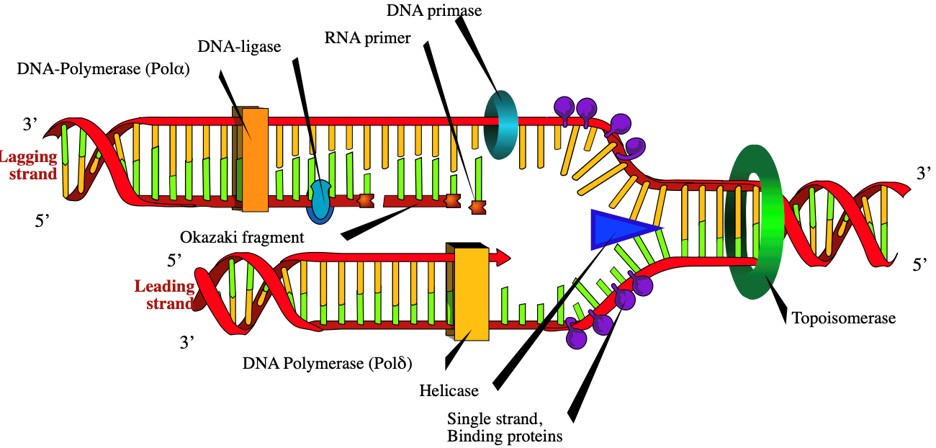
Simplified diagram of DNA Replication to produce two copies from one (Wikimedia Commons). Each of the colored shapes along the DNA strand represents a complex properly folded protein regulator.
Simplified diagram of DNA Replication to produce two copies from one. From Wikimedia commons. Each of the colored shapes represents a complex properly folded protein
References
[1] Ball, Philip, “Why the human genome’s tangled physicality may confound AI,” Quanta Magazine, https://www.quantamagazine.org/why-the-human-genomes-tangled-physicality-may-confound-ai-20260618/, 18 June 2026.
[2] Ball, 2026.
[3] Ball, 2026.
[4] Ball, 2026.
[5] Ball, 2026.
 Dr. Jerry Bergman has taught biology, genetics, chemistry, biochemistry, anthropology, geology, and microbiology for over 40 years at several colleges and universities including Bowling Green State University, Medical College of Ohio where he was a research associate in experimental pathology, and The University of Toledo. He is a graduate of the Medical College of Ohio, Wayne State University in Detroit, the University of Toledo, and Bowling Green State University. He has over 1,900 publications in 14 languages and 40 books and monographs. His books and textbooks that include chapters that he authored are in over 1,800 college libraries in 27 countries. So far over 80,000 copies of the 60 books and monographs that he has authored or co-authored are in print. For more articles by Dr Bergman, see his Author Profile.