


Consciousness Does Not Emerge; It Transcends
By what authority does science
dismiss the existential status
of consciousness, defining it
away as an “emergent quality”?
A “Gateway” for Consciousness?
by John D. Wise, PhD
As a professor of philosophy, I couldn’t help but smile at the headline: “Neuroscientists identify key gatekeeper of human consciousness.”
Science, meet Descartes.
According to the article:
A new study published in Science has identified the thalamus as a central player in how humans become consciously aware of visual information … Scientists discovered that specific thalamic regions activate earlier and more strongly during moments of visual awareness. These findings suggest that the intralaminar and medial thalamic nuclei act as a gateway that initiates conscious perception by influencing the activity of the prefrontal cortex.
The thalamus, a small, egg-shaped structure deep within the brain, is known to relay sensory data – sight, sound, touch – to the cerebral cortex, where interpretation occurs. It also helps regulate alertness, sleep, and attention. Now, it appears it does more. This research suggests it may be the threshold to consciousness.
Philosophy nerds like me can’t help but smile at this revelation – especially when accompanied by an infographic labeling the thalamus and, just beneath it, the pineal gland. That’s the same pineal gland René Descartes (1596–1650), “father of modern philosophy,” famously identified as the bridge between the immaterial soul (res cogitans) and the material body (res extensa). In The Passions of the Soul (1649, Article 31), Descartes wrote:
Although the soul is joined to the whole body, there is yet in the body some one part in which it seems to exercise its functions more particularly than in all the others.… I judge that it is the innermost part of the brain, which is a certain very small gland situated in the middle of its substance.
To modern science, Descartes is the guy who got it wrong, knowing next to nothing about neuroanatomy. But what really makes him suspect isn’t his neuroanatomical error – it’s his metaphysics. Descartes believed reality includes both material and immaterial dimensions. For today’s science, that’s not just outdated; it’s heresy. Materialism insists consciousness is not a thing, but an emergent property – a byproduct of brain activity; but it most definitely is not a bridge between material and non-material realms.
Yet four centuries later, neuroscience is drawn back to a brain locus remarkably close to Descartes’ little gland – and to calling it the “gateway to consciousness.”
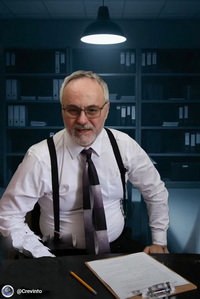
The Wise Investigator interrogates Mr. Matter. Watch the action here!
But language matters. A gateway is an opening in something, and consciousness is an empirically verifiable reality. Both are observationally admitted by scientific investigation. By what authority, then, does science dismiss the existential status of consciousness, defining it away as an “emergent quality”?
There is only one answer, and it is philosophical, not scientific: metaphysics, a rationalized explanatory schema that is chosen, not imposed by the data or reason. A preferential story.
Can scientists take a hint from their own language? Why isn’t it possible that consciousness is more than the leftovers of chemistry in a bone beaker? Why can’t it point to something real beyond their materialist bias? What prevents the empirical data from being evidence of consciousness as an immaterial reality?
Arbitrary choice.[1]
Quantum Evidence of Cellular Consciousness
Biologists mocked Sir Roger Penrose and Stuart Hameroff’s Orchestrated Objective Reduction (Orch OR) theory of consciousness when it was first proposed in the 1990’s. The idea that the brain – warm, wet, and messy biological matter – could sustain quantum computational processing was ridiculous. Today’s quantum computers require supercooled labs and delicate isolation. But the mocking is quieter these days.
While still controversial, Orch OR has gained new attention due to growing evidence of quantum coherence in biological systems. One 2025 study found superradiance – a quantum optical effect[2] – in tryptophan networks inside cells. Tryptophan isn’t just in your Thanksgiving turkey – it’s woven into your cells’ microtubules, the very structures tied to consciousness in Penrose and Hameroff’s Orch OR theory.[3]
Another study found quantum entanglement in water molecules inside the brain – correlating with short-term memory. A third theory derived a Schrödinger-like equation for neurons. Quantum biology – and maybe even neurology – is no longer science fiction.
Physicist Philip Kurian argues that cells with no nervous system at all can compute information a billion times faster than classical biochemistry allows. If this is verified a single cell might be crunching numbers faster than the world’s fastest supercomputer.
To sum up, it’s possible that cells (brain cells, body cells, bacteria) are processing information at the quantum level. This suggests to me a Cellular Basis for Consciousness (CBC). It also suggests to me that Orch OR is on to something profound. Perhaps the level of confidence among materialists is a bit overblown these days. A dualist metaphysics that merges immaterial and material reality, at least does not explain away our experience of self and others as epiphenomenal.
No one can live as if their consciousness is illusion.
Heresy and Incarnation
Yet evolution demands we believe that all we’ve discussed above, if verified, came about through chemical interactions governed by natural law, no intelligence required. A few molecules bump into each other in a primordial soup and invent quantum computing – in warm and wet conditions that defy our smartest engineers. As in the origin of life, so in quantum biology. For materialist science to deny miracles, they must first embrace the miraculous – life and consciousness.
Shades, perhaps, of the Incarnation?
Maybe it’s time to invert our allegiances—from theory over reality, to reality over theory. Perhaps it’s time for science to practice methodological doubt – not toward the evidence of consciousness, but toward the metaphysical dogma that says it must be an illusion.
Maybe consciousness didn’t emerge from matter; maybe consciousness indwells a material form.
Descartes and Difficult Questions
Back to Descartes. He didn’t have PET scans or MRI machines. His anatomical knowledge was primitive by our standards. He believed what common sense and the Bible told him – that the “soul” is real and immaterial. Yet after nearly four centuries of scoffing, science is led back toward Descartes’ “naïve” dualism. He didn’t get every detail right; he saw the forest, not the trees. But he asked the right questions.
Questions modern science is terrified to ask.
Evolutionary theory demands consciousness be an accident, an epiphenomenal byproduct, a kludge. Anything else – even the faintest whisper of intention or immaterial reality – risks awakening the spirit they’ve worked so hard to exorcise: the supernatural.
But the more we study life, the more we see that spirit evident in it. Cells are not mere chemistry. They behave with direction, purpose – even preference. They may be processing information at speeds scientists thought impossible, and harnessing quantum effects and processes. They certainly display intention.
Let’s stop with arbitrary limitations placed on reality – that’s not evolution.
As evidence mounts and silence from the Big Science cartel becomes deafening, their collective denial knows no bounds. If it exists, it evolved … period.
The question is off-limits, impolitic, heretical: Could consciousness, could life, evolve?
Maybe the real question is this:
Is it conceivable that any evidence – no matter how grand, obvious and compelling – could lead evolutionary biologists to answer “No” to that question?[5]
Footnotes
[1] This is really the import of Richard Lewontin’s famous foreword in Carl Sagan’s book, The Demon Haunted World: no divine foot in the door.
[2] This does not, of course, demonstrate quantum computing, but it does connect biology with quantum-level effects. This point applies also to the quantum entanglement of water molecules in the next cited study.
[3] HIGHLY TECHNICAL: Orch OR, or Orchestrated Objective Reduction, is a controversial theory of consciousness posited by eminent mathematical physicist Sir Roger Penrose in collaboration with anesthesiologist Stuart Hameroff in the mid-1990’s. Its genesis lies in Penrose’s dissatisfaction with theories of consciousness as computational, or computer-like. In addition, Penrose disliked the subjectivity and ambiguity inherent in the Copenhagen interpretation of quantum mechanics, in which a ‘measurement’ by an undefined ‘observer’ collapses the wave-function into a determinate state. He sought a more ‘Objective Reduction’ (OR) of the quantum field, one grounded in fundamental physics. He therefore suggested that consciousness is non-algorithmic, more like a flash of insight grasping non-algorithmic truths than a step-by-step, algorithmic computation. He grounded this awareness in an objective space-time quantum threshold, positing that wave-function collapse occurs not due to subjective observation, but when a critical gravitational self-energy within the superposed system is reached. It was Hameroff who suggested to Penrose that the cellular microtubular network might provide the biological localization for these Objective Reductions, allowing them to be “orchestrated” (the “Orch” in Orch OR). When I became aware of this theory I immediately thought of Husserl’s principle of intentionality. Penrose himself makes a connection to the Platonic forms, so this is a philosopher’s dream!
[4] To be fair, all the theories we’ve discussed are within the materialist-fold. None of them are proposing an independent spiritual realm, but neither do they give any evidence against one. What they do suggest is that the level of complexity of physical reality is so deep, profound and intricately designed that evolutionary appeals evaporate into statistical nonsense. Admittedly, we can believe such things in the face of the evidence, but scientifically, rationally, should we?
[5] I cannot help being reminded of the conversation between the rich man and Lazarus in Luke 16. The rich man begs Abraham to send someone to his family-members to warn them of eternal damnation. Abraham’s first reply is that they already have God’s testimony in His word. The conversation ends this way:
And [the rich man] said, “No, father Abraham, but if someone goes to them from the dead, they will repent.” [Father Abraham] said to him, “If they do not hear Moses and the Prophets, neither will they be convinced if someone should rise from the dead.”
If we stubbornly choose to deny the evidence that is given us, then even a miracle will not change our minds. Life is a miracle. Human rationality is a miracle. No evidence for the supernatural? Who is kidding whom?
 John Wise received his PhD in philosophy from the University of CA, Irvine in 2004. His dissertation was titled Sartre’s Phenomenological Ontology and the German Idealist Tradition. His area of specialization is 19th to early 20th century continental philosophy.
He tells the story of his 25-year odyssey from atheism to Christianity in the book, Through the Looking Glass: The Imploding of an Atheist Professor’s Worldview (available on Amazon). Since his return to Christ, his research interests include developing a Christian (YEC) philosophy of science and the integration of all human knowledge with God’s word.
He has taught philosophy for the University of CA, Irvine, East Stroudsburg University of PA, Grand Canyon University, American Intercontinental University, and Ashford University. He currently teaches online for the University of Arizona, Global Campus, and is a member of the Heterodox Academy. He and his wife Jenny are known online as The Christian Atheist with a podcast of that name, in addition to a YouTube channel: John and Jenny Wise.